

The Authority in Global Agricultural Chemistry & Bio-Resources
How to Design Ventilation for Cage Houses to Control Heat, Moisture, and Ammonia?
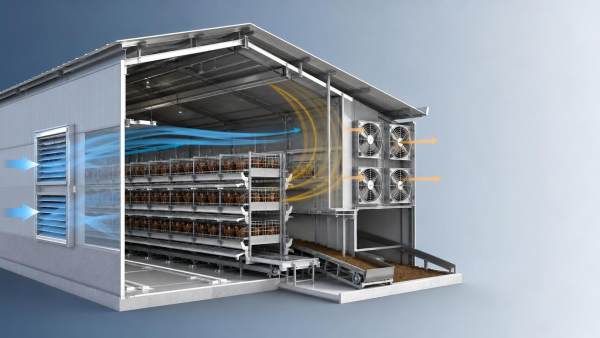
Designing effective ventilation for cage houses is one of those tasks that looks straightforward on paper and becomes complicated the moment real operating conditions enter the picture. Project teams are rarely dealing with airflow alone. They are managing bird density, local climate, structural constraints, power reliability, manure handling, equipment maintenance, and increasingly, environmental expectations around emissions and welfare. When ventilation is undersized or poorly controlled, the symptoms appear quickly: heat stress during warm periods, condensation and wet litter or manure belts during cool periods, and ammonia accumulation that erodes animal performance and working conditions.
For project managers and engineering leads, the key question is not simply how to move more air. It is how to design a system that maintains acceptable temperature, moisture, and gas conditions across changing seasons without creating excessive energy cost or operational complexity. Good ventilation for cage houses is therefore a control problem, not just an equipment selection exercise.
The starting point is to treat heat, moisture, and ammonia as linked but distinct loads.
Heat load comes from the birds, solar gain, motors, lighting, and in some regions, warm incoming air. Moisture load is driven by respiration, drinking systems, manure condition, and building leakage. Ammonia depends heavily on manure residence time, moisture content, pH conditions, and air exchange near manure surfaces. A design that only targets temperature may still fail badly on ammonia. A design that solves ammonia by running aggressive winter ventilation may create drafts, poor feed conversion, and unnecessary heating cost. The practical objective is balance.
Why cage houses behave differently from other livestock buildings
Cage systems create a different airflow challenge from floor systems because the animals are distributed vertically and manure is often retained within the building for some period before removal. That changes both air distribution and contaminant generation. Warm, moist air tends to stratify if mixing is poor. Upper cage tiers may experience higher temperatures, while lower levels can suffer from stale air pockets. If manure dries slowly or belts are poorly ventilated, ammonia release rises even when average room temperature seems acceptable.
This is why project teams should avoid relying on broad air-change rules alone. A cage house may meet a nominal ventilation rate and still perform poorly if the airflow path bypasses occupied zones or fails to sweep moisture away from manure accumulation areas.
Begin with the design conditions, not the fan catalogue
A common mistake in new projects is selecting fans early and defining strategy later. In practice, the sequence should be reversed. The design basis should include:
- Bird species, age range, and stocking density
- Local outdoor temperature and humidity extremes
- Seasonal operating mode: cold, mild, and hot weather
- Manure handling method and removal frequency
- Building dimensions, tier arrangement, and ceiling geometry
- Permissible indoor temperature range and target relative humidity
- Ammonia management threshold determined by welfare, worker exposure, and site policy
- Power quality, backup requirements, and control redundancy
Indoor environmental targets vary by species and operation, so site teams should align them with veterinary and production guidance rather than applying generic values. Relative humidity is often managed within a moderate band to reduce condensation risk while avoiding excessive drying stress. Ammonia limits should be set conservatively; exact thresholds used in a project should follow applicable local standards, customer requirements, and welfare protocols. Where no formal threshold is specified, this should be marked as a project assumption and validated before procurement.
Minimum ventilation is where many projects fail
Summer design usually gets the most attention because heat stress is visible and urgent. Yet in many cage houses, the bigger long-term losses come from poor minimum ventilation during cool or cold weather. When outside air is cold, operators tend to reduce fan runtime to preserve heat. If the system cannot introduce small but well-directed volumes of fresh air, moisture and ammonia start to accumulate.
The challenge is that minimum ventilation must do three things at once: remove moisture, dilute gases, and avoid chilling the birds. That requires controlled inlets with enough air velocity to project incoming air along the ceiling or into a mixing zone before it drops into occupied areas. Simply opening sidewall gaps or relying on uncontrolled leakage is not ventilation control; it is a predictable route to drafts and dead zones.
For project design, this means low-stage fans and inlet geometry matter as much as total installed capacity. A house with excellent peak airflow but weak low-stage control will often underperform for much of the year.
Air distribution should be designed around occupied zones and manure zones
In practical terms, airflow mapping inside a cage house should answer four questions:
- Does fresh air reach all cage tiers?
- Are there stagnant zones behind structural members or between rows?
- Is air moving sufficiently around manure collection areas to support drying without overcooling birds?
- Can the system transition between seasonal modes without manual improvisation?
These questions are especially important in long houses where static pressure losses and fan staging can create uneven end-to-end conditions. Computational fluid dynamics can help on large or unusual projects, but many design errors can be caught earlier through simpler engineering review: inlet spacing, throw angle, obstruction by equipment lines, fan-to-inlet relationships, and expected pressure regime.
Where manure belts are used, the ventilation strategy should recognize their contribution to ammonia control. Faster manure removal often reduces gas load more effectively than simply increasing building ventilation. This is a design coordination issue between housing, manure handling, and environmental control packages. If those packages are specified separately without integration, the ventilation system usually ends up compensating for avoidable manure-management shortcomings.
Hot-weather ventilation is about heat removal and air speed, not just fan quantity
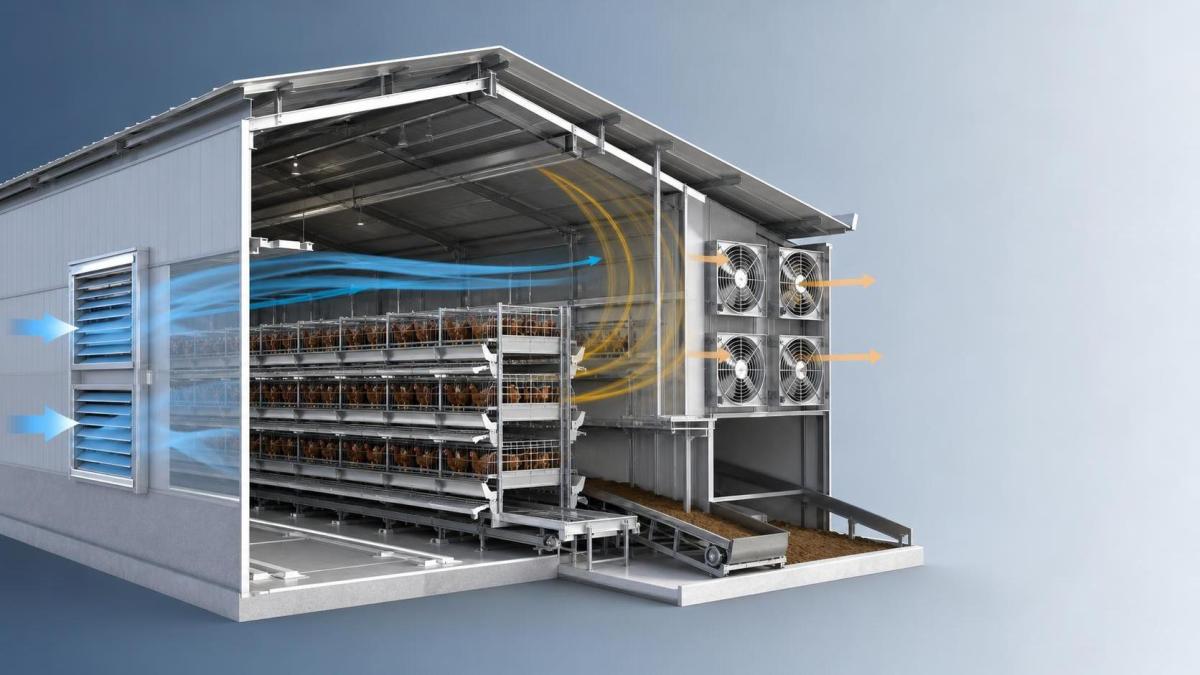
In warm climates or during seasonal heat events, cage houses need enough airflow to remove sensible heat and increase convective cooling around the birds. But project teams should be careful with the assumption that more fans automatically solve heat stress. Fan placement, tunnel geometry, inlet opening area, and internal resistance all affect delivered air speed.
Tunnel ventilation can be effective in many cage-house applications, especially where high air velocity is needed across long buildings. Cross-ventilation may suit other layouts, particularly where building width and row arrangement make lateral airflow more uniform. The correct choice depends on building proportions, regional climate, and how consistently the house can maintain the intended pressure and inlet configuration.
For hot-weather design review, look beyond rated fan performance at free air. What matters is delivered performance under operating static pressure, with shutters, guards, screens, evaporative cooling media if used, and real inlet conditions. Fan selection based on optimistic catalogue assumptions is one of the most common sources of underperformance in the field.
Moisture control is not only a ventilation issue
When condensation appears on ceilings, trusses, or equipment, ventilation is often blamed first. Sometimes correctly, but not always. Excess moisture can also come from leaking drinker systems, poor insulation, thermal bridges, wet manure, inadequate drainage, or short-circuit airflow that replaces air volume without removing moisture from critical areas.
For project managers, this matters because a mechanical redesign cannot compensate for construction defects or poor water management. During commissioning and early operation, moisture problems should be investigated as a building-system issue:
- Are drinker lines over-delivering or leaking?
- Is manure drying as expected?
- Are ceiling and wall insulation levels adequate for local winter conditions?
- Are inlets sealing and opening consistently?
- Is the controller running minimum ventilation based on time only, or on a combination of temperature, humidity, and pressure logic?
In other words, stable humidity depends on the interaction between envelope, water systems, manure handling, and controls. Projects that isolate these disciplines during design usually pay for it later in troubleshooting.
Ammonia control starts at the source
Ammonia is often discussed as if it were purely a ventilation dilution problem. In cage houses, that is too narrow. Ventilation can reduce concentration, but if manure remains wet and accumulates for extended periods, the source strength rises and the building must work harder to cope. Source control usually includes some combination of rapid manure removal, belt drying, leak prevention, and avoiding conditions that keep manure damp.
This has direct implications for capex planning. A project team deciding between a lower-cost ventilation package and a more integrated system with manure drying or faster manure evacuation should evaluate total operating impact, not only first cost. In many cases, reducing ammonia generation at the source provides more stable results than increasing fan runtime across the entire house.
Controls determine whether the design works in reality
Even well-sized equipment can fail operationally if the controls are too coarse or too dependent on manual intervention. Cage houses need staged control logic that reflects seasonal priorities. In cold weather, the system should protect air quality with minimum ventilation while avoiding cold drafts. In mild weather, it should transition smoothly without large swings in pressure or temperature. In hot weather, it should maximize effective air exchange and air speed.
Sensors should be placed where they represent actual bird-level conditions, not just where installation is convenient. Temperature stratification is common, so one sensor location is rarely enough for a large or multi-tier building. Humidity sensing is valuable, but it must be maintained and calibrated. Ammonia sensing can support monitoring, though project teams should verify sensor suitability, maintenance burden, and accuracy under agricultural conditions before depending on it for automated control.
Alarm logic also deserves more attention than it usually gets. High temperature, fan failure, power loss, pressure deviation, and controller communication faults should all be integrated into a clear escalation protocol. For projects in regions with unstable power supply, backup generation and fail-safe inlet/fan behavior are not optional design extras.
What to verify before freezing the project specification
Before issuing final procurement packages, engineering leads should pressure-test the ventilation concept against real operating scenarios rather than nominal design points. The most useful review questions are practical:
- Can the house maintain acceptable air quality during cold, damp weather without causing drafts?
- Will upper and lower cage tiers experience materially different conditions?
- What happens if one fan bank is unavailable during peak summer load?
- How sensitive is performance to poor maintenance, dirty shutters, or worn belts?
- Can operators understand and manage the control logic without constant vendor support?
- Are replacement parts and technical service available in the target export market?
For internationally supplied systems, this last point is often underestimated. A technically sound design can become a project liability if actuators, controllers, or fan motors are difficult to support locally. Export-oriented buyers should therefore evaluate not only performance specifications, but also documentation quality, electrical compatibility, spare parts strategy, and commissioning support.
Common design errors that look minor at tender stage
Several recurring issues tend to surface after installation:
- Oversized fans combined with poor low-stage control, leading to cycling and unstable winter conditions
- Inlet systems chosen for price rather than air throw performance
- Ignoring static pressure losses from screens, pads, and internal obstructions
- Underestimating moisture contribution from manure and water systems
- Control sensors placed away from representative bird zones
- No clear integration between manure removal schedule and ventilation settings
- Insufficient commissioning time for seasonal control tuning
None of these are exotic engineering failures. They are coordination failures, which is why project management discipline matters as much as equipment quality.
A workable decision framework for project teams
If the goal is to design ventilation for cage houses that remains effective under commercial conditions, the most reliable approach is to make decisions in this order: define environmental targets, quantify seasonal loads, design airflow paths, address ammonia at the manure source, verify delivered fan performance at operating pressure, and only then finalize controls and procurement.
That sequence keeps the project anchored to functional outcomes rather than hardware lists. It also reduces a common risk in cage-house development: solving the visible summer problem while leaving unresolved winter moisture and ammonia issues that quietly damage productivity over time.
The strongest projects are usually not the ones with the most aggressive fan capacity. They are the ones where ventilation, building envelope, manure management, and controls are treated as one system from the beginning. For project managers, that is the real design standard to aim for.
Related Intelligence
- Poultry Housing & CagingHow Cage Specifications Affect Poultry Housing Costs in NigeriaLocally made poultry cage price in Nigeria: compare cage specifications, housing costs, durability, ventilation, manure systems, and installation factors for smarter poultry investment.
- Poultry Housing & CagingWhat Determines Battery Cage Prices in Nigeria Beyond Bird Capacity?Battery cage price in Nigeria depends on more than capacity. Compare steel, automation, logistics, and installation scope for a smarter poultry investment.
- Poultry Housing & CagingBuilding a Poultry Farm Equipment Solution Around Flock Size and LayoutPoultry farm equipment solution planning for flock size and layout—optimize feeding, water, ventilation, automation, and future expansion.
The Morning Broadsheet
Daily chemical briefings, market shifts, and peer-reviewed summaries delivered to your terminal.
