

The Authority in Global Agricultural Chemistry & Bio-Resources
How to Choose HDPE Livestock Water Systems for Freeze Resistance and Low Maintenance
Start with the freeze failure mode, not the pipe material
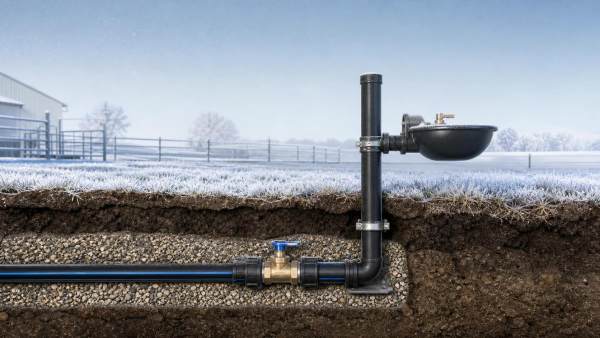
When teams evaluate HDPE livestock water systems, they often begin with pipe diameter, price, or the supplier’s general cold-weather claims. That is usually the wrong starting point. In cold-climate livestock operations, the first question is simpler: where is the water most likely to stop moving and freeze? Freeze damage rarely begins as a broad system issue. It usually starts at a transition point, a shallow run, an exposed riser, a drinker valve, a dead leg, or a line that sees long idle periods.
HDPE livestock water systems can be a strong choice because HDPE handles impact well, tolerates many outdoor installation conditions, and is widely used for water conveyance. But freeze resistance is never delivered by pipe resin alone. It comes from the whole layout: burial depth, circulation strategy, insulation details, equipment protection, and how the site is actually operated in winter.
For project managers and engineering leads, the practical job is to screen options in the order that real failures happen. If a system has one vulnerable point that can shut down a pen, a lane, or a wintering area, the rest of the specification matters less.
Map the water path before comparing quotations
Before asking vendors for final pricing, draw the water path from source to animal access points and mark every location where temperature, flow, or service access changes. This sounds basic, but it is where a lot of procurement mistakes begin. A quotation may describe an HDPE livestock water system as if it were one product. It is not. It is a chain of components and site conditions.
- Identify buried mains, branch lines, risers, valves, bowls, tanks, manifolds, and drains.
- Mark which segments are always flowing, occasionally flowing, or mostly stagnant.
- Flag low points and high points that may complicate draining or trap air.
- Note every interface where HDPE connects to another material or to equipment housings.
- Separate “frost line protected” sections from “weather exposed” sections on the drawing.
Once you have this map, vendor conversations get sharper. You are no longer asking, “Is this system freeze resistant?” You are asking, “How is this riser protected?” or “What prevents freezing at this drinker when animal demand is low overnight?” That is a much better buying position.
Check burial strategy against the real site, not a generic winter label
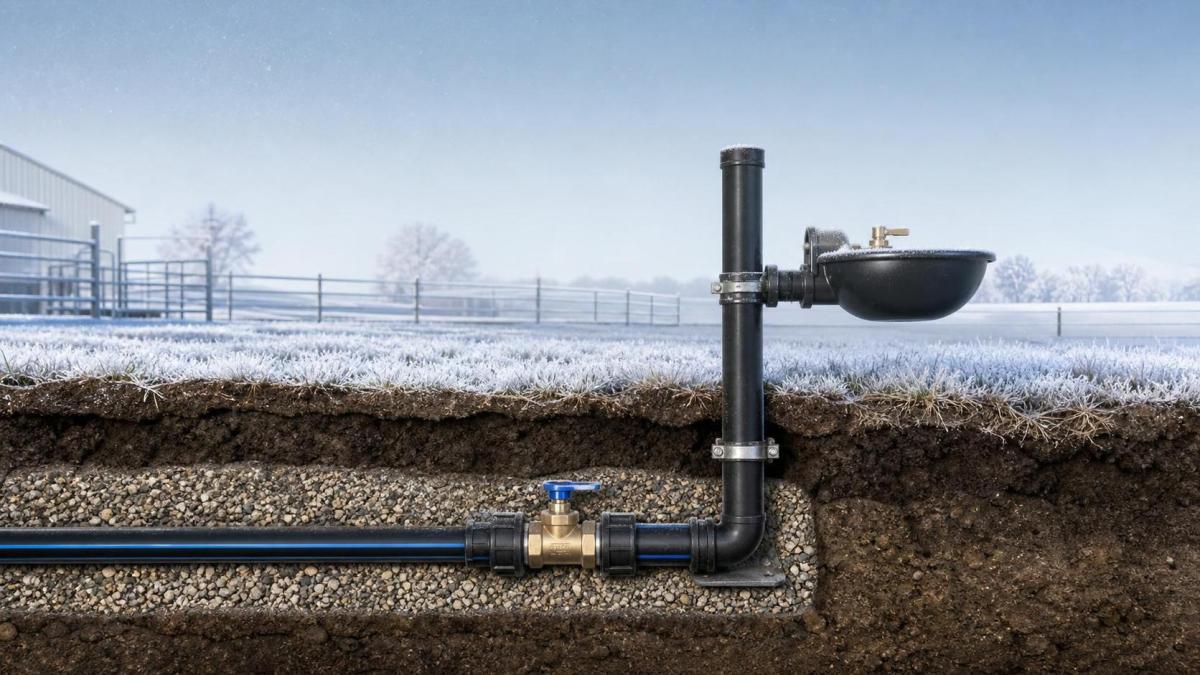
A common mistake is assuming that installing HDPE below grade automatically solves freezing. It helps, but only if the burial depth matches the site’s frost exposure, surface traffic, drainage, and topography. A line that is deep enough in one part of the property may become vulnerable where the ground profile rises, where erosion reduces cover, or where a trench crosses compacted vehicle routes.
Ask for the installation drawing, not just the bill of materials. You want to see whether the proposed route keeps critical sections consistently protected and whether there are unavoidable shallow crossings. If there are, the decision is no longer about the pipe alone. It becomes a design question involving rerouting, additional protection, or a different freeze-control method.
This is also the point to ask how the system will behave if winter conditions are not average. The right question is not “Will it work in winter?” The right question is “Which sections are most sensitive when temperature drops coincide with low demand and wind exposure?”
Look hard at low-use branches and dead ends
Most freeze-prone trouble spots are not on the main line. They are on short branches feeding isolated drinkers, seasonal pens, or overflow areas. These sections may sit with little movement for long periods, especially overnight or during partial occupancy.
If a proposed HDPE livestock water system includes dead-end branches, do not accept them casually. Ask whether the design allows recirculation, routine flushing, or full draining of unused sections. If it does not, you are taking on a maintenance burden from day one. That burden may stay hidden until the first severe cold spell, and then it becomes an emergency callout rather than a design discussion.
A simple rule used by experienced site teams: lines that cannot be kept warm through depth, movement, or protected hardware need a clear shutdown and drain procedure. If nobody can explain that procedure during procurement, the system is not ready.
Evaluate the drinker assembly as carefully as the buried pipe
The visible drinking point is often the first part operators blame, and not without reason. Even when buried HDPE runs are well protected, bowls, valves, float mechanisms, and short vertical sections above grade remain exposed to cold air, splashing, wind, and repeated freeze-thaw cycles.
When reviewing assemblies, focus on serviceability. Can a technician reach the valve without dismantling half the unit? Is there enough room to clear debris or ice without damaging fittings? Are replacement parts standard enough to source quickly? Low-maintenance performance is usually the result of straightforward access, not the absence of moving parts.
Another practical check: look for narrow, exposed cavities where residual water can sit. These small pockets are easy to miss on brochures and easy to discover at 5 a.m. in freezing weather.
Do not separate freeze resistance from flow reliability
A system that resists freezing but struggles to maintain usable flow under peak demand is still a poor choice. In livestock operations, freeze resilience and flow reliability are linked. Undersized sections, poorly balanced branches, or pressure loss across long runs can turn a technically thawed system into an operational bottleneck.
This is where project teams need to move beyond generic “suitable for farm use” language. Ask suppliers to walk through how the proposed layout handles simultaneous demand across the intended drinking points. You do not need invented performance claims to make a sound decision. You need the logic behind the layout: branch arrangement, expected pressure management, and whether the freeze-control method depends on continuous movement that the real site may not sustain.
Treat fittings and transitions as risk multipliers
The pipe run gets most of the attention, but fittings decide a lot of long-term maintenance outcomes. Every elbow, tee, reducer, valve body, threaded adapter, and material transition introduces another possible leak path, another place for poor installation, and another component that may respond differently to thermal movement.
During selection, count transitions. If one design achieves the same distribution logic with fewer exposed fittings and fewer material changes, that usually deserves real weight in the decision. Fewer problem points often matter more than a lower initial line item cost.
It also helps to ask who owns compatibility at interfaces. If the HDPE line, valve set, and drinker hardware come from different sources, somebody still needs to define the connection standard, installation responsibility, and replacement path. If that is left vague, maintenance teams inherit the confusion.
Ask how the system is meant to be maintained in January
“Low maintenance” is one of the most abused phrases in equipment buying. For a cold-weather livestock water system, it should mean something very specific: the system can be inspected, isolated, drained, cleaned, and repaired quickly under winter conditions without specialist improvisation.
A useful procurement exercise is to walk through likely maintenance events before purchase:
- A drinker valve sticks during freezing weather.
- A branch line serving a small group sees little use and starts icing.
- A fitting near an exposed transition develops a leak.
- A pen needs to be temporarily shut down and brought back online.
If the supplier cannot explain the isolation points, access steps, and restart sequence for those situations, the maintenance burden is probably being underestimated.
Match the system to the operating pattern, not just the site layout
Two farms with similar footprints can need very different solutions. The difference often comes from occupancy pattern, stocking movement, labor coverage, and whether water demand is steady or highly variable. A layout that works well for consistently occupied pens may become troublesome in a rotational setup where some drinkers sit idle for periods.
That is why selection should include an operations review, not just a civil or mechanical review. Ask:
- Which drinkers are active year-round and which are seasonal?
- Are there sections that may be underused overnight or between production cycles?
- Can staff realistically carry out flushing or draining routines during winter?
- Will snow, mud, or vehicle traffic affect access to service points?
These answers change the right specification more than many buyers expect.
Review documentation with procurement in mind
By the time a project reaches supplier comparison, the engineering questions should translate into procurement-ready checkpoints. You are not only buying HDPE livestock water systems; you are buying clarity around installation, operation, and replacement.
At minimum, request a document set that lets your team verify:
- the system layout and component locations;
- the intended winter operating method, including any reliance on circulation or draining;
- the maintenance access points and isolation logic;
- the spare parts list for wear items and exposed assemblies;
- the defined scope between pipe supply, drinker hardware, and installation responsibility.
This is not paperwork for its own sake. It is how you avoid buying a design that looks simple on a quote sheet but becomes fragmented once installation starts.
A practical decision sequence for project teams
If you need a working order for decision-making, use this one. Screen the freeze exposure points first. Then test whether the layout supports reliable flow under actual use. After that, judge serviceability, drainability, and the number of vulnerable transitions. Price belongs near the end, once you know the system will not force expensive winter interventions.
A solid choice is rarely the option with the most aggressive cold-weather marketing. It is the system whose weak points are visible, managed, and serviceable. For most project managers, that is the difference between a winter water network that quietly does its job and one that keeps generating urgent work orders.
Start with the route map, challenge every exposed or low-use section, and make vendors explain how the system behaves when demand drops and temperatures do not. That sequence will get you closer to a freeze-resistant, low-maintenance outcome than any generic product label.
Related Intelligence
- Feeding & Watering SystemsSelecting a Nipple Drinking System for Broiler and Layer HousesNipple drinking system selection guide for broiler and layer houses: compare water flow, pressure control, flushing, durability, and installation needs.
- Feeding & Watering SystemsHow to Select Poultry Feeding Systems for Broiler Farms by Flock Size and Feed WasteFarm poultry feeding systems: learn how to match feeder design to broiler flock size, reduce feed waste, improve uniformity, and control lifecycle costs.
- Feeding & Watering SystemsAnimal Feeding Automation Sourcing Guide: How to Compare Systems, Suppliers, and ROIAnimal feeding automation sourcing guide for buyers comparing systems, suppliers, and ROI. Learn how to reduce risk, avoid lock-in, and choose a platform that fits real farm operations.
The Morning Broadsheet
Daily chemical briefings, market shifts, and peer-reviewed summaries delivered to your terminal.
