

The Authority in Global Agricultural Chemistry & Bio-Resources
Feed Production Systems for Dairy Farms: Sizing for Herd Size and Ration Needs
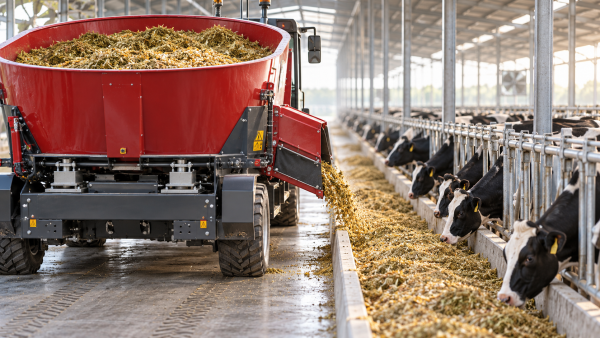
A dairy farm can have enough mixer capacity on paper and still miss its feeding schedule. The mismatch often starts when equipment is selected by cow numbers alone, without accounting for ration moisture, forage bulk, separate feeding groups, and the time required to load and deliver each batch. Feed production systems for dairy farms should be sized around the most demanding credible feeding day, with enough operating flexibility to handle smaller batches without compromising consistency.
The starting point is a group-by-group feed balance, followed by a workable production schedule. Mixer volume matters only after daily feed mass, ration volume, and delivery deadlines are understood. A larger machine can reduce batch count, but its value depends on whether it can also mix the farm’s smallest ration, move through existing access routes, and operate effectively with the loading equipment available.
Convert herd size into feed demand before comparing machines. A herd total conceals differences between lactating cows, dry cows, transition animals, and replacement stock. Each group may have its own intake, ration composition, feeding frequency, and delivery location. Include only the animals served by the proposed system, and identify any purchased feeds or separately delivered ingredients that bypass it.
For each group, calculate daily dry matter demand as animal count multiplied by planned dry matter intake per animal. Then convert that requirement into the quantity of feed to be mixed and delivered. For a complete ration, the basic relationship is:
Daily fresh feed mass = daily dry matter allocation ÷ ration dry matter fraction.
The allocation should reflect the farm’s feeding policy. Expected consumption and feed offered are different quantities where refusals are planned. State explicitly whether the calculation includes an allowance for refusals, so the same allowance does not appear again as a general capacity margin. Storage losses also belong in the purchasing and inventory balance; they should not automatically be added to mixer demand.
Consider an illustrative group of 200 lactating cows allocated 24 kg of dry matter per cow daily. The group requires 4,800 kg of dry matter. At 45% ration dry matter, that becomes approximately 10,667 kg of fresh feed per day. These figures are calculation assumptions, not recommended intake or ration targets; the farm’s nutrition plan must supply those inputs.
Moisture variation can materially change the machinery requirement. If the same dry matter allocation is supplied by a ration at 40% dry matter, fresh feed demand rises to 12,000 kg. That additional mass affects loading, payload, and delivery time. Its effect on required mixer volume also depends on the resulting ration density. Recalculate the ingredient weights when forage dry matter changes rather than treating moisture variation as a reason to add an arbitrary equipment margin.
Build this calculation for every feeding group. The output should show fresh mass per day, mass per delivery, and the delivery window. Two farms with identical herd sizes can then produce very different specifications: one may prepare a few large batches, while another must accommodate several small, distinct rations.
Translate fresh feed mass into usable batch capacity. A mixer’s stated vessel volume does not establish how much of a particular ration it can mix effectively. Feed needs room to circulate, and working capacity depends on machine design, ingredient characteristics, loading sequence, and the amount of processing performed inside the mixer. Compare suppliers using a defined ration and operating method.
A preliminary volume calculation is:
Required ration volume per batch = fresh feed mass per batch ÷ mixed-ration bulk density.
Using the illustrative group above, two equal daily deliveries would each contain approximately 5,333 kg. If the mixed ration has an assumed bulk density of 350 kg/m³, each delivery represents about 15.2 m³ of material. At an assumed 300 kg/m³, it represents about 17.8 m³. These densities illustrate sensitivity; they are not specifications for a particular ration.
Use representative measurements or a supplier evaluation with the intended ingredients to establish a defensible density range. Loose forage volume during loading can differ from the volume of the finished mix. Long material may temporarily occupy considerable space before processing, so a machine that accommodates the finished ration may still have difficulty accepting the planned loading sequence.
Ask the supplier to distinguish nominal vessel volume, recommended working volume, maximum payload, and minimum effective batch size. Check the weighing system, chassis or stationary support structure, and discharge arrangement against the proposed load. A dense ration can reach a mass limit before the vessel appears full, while a bulky ration can reach its practical volume limit at a comparatively low mass.
The smallest batch deserves equal attention. A mixer selected around the main lactating group may have difficulty distributing small ingredient additions through a much smaller transition ration. Effective minimum fill is specific to the machine and ration. Request evidence for the smallest intended batch, including the loading order and mixing procedure. If its performance is unsuitable, a separate small mixer or a different grouping arrangement may be more practical than enlarging the main unit.
For the 200-cow example, dividing each delivery into two batches would reduce the required volume per batch, but it would also create four production cycles per day. That trade-off cannot be evaluated from the equipment specification alone. It requires a timeline covering ingredient retrieval through to the final discharge.
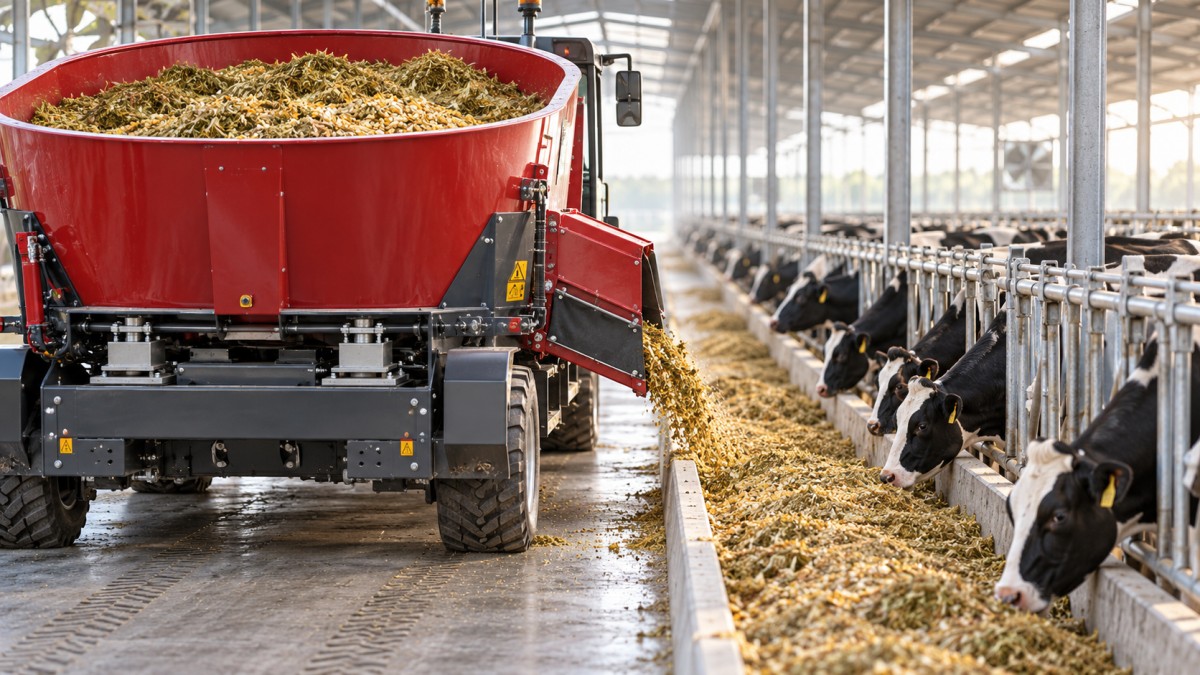
Check whether the complete system can meet the feeding window. Daily tonnes provide a useful scale indicator, but scheduled throughput determines whether the installation will work. Measure or estimate ingredient retrieval, weighing, loading, any required forage processing, mixing, travel, discharge, return travel, and routine cleanout. Include operator tasks that interrupt the sequence, such as moving between ingredient storage areas.
A useful first calculation is batch count multiplied by cycle time, with separate allowances for activities that occur only once per feeding period. Record which tasks overlap. A stationary mixer may prepare the next ration while a delivery vehicle is away, provided the layout and discharge arrangement support that sequence. A mixer wagon used for both mixing and delivery remains occupied during travel and feeding.
Suppose a proposed schedule requires four batches within a three-hour window. At an illustrative complete cycle time of 40 minutes, production consumes 160 minutes and leaves 20 minutes for disruption. A fifth batch would exceed the window. This calculation can reveal a capacity constraint that remains hidden when a quotation reports only mixing time or an hourly output under favorable conditions.
Look upstream and downstream before increasing mixer size. A larger batch may require more loader trips, longer retrieval time, or a heavier towing vehicle. A small concentrate conveyor may hold up every recipe. A delivery route with narrow access or slow discharge may prevent the farm from gaining much time from a larger mixer. Where concentrate quantities are small, weighing resolution and repeatable dosing also deserve attention; a high total throughput does not establish ingredient accuracy.
The decision about on-farm processing should follow the ration’s actual requirements. A farm buying prepared concentrates may principally need storage, weighing, mixing, and delivery. A farm processing its own grain must also size the mill, conveying equipment, and intermediate storage. Check whether grain preparation can occur outside the feeding window and whether the buffer capacity supports that schedule. If processing and mixing share electrical capacity, labor, or conveying equipment, reflect those dependencies in the timeline.
Storage should support the same operating plan. For purchased dry ingredients, calculate usable inventory from daily consumption, delivery intervals, and a justified reserve. Account for access and the ability to receive a delivery before storage is empty. For silage, evaluate storage and face management with the farm’s forage adviser. Increasing exposed inventory simply to make loading easier can create a feed management problem.
Select a configuration that can handle variation and interruption. A mobile mixer can suit operations where one machine loads, mixes, and feeds along accessible routes. A stationary installation can separate production from delivery and support more controlled ingredient handling, but it introduces transfer points and coordination between equipment. Automated feeding adds requirements around feed availability, replenishment, controls, and recovery from interruptions. Compare complete workflows against the same ration schedule.
Forage characteristics should shape that comparison. State the form and expected condition of ingredients entering the system, including whether the mixer must process long forage. Mechanical suitability should be assessed through the intended feeding result: adequate incorporation, repeatable distribution, controlled particle processing, and acceptable discharge. Additional mixing time cannot compensate reliably for every loading error, and excessive processing can alter the physical structure of the ration.
Turn these requirements into a focused acceptance plan before placing an order:
- Demonstrate the largest bulky ration and the smallest separate ration at their proposed batch sizes.
- Record the full production and delivery cycle, including operator and loader time.
- Check weighing and dosing performance at quantities representative of the actual recipes.
- Assess distribution using an agreed sampling method, alongside particle structure and discharge behavior.
- Confirm how the system resumes operation after an interrupted batch or equipment fault.
Acceptance limits and sampling procedures should be agreed with the supplier and the farm’s nutrition adviser. A satisfactory demonstration must establish performance across the operating range that matters to the farm. A single large batch of an easily mixed ration provides limited evidence about a small transition batch containing different ingredients.
Expansion planning should use defined scenarios. Recalculate the feed balance and schedule for the current herd, a committed expansion, and any realistic later stage. Include changes in group structure: adding cows to an existing ration can have a different effect from creating another group that requires its own batch. Check available hours, ingredient storage, loader capacity, power supply, delivery access, and labor alongside mixer capacity.
Specify operating reserve in practical terms. An extra batch within the feeding window, space for an additional ingredient bin, or provision for a second delivery vehicle is easier to evaluate than an unexplained percentage of spare capacity. Where herd growth is uncertain, modular expansion may preserve flexibility while avoiding a machine whose current batches fall below its effective working range.
Finally, compare lifecycle cost using the validated schedules. Include labor, energy or fuel, wear parts, maintenance access, cleaning, ingredient losses, and the resources needed during downtime. Identify which failure would stop feeding and how the farm would maintain service while it is repaired. A lower purchase price has limited value if the proposed arrangement consumes all available feeding time under normal conditions.
The purchase specification should therefore state a feed production duty: which rations, how much per batch, the credible moisture and density range, and when each group must receive feed. Ask each supplier to show how its system performs that duty today and at the planned herd size. That gives the evaluator a concrete basis for choosing capacity—and makes the compromises in batch size, scheduling, and future expansion visible before equipment is ordered.
Related Intelligence
- Feeding & Watering SystemsFeed Production Systems for Dairy Farms: Sizing for Herd Size and Ration NeedsSize feed production systems for dairy farms to match herd size, ration needs, and feeding schedules. Discover how to choose capacity, avoid bottlenecks, and plan for growth.
- Feeding & Watering SystemsHow to Size Commercial Farm Feed Systems for Herd Capacity and Feed FlowFarm commercial feed systems: learn how to size storage, conveyors, and feed flow for herd capacity, peak demand, resilience, and efficient farm operations.
- Feeding & Watering SystemsSelecting a Nipple Drinking System for Broiler and Layer HousesNipple drinking system selection guide for broiler and layer houses: compare water flow, pressure control, flushing, durability, and installation needs.
The Morning Broadsheet
Daily chemical briefings, market shifts, and peer-reviewed summaries delivered to your terminal.