

The Authority in Global Agricultural Chemistry & Bio-Resources
Choosing a Livestock Feeding Systems Exporter: Delivery and After-Sales Support
Choosing a Livestock Feeding Systems Exporter: Delivery and After-Sales Support
Choosing a livestock systems exporter involves more than comparing equipment prices. Delayed shipments, unclear installation responsibilities, and limited spare-parts access can disrupt feeding operations and increase total ownership costs. A reliable supplier should provide realistic delivery schedules, transparent shipping terms, and after-sales support suited to the farm’s location and operating requirements.
The difficult part is distinguishing a credible commitment from a reassuring sales answer. “Installation included” may exclude electrical work. “Parts available” may mean stocked overseas, without a confirmed dispatch time. Procurement decisions become safer when these phrases are converted into documented responsibilities, acceptance criteria, and service arrangements before the purchase order is issued.
Define the feeding requirement before comparing exporters
Livestock feeding systems cover different operating duties: bulk storage, conveying, weighing, mixing, distribution, and individual-animal feeding. A supplier experienced in poultry feed lines may not have the same capabilities in cattle ration handling or sow feeding controls. Relevant experience means familiarity with the proposed process, not simply a long export history.
Give shortlisted suppliers the same operating brief. Include livestock type, feed form, required delivery rate, feeding windows, route lengths, elevation changes, and the existing site layout. Where feed characteristics affect handling, specify the expected range rather than assuming pellets, mash, and fibrous ingredients behave alike. Bridging, segregation, moisture variation, and abrasive ingredients can change equipment suitability.
Ask each exporter to identify assumptions and exclusions. Does quoted capacity apply to a straight conveyor or the actual route? Does weighing performance require particular installation conditions? Will the controller integrate with existing equipment, and who is responsible for that interface? Unanswered questions here often become expensive modifications after arrival.
AgriChem Chronicle’s coverage across agricultural machinery and feed processing provides a useful editorial perspective: equipment should be assessed as part of a production chain, not as an isolated purchase. A technically suitable feeder still creates procurement risk if its delivery, utilities, controls, and maintenance arrangements do not fit the farm.
A delivery date needs a sequence behind it
“Delivery in twelve weeks” is incomplete unless the starting point and finishing point are defined. The clock might begin after deposit receipt, drawing approval, or confirmation of purchased components. The endpoint might be factory readiness rather than arrival at the farm. These distinctions determine whether a schedule supports the planned installation window.
Request a milestone schedule covering engineering approval, manufacture, inspection, packing, dispatch, transit, customs clearance, and site delivery. Separate supplier-controlled activities from estimates dependent on carriers, ports, or border agencies. A credible exporter explains uncertainty rather than treating every stage as equally predictable.
Also establish how changes are communicated. A delayed motor or revised silo drawing can affect more than shipment: it may leave installers booked, lifting equipment reserved, and buildings waiting. Require notification when a milestone slips, with a revised schedule and recovery proposal. Consider split shipments only after checking whether the first consignment can actually support useful installation work.
Check export readiness, not just manufacturing readiness
Ask for a proposed document list and packing approach before dispatch. Commercial invoices, packing lists, transport documents, and any destination-specific certificates should match the goods and transaction. Import classification and conformity obligations need confirmation with the relevant broker or compliance adviser; a supplier’s previous shipment elsewhere does not establish compliance in your market.
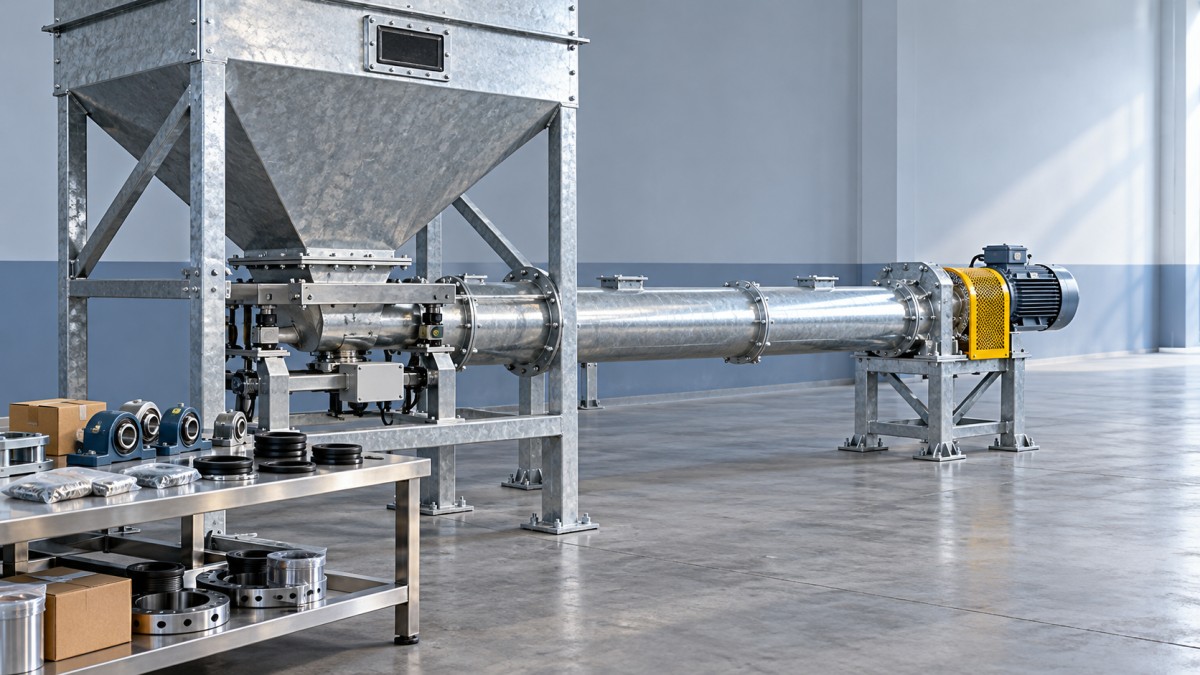
Packing deserves technical review. Long conveyor sections, control cabinets, weighing devices, and loose installation hardware have different handling needs. Identify moisture protection, lifting points, package weights, and storage restrictions. Where regulated wood packaging is used, verify the applicable treatment and marking requirements. Missing labels or mixed hardware may not damage equipment, but they can waste installation time.
Make the landed-cost comparison fair
Two quotations are not comparable until their delivery boundaries match. Specify the Incoterms® rule, named place or port, and version. These rules allocate particular transport obligations, costs, and risks; they do not replace clauses covering payment, ownership, acceptance, or warranty.
Under DAP, for example, delivery is generally made at the named destination with goods ready for unloading, while import clearance remains the buyer’s responsibility. Under DDP, the seller takes on import-clearance obligations, but its ability to fulfil them must be verified for the destination. Neither label eliminates the need to clarify site access and unloading arrangements.
Build the comparison around costs that will actually reach the project budget:
- Equipment, export packing, freight, and cargo insurance where applicable.
- Import duties, non-recoverable taxes, brokerage, terminal charges, and inland transport.
- Unloading, lifting, foundations, electrical work, and installation labour.
- Commissioning travel, accommodation, training, and initial spare parts.
- Software subscriptions, remote-access charges, and scheduled maintenance obligations.
Evaluate recoverable taxes separately as a cash-flow issue rather than automatically treating them as permanent costs. Keep contingency visible, too. Hiding uncertain expenses inside a single landed-price estimate makes it harder to see which supplier has genuinely reduced risk and which has simply left costs undefined.
Separate installation from operational acceptance
Equipment can be mechanically installed without being ready to feed livestock reliably. Commissioning may involve checking motor rotation, calibrating weighing equipment, testing alarms and interlocks, verifying discharge sequences, and adjusting control settings using the intended feed. The contract should distinguish these activities from assembly.
A responsibility schedule should identify who supplies foundations, lifting equipment, electrical connections, network access, test feed, and operators. Confirm whether the exporter provides an on-site technician, remote supervision, or a local contractor. If remote assistance is proposed, assess whether site personnel have the skills and language support to carry out the work safely.
Agree factory and site acceptance procedures where appropriate. Factory checks can confirm equipment identity, assembly, controls, and documented tests, but they may not reproduce the installed route or actual feed characteristics. Site acceptance should address the performance that matters in operation: delivery capacity under agreed conditions, weighing performance where relevant, control sequences, and response to faults.
Document the test material, measurement method, pass criteria, and treatment of outstanding defects. Link payment milestones to objective deliverables where commercially feasible. Avoid vague conditions such as “satisfactory operation,” which leave both parties uncertain about when acceptance has occurred.
After-sales support must describe what happens during a stoppage
A warranty states certain remedies; it does not necessarily provide rapid recovery. An exporter may agree to replace a failed component while excluding diagnosis, removal, freight, travel, or reinstallation. Ask for these cost boundaries explicitly, along with the warranty start date and any commissioning deadline that affects coverage.
Service commitments should distinguish acknowledgment, technical assessment, parts dispatch, and on-site attendance. A quick acknowledgment is useful, but it is not a repair commitment. Check support hours against the farm’s time zone, weekend operations, and feeding schedule. Identify an escalation contact rather than relying entirely on the salesperson who negotiated the order.
Request a sample troubleshooting procedure. Useful support begins with identifiable equipment records, electrical drawings, fault codes, and accessible manuals. For connected systems, clarify remote-access permissions, cybersecurity responsibilities, controller backups, software licensing, and who retains access to configuration files. Recovery becomes harder if only one overseas technician can restore the settings.
Turn spare-parts availability into a workable stock plan
Ask the exporter to separate consumables, routine wear parts, and components whose failure could stop an entire feed route. The appropriate stockholding depends on equipment design and local sourcing options. Motors or bearings may be locally obtainable, while a proprietary controller, gearbox interface, or dosing component may require the original supplier.
For critical items, obtain part numbers, current prices, stock locations, dispatch assumptions, and substitution rules. “Available from stock” should identify whose stock and where. Check how long the supplier intends to support control hardware and what happens when components become obsolete. A spare-parts list without identification drawings is less useful when maintenance staff need to order under pressure.
Plan a safe feeding contingency with farm management. Depending on the system, this may involve isolating a failed section or using an approved alternative distribution method. Do not assume manual bypass is safe or permitted; the manufacturer should explain operating limits without disabling protective functions.
Choose on evidence, then close the remaining gaps
Before awarding the contract, request references involving comparable equipment, installation conditions, and service geography. Ask how commissioning was handled, whether parts arrived as promised, and who resolved technical disputes. References cannot guarantee future performance, but specific answers are more informative than an export-country list.
Compare shortlisted suppliers against the same operating assumptions and ownership period. Include planned maintenance, likely wear replacements, support fees, and plausible disruption scenarios. Keep uncertain costs labelled as assumptions; a precise-looking total is not dependable when its inputs are speculative.
The stronger livestock systems exporter is not necessarily the lowest bidder or the one promising the fastest shipment. It is the supplier whose scope, schedule, acceptance obligations, and recovery arrangements can be checked. Before signing, close the gaps that could leave the farm paying for equipment it cannot yet operate—or waiting for a part it cannot readily obtain.
Related Intelligence
- Feeding & Watering SystemsChoosing a Livestock Feeding Systems Exporter: Delivery and After-Sales SupportChoose a livestock systems exporter with reliable delivery, clear installation terms, and responsive after-sales support. Discover what to check to reduce downtime and protect your investment.
- Feeding & Watering SystemsFeed Production Systems for Dairy Farms: Sizing for Herd Size and Ration NeedsSize feed production systems for dairy farms to match herd size, ration needs, and feeding schedules. Discover how to choose capacity, avoid bottlenecks, and plan for growth.
- Feeding & Watering SystemsHow to Size Commercial Farm Feed Systems for Herd Capacity and Feed FlowFarm commercial feed systems: learn how to size storage, conveyors, and feed flow for herd capacity, peak demand, resilience, and efficient farm operations.
The Morning Broadsheet
Daily chemical briefings, market shifts, and peer-reviewed summaries delivered to your terminal.
