

The Authority in Global Agricultural Chemistry & Bio-Resources
Rapid Custom Chemical Synthesis: When to Choose It for Small-Batch R&D and Scale-Up

Rapid Custom Chemical Synthesis: When to Choose It for Small-Batch R&D and Scale-Up
For technical teams, rapid custom chemical synthesis is often the fastest way to turn a concept into a usable material. It is especially valuable when the real question is not “Can we make it?” but “Can we make it fast, clean, and in a way that still supports downstream scale-up?”
In early-stage development, every week matters. Delays in sampling, impurity review, or route selection can slow assay work, formulation trials, and process validation. That is why rapid custom chemical synthesis has become a practical option for small-batch R&D, analytical method development, and pre-scale feasibility checks.
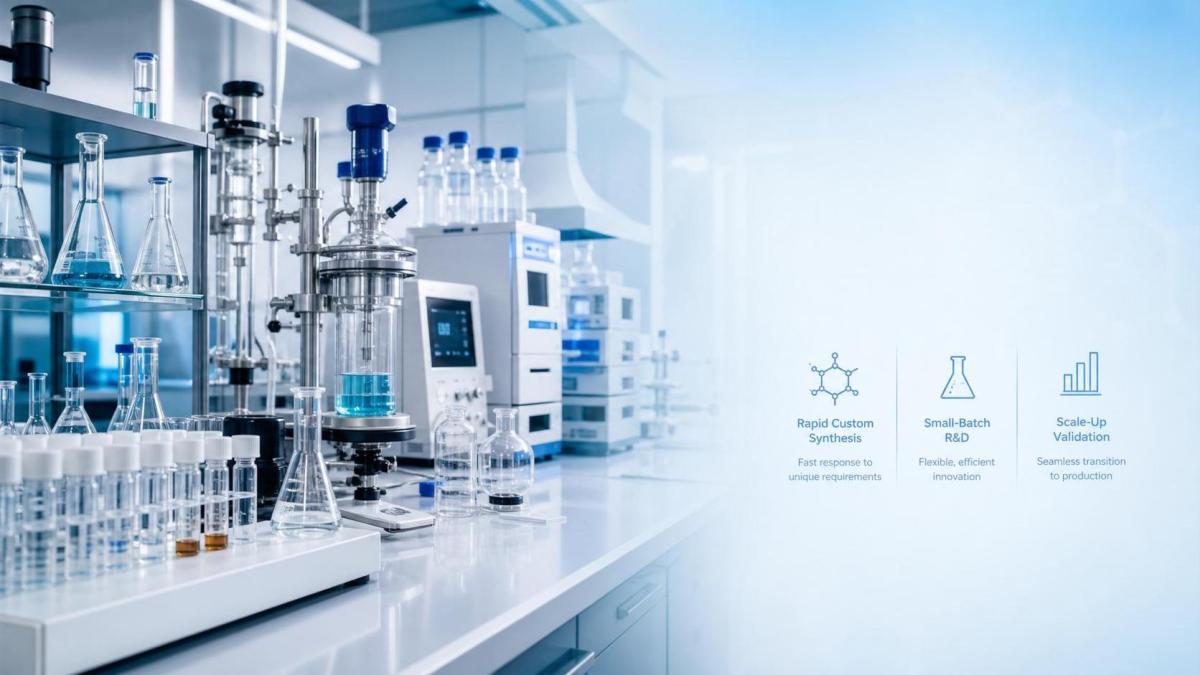
Where Rapid Custom Chemical Synthesis Fits Best
The strongest use case is usually a narrow one. You need a defined compound, a short turnaround, and a specification that is good enough for testing without overinvesting in a full production route.
This is common in lead optimization, reference standard preparation, impurity profiling, and route scouting. It also fits situations where procurement risk is high and internal synthesis capacity is already committed.
- Small-batch R&D batches for screening and comparison
- Reference materials for analytical and QC work
- Specialty intermediates for route confirmation
- Early scale-up lots for process stress testing
From recent project patterns, the best results come when the requested target is well defined and the acceptance criteria are realistic. Rapid custom chemical synthesis works best when speed matters, but not at the expense of traceability or purity control.
Decision Signals That It Is the Right Choice
A simple rule helps here: if the project is blocked by material availability rather than process ambition, rapid custom chemical synthesis is worth serious consideration. The same is true when a team needs a batch for method development before locking a larger budget.
More obvious signals include unstable supplier lead times, unclear impurity profiles, or a need to compare alternate routes quickly. In those cases, waiting for a traditional long-cycle development path can cost more than commissioning a focused synthesis run.
It also helps when you need a controlled handoff from lab discovery to pilot planning. A rapid batch can reveal whether the target molecule is sensitive to workup conditions, whether isolation is practical, and whether analytical methods are robust enough for the next stage.
The key is to match the synthesis scope to the decision you need to make. If the goal is proof, not volume, rapid custom chemical synthesis often gives the cleanest answer.
What to Specify Before You Start
Clear inputs reduce rework. Before placing a request, teams should define the target structure, required quantity, acceptable impurity limits, and any method-specific constraints.
It also helps to share the intended use. A material for discovery screening does not need the same documentation package as one used in regulated process development. That distinction can save time and avoid unnecessary cost.
This is where rapid custom chemical synthesis becomes more predictable. The better the input package, the fewer surprises in route design, isolation, and final release testing.
Risk Controls That Matter in Practice
Fast delivery is useful only if the result is usable. That means quality checks should be built in from the start, not added at the end as a rescue step.
For technical evaluators, the most important checks usually involve route robustness, impurity carryover, reproducibility, and documentation quality. If the synthesis depends on fragile conditions or hard-to-source starting materials, the batch may solve today’s problem but create tomorrow’s scale-up risk.
A practical review should ask whether the route can be repeated, whether the material can be characterized cleanly, and whether the process leaves room for later optimization. Rapid custom chemical synthesis should support scale-up thinking, not hide it.
- Confirm analytical methods before release
- Track reagent and solvent quality
- Review purification feasibility early
- Ask for route notes that support tech transfer
How It Supports Scale-Up Planning
A good small-batch result should do more than meet the immediate request. It should also tell you whether the chemistry can survive a larger campaign.
That is why rapid custom chemical synthesis is often used as a bridge between discovery and pilot work. The batch can expose heat management issues, isolation losses, solvent sensitivity, or step complexity before those issues become expensive at scale.
In many cases, the best outcome is not just a sample, but a clearer decision path. Teams can compare route options, refine specifications, and estimate whether the process deserves further development or should be replaced.
That also means the synthesis partner should think like a process collaborator, not only a batch provider. The more the result supports tech transfer, the easier the move from one-off material to repeatable production.
A Practical Way to Decide
Choose rapid custom chemical synthesis when speed, specificity, and decision quality matter more than volume. It is a strong fit when you need a controlled batch for R&D, a dependable reference material, or a realistic first look at scale-up behavior.
Do not use it as a shortcut for poor planning. The best projects still begin with clear targets, realistic quality requirements, and an honest view of downstream risk. When those pieces are in place, rapid custom chemical synthesis can shorten timelines without sacrificing technical confidence.
If your next step depends on whether a route is feasible, repeatable, and ready for larger commitment, start with a focused batch request, define the acceptance criteria, and review the data with scale-up in mind. That is usually the fastest path to a reliable decision.
Related Intelligence
- Custom SynthesisWhat Data Should a Chemical Manufacturer Provide for a GMP Audit?What data should a chemical manufacturer provide for GMP audit readiness? Explore the essential records for traceability, validation, data integrity, and confident compliance.
- Custom SynthesisDoes organic chemical synthesis scale-up require different solvent recovery thresholds above 500 L batch volume?Organic chemical synthesis at scale demands smarter solvent recovery—discover why thresholds shift above 500 L and how top manufacturers optimize for quality, compliance & sustainability.
- Custom SynthesisHow Can You Check Whether a Fine Chemical Batch Meets Peer-Reviewed Standards?Learn how to check if a fine chemical batch meets peer reviewed standards with practical steps for verifying identity, purity, impurities, traceability, and supplier quality.
The Morning Broadsheet
Daily chemical briefings, market shifts, and peer-reviewed summaries delivered to your terminal.
