

The Authority in Global Agricultural Chemistry & Bio-Resources
Procurement and Safety Considerations for Industrial Edible Oil Tanks
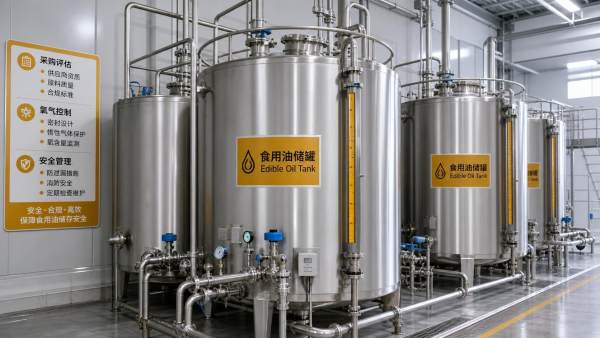
Procurement and Safety Considerations for Industrial Edible Oil Tanks
Edible oil storage is often treated as a utility function until a quality deviation, shutdown, or safety incident reveals how much depends on tank performance. For food processors, ingredient distributors, and large catering supply operations, storage conditions influence oxidation rate, cleaning frequency, transfer efficiency, and product consistency. Procurement teams reviewing tank investments are therefore not only buying capacity. They are shaping operating risk, maintenance workload, and the ability to preserve oil quality from receipt to dispatch.
This issue matters more as businesses try to manage tighter quality expectations, variable raw material costs, and greater scrutiny over process hygiene. Oils may appear stable compared with highly perishable products, yet they remain sensitive to oxygen exposure, temperature fluctuation, residue buildup, and contamination during storage and handling. A tank that performs adequately in one facility may create avoidable problems in another if site conditions, turnover cycles, and process integration are not properly considered during procurement.
In many purchasing discussions, initial price still receives disproportionate attention. That approach can be costly over time. A lower-cost vessel may require more frequent intervention, create cleaning inefficiencies, or make oxygen management harder during filling and discharge. For decision-makers, the more reliable lens is total operating suitability: how well the tank supports quality preservation, process continuity, worker safety, and inspection readiness over years of use rather than only at delivery.
Why Oxygen Control Deserves Procurement Attention
One of the most important but sometimes underexamined factors in edible oil storage is oxygen exposure. Contact with oxygen can accelerate oxidation, which may affect flavor stability, shelf life, and downstream product performance. In stainless steel systems, oxygen control is not only a technical detail for engineers. It is a procurement issue because tank geometry, sealing quality, venting arrangement, headspace management, and compatibility with blanketing systems all influence whether the storage environment remains stable.
For operations storing refined oils at larger volumes or for extended holding periods, oxygen management may become especially relevant. A buyer comparing stainless tanks should therefore examine whether the design can support practical measures such as controlled headspace conditions, low-leak connections, and integration with inert gas protection when the process requires it. This is where industrial edible oil tanks should be evaluated as part of a broader storage strategy rather than as standalone metal containers with similar nominal capacity.
The right question is not simply whether a tank can hold oil. It is whether it can hold oil under conditions that preserve quality with acceptable operating complexity. That distinction becomes important for procurement personnel, quality managers, and safety teams who need confidence that equipment decisions will remain defensible after installation.
Core Procurement Criteria Beyond Capacity
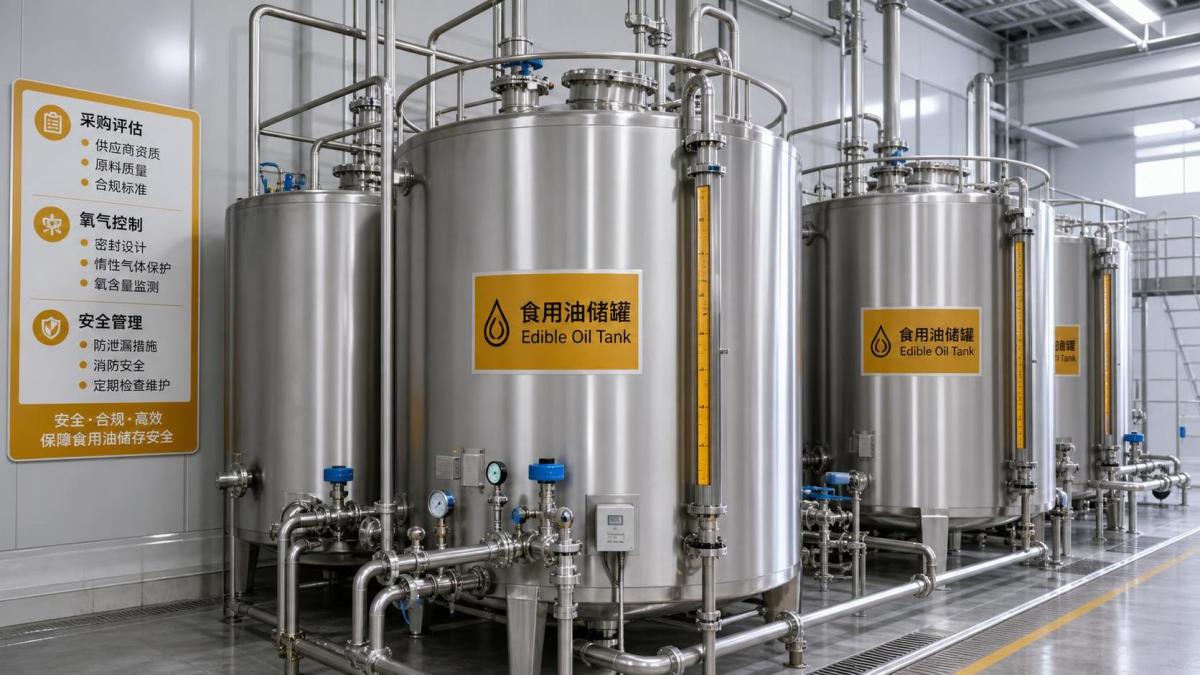
Capacity is usually the first specification discussed, but it should not dominate the decision. A sound procurement review typically includes material selection, internal finish, fabrication consistency, access design, drainage performance, instrumentation compatibility, and installation constraints. Stainless steel is widely chosen for edible oil storage because it generally supports hygiene, corrosion resistance, and cleaning control, but grades and finishing details still matter depending on the oil type, cleaning regime, and surrounding environment.
Internal surface condition is especially important. Rough surfaces, poorly finished welds, or dead zones may allow residue retention and complicate cleaning validation. Even where edible oils are less microbially sensitive than water-based products, residue accumulation can still affect quality and increase maintenance demands. Procurement teams should ask how the tank interior is fabricated, how weld areas are treated, and whether the design minimizes product traps during draining and line changeover.
Another key area is the relationship between the tank and the wider process. Inlet and outlet positioning, pump matching, heating arrangements if needed, level sensing, vent design, and manway accessibility all influence daily usability. A tank that looks adequate on a specification sheet may perform poorly if operators struggle to inspect it, clean it, or maintain stable transfer conditions during high-throughput production cycles.
Safety Considerations That Affect Long-Term Value
Safety should be treated as part of equipment value, not a separate compliance box. In edible oil storage, many risks are operational rather than dramatic, but they can still create serious consequences. Slippery work areas from leaks, manual cleaning exposure, pressure imbalance, poor venting, hot-oil handling, and maintenance access problems can all affect personnel safety and uptime. A procurement process that overlooks these details may create avoidable hazards that are much harder to correct after commissioning.
Where oxygen control systems such as inert gas blanketing are under consideration, safety review becomes even more important. Buyers should assess how pressure control is managed, whether valves and seals are appropriate for the application, and how the system behaves during filling, emptying, and idle periods. Safety managers may also want clarity on inspection points, alarm logic, and maintenance procedures so that the equipment remains reliable under real operating conditions rather than only under ideal design assumptions.
Procurement and safety functions often work in parallel, but this category benefits from closer coordination. A tank with slightly higher acquisition cost may reduce manual intervention, improve access for inspection, and support more stable operating conditions. Those factors can lower incident exposure and reduce unplanned stoppages, which matters to both plant leadership and finance teams.
Common Procurement Mistakes
One common mistake is specifying the vessel too narrowly around storage volume while leaving process conditions underdefined. Oil type, residence time, fill frequency, transfer temperature, cleaning method, and expected expansion plans should all influence the final configuration. Without that context, suppliers may quote technically compliant tanks that are not well matched to the actual use case.
Another mistake is assuming all stainless tanks offer similar performance. Small differences in sealing quality, weld execution, structural design, and accessory integration may affect oxygen ingress, cleaning efficiency, and maintenance needs. These differences are not always obvious in a basic quotation comparison, which is why procurement teams benefit from asking structured technical questions rather than relying solely on commercial summaries.
A third mistake is underestimating lifecycle costs. Tanks that are difficult to clean, inspect, or integrate with monitoring systems may consume more labor and create more production disruption over time. In many facilities, indirect costs from quality holds, maintenance delays, or process instability outweigh modest savings achieved during the initial purchase.
Practical Questions Buyers Should Raise
- How does the tank design help limit unnecessary oxygen exposure during normal storage and transfer?
- What interior fabrication details support effective cleaning and complete draining?
- Can the vessel accommodate current and future instrumentation, heating, or inert gas control requirements?
- What inspection and maintenance points are accessible without excessive manual risk or downtime?
- How well does the design fit the site layout, utility conditions, and production rhythm of the facility?
These questions help shift the conversation from equipment purchase to operational fit. They also create a more useful basis for comparing suppliers whose quotations may appear similar on the surface but differ meaningfully in long-term performance.
Different Priorities for Different Stakeholders
Procurement personnel typically focus on supplier reliability, delivery schedule, specification clarity, and lifecycle value. Their concern is not only price control but the reduction of hidden cost drivers after installation. Quality teams tend to emphasize cleanability, material integrity, contamination control, and the ability to preserve oil characteristics consistently across storage periods. Safety managers are more likely to focus on pressure management, safe access, leak prevention, and maintenance exposure. Senior decision-makers usually need a view that connects all three: commercial rationale, product protection, and operating resilience.
When these perspectives are aligned early, tank procurement becomes more disciplined. Requirements are clearer, evaluation criteria become more objective, and post-installation compromise is less likely. That is particularly useful for businesses expanding storage capacity, upgrading older stainless systems, or trying to standardize equipment across multiple sites.
A Balanced Path to Selection
For many enterprises, the most practical approach is to evaluate tank options through a balance of quality protection, process compatibility, safety control, and maintainability. Oxygen control in stainless tanks should be reviewed as a serious part of that analysis, especially where oil value, storage duration, or product sensitivity makes oxidation management commercially important. A well-selected tank may help stabilize operations in ways that are not obvious in a simple procurement spreadsheet but become clear over the life of the asset.
Industrial edible oil storage is not a category where buyers benefit from the narrowest specification or the fastest quote comparison. The better outcome usually comes from understanding how tank design choices affect quality retention, routine safety, and operational efficiency together. In that context, procurement is not just a buying exercise. It is a decision about how securely the business can store, protect, and move a valuable food-grade material under real production conditions.
Related Intelligence
- Grain Silos & StorageIraqi Trade Minister Reviews Grain Silo Project at Bühler HeadquartersIraq grain silo project: Trade Minister Atheer Daoud reviews progress at Bühler headquarters. Explore how five planned silos could expand grain storage and support food security.
- Grain Silos & StorageGrain Silos vs. Flat Storage: Comparing Usable Capacity and Space NeedsExplore a category comparison by storage capacity for grain silos vs. flat storage. Compare usable tonnes, site space, and operating needs to choose the right system.
- Grain Silos & StorageHow Modular Feed and Grain Systems Support Scalable Storage and Processing ExpansionModular feed and grain systems enable smarter, scalable expansion across storage, conveying, processing, and loadout. Discover how to eliminate bottlenecks, protect future capacity, and keep operations moving.
The Morning Broadsheet
Daily chemical briefings, market shifts, and peer-reviewed summaries delivered to your terminal.
