

The Authority in Global Agricultural Chemistry & Bio-Resources
India Drops Local Feed Label Rule, Mandates E-Filing by July 15

On June 27, 2026, India’s Ministry of Agriculture and Farmers Welfare (MoAFW) revised its import compliance approach for Commercial Feed Pellet by removing the planned paper-based local nutrition labeling requirement and replacing it with a fully electronic filing process. For importers, feed traders, supply chain operators, and downstream buyers, this is worth tracking because the compliance burden is not disappearing; it is being shifted into advance digital reporting, with full enforcement starting at 00:00 on July 15 and a 72-hour pre-arrival filing window that could directly affect shipment readiness and customs coordination.
What the revised notice changes
According to the information provided, MoAFW issued a revised notice on June 27, 2026 concerning imports of Commercial Feed Pellet. The revision cancels the previously planned paper sticker requirement for localized nutritional labeling on imported products.
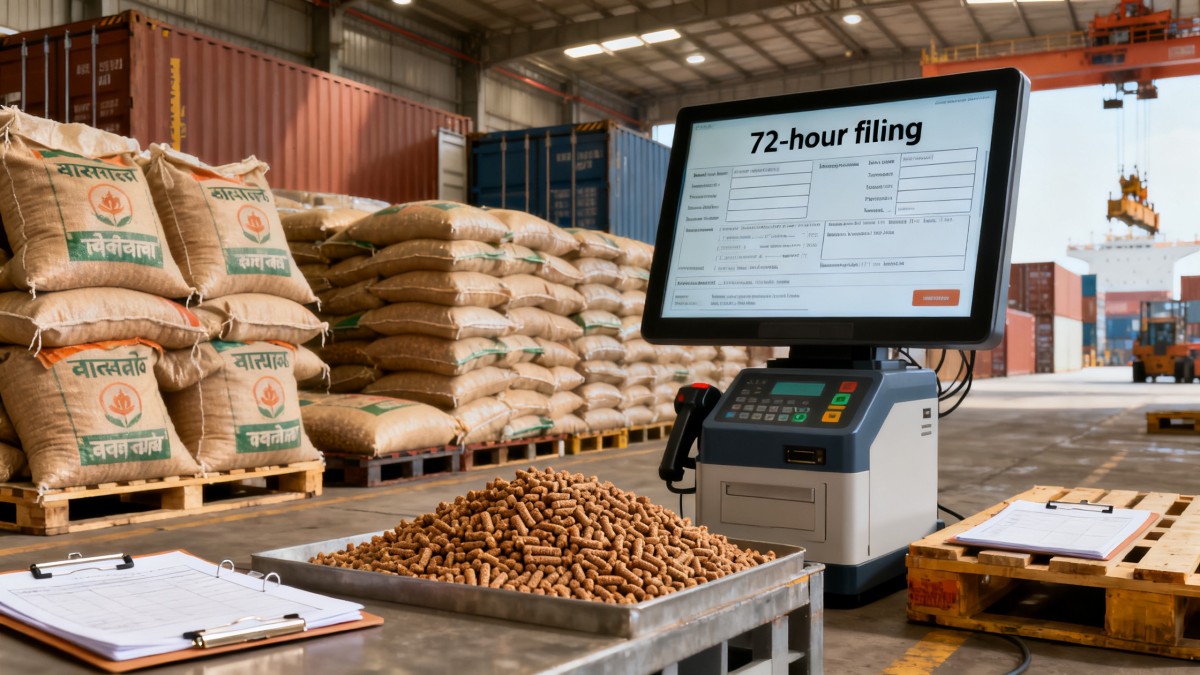
In place of that paper-based step, the ministry will require end-to-end electronic filing. All importers must submit structured data through the AGRI-IMPORTS Portal no later than 72 hours before cargo arrival.
The required filing fields include the INCI name, crude protein and lysine content, and the applicable animal species. The new requirement will be fully implemented from 00:00 on July 15.
Where the operational impact is likely to appear
Import compliance moves upstream in the shipment cycle
From an industry perspective, direct trading companies are likely to feel the first impact because the key compliance action now shifts to the period before cargo arrival. The practical effect is less about packaging execution and more about whether product data can be prepared, verified, and submitted within the 72-hour window.
What deserves closer attention is the timing risk: if filing readiness lags behind vessel or cargo schedules, the issue may emerge before physical receipt rather than at the labeling stage.
Suppliers and procurement teams will need cleaner product data
For procurement organizations and upstream suppliers, the change may affect how product specifications are exchanged and confirmed. Because the filing requires structured information such as INCI name, crude protein, lysine content, and applicable animal species, the quality and consistency of technical product data become more important in transaction preparation.
Analysis shows that even though the paper label requirement has been removed, the data obligation has become more explicit. Any mismatch between commercial documents and submitted product details could become an operational concern.
Logistics and service providers may face tighter coordination demands
Supply chain service providers, including those involved in shipment planning and import documentation support, may also be affected. Their role is likely to become more sensitive to timing, because the compliance checkpoint is now linked to cargo arrival deadlines rather than a post-arrival labeling step.
Observably, this raises the importance of coordination between importer, supplier, and logistics teams, especially where cargo timelines are short or documentation is finalized late.
What companies should watch now
Read the compliance shift correctly
Companies should not interpret the waiver of localized paper labeling as a reduction in compliance expectations overall. Based on the provided notice summary, the regulatory focus has moved from physical label execution to digital pre-arrival disclosure. That distinction matters for planning internal responsibilities and timelines.
Check whether product master data is filing-ready
Importers and their suppliers should review whether the required fields can be consistently provided in a structured form before shipment arrival. In this case, the practical attention point is not general documentation volume, but whether INCI naming, nutrient content entries, and animal-use classification can be supplied in a form suitable for portal submission.
Prepare around the 72-hour deadline
The 72-hour advance filing rule makes timing a central execution issue. Businesses involved in procurement, shipping, and import clearance should pay attention to whether internal approval flows and supplier communications can support submission before cargo reaches India. This is especially relevant where product data is usually confirmed late in the shipping cycle.
Keep watching for clarifications in official wording and practice
Analysis shows that the headline change is clear, but practical implementation often depends on how filing fields, validation rules, and enforcement expectations are applied in use. Companies should therefore distinguish between the announced rule and the way it is handled in day-to-day import operations after July 15.
Why this looks like a procedural shift, not a relaxed standard
From an industry perspective, this update is more appropriately understood as a change in compliance method than as a rollback of regulatory oversight. The ministry has removed a physical labeling transition requirement, but at the same time it has set a firm digital reporting obligation with a defined deadline and specified data fields.
Observably, that makes this both a short-term operational change and a longer-term signal. In the short term, companies need to adapt workflows before the July 15 enforcement point. As a longer-term signal, the move suggests greater reliance on structured electronic declarations in import administration for this product category. That said, the available information does not confirm how broadly this approach may extend beyond the stated requirement, so further observation remains necessary.
How this update is best understood at this stage
At this stage, the most balanced reading is that India has eased one visible compliance step for Commercial Feed Pellet imports while tightening expectations around digital submission discipline. The immediate significance lies in execution: importers must be ready to file complete product data through the AGRI-IMPORTS Portal at least 72 hours before arrival, with full implementation from July 15.
It is more appropriate to understand this as a targeted procedural change with real operational consequences, rather than as a broad shift in market conditions. The industry value of the update lies in how it changes preparation, coordination, and timing across the import chain.
Basis of this article
This article is based on the user-provided news title, event date, and event summary regarding MoAFW’s June 27, 2026 revision for Commercial Feed Pellet imports in India.
For developments of this kind, relevant source types typically include official government notices, company compliance communications, industry association updates, authoritative media coverage, and standards or regulatory documents. A specific official source link was not provided in the input, so the exact document text and any later clarification should continue to be verified.
Further follow-up should focus on whether additional official wording, portal-level filing instructions, or implementation clarifications emerge after the July 15 effective date.
Related Intelligence
- Commercial Feed PelletFeed Production System Price Trends: Cost Drivers and Budgeting for New LinesFeed production systems price trend insights: compare cost drivers, automation, utilities, compliance, and total ownership costs to budget smarter for new feed lines.
- Commercial Feed PelletHow to Troubleshoot Common Feed Machinery BreakdownsHow to troubleshoot common feed machinery breakdowns with practical checks for blockages, pellet mills, mixers, motors, and preventive maintenance.
- Commercial Feed PelletHow Can Feed Pellet Quality Be Kept Consistent Across Batches?Learn how to ensure feed pellet quality consistency across batches with proven controls for ingredients, conditioning, milling, cooling, testing, and traceable process data.
The Morning Broadsheet
Daily chemical briefings, market shifts, and peer-reviewed summaries delivered to your terminal.
