

The Authority in Global Agricultural Chemistry & Bio-Resources
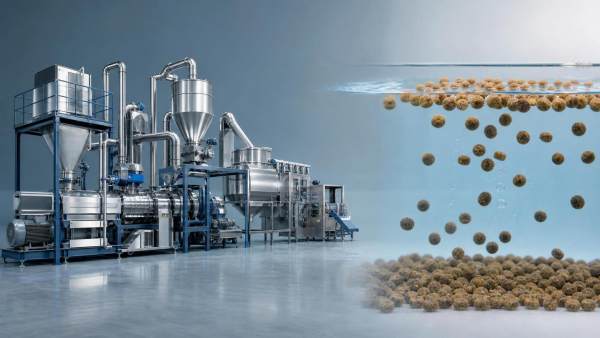
Aquafeed Pellet Processing: Key Steps, Pellet Quality Factors, and Line Selection
Aquafeed Pellet Processing: Key Steps, Pellet Quality Factors, and Line Selection
In aquaculture, pellet quality is rarely a single-machine issue. It is the cumulative result of formulation logic, process control, equipment fit, and how well the line matches the species being fed. A feed mill can have a strong extruder or a well-built pellet mill and still struggle with float rate, fines, oil leakage, or inconsistent water stability if upstream and downstream steps are not aligned.
That is why aquafeed pellet processing deserves to be evaluated as a system rather than a sequence of isolated machines. For technical reviewers comparing line options, the real question is not only whether a line can produce pellets, but whether it can do so repeatedly across changing formulations, raw material variability, and tightening quality expectations. This is especially relevant in the kind of regulated, multi-source supply chains regularly examined by AgriChem Chronicle, where equipment, ingredients, and compliance documentation increasingly intersect.
The practical concerns are familiar: Can the process preserve heat-sensitive nutrients? Will shrimp feed hold in water without excessive nutrient leaching? Can a fish feed line switch between sinking and floating products without creating long downtime or unstable output? Those answers sit inside the process details.
The process flow is straightforward on paper, less forgiving in practice
A typical line includes raw material receiving, grinding, batching, mixing, conditioning, pelletizing or extrusion, drying, cooling, screening, coating, and packing. Most plants know this sequence. What tends to separate a robust operation from a problematic one is not the existence of these steps, but how tightly they are connected.
Grinding is a good example. Fine particle size usually helps improve starch gelatinization, pellet binding, and surface finish, but over-grinding raises energy use, dust load, and in some formulas can create handling issues before the material even reaches the conditioner. For carnivorous fish diets with high protein and oil, the target grind often needs to support both digestibility and forming behavior. Shrimp feed usually asks for tighter particle control because water stability is less tolerant of coarse, poorly integrated solids.
Mixing follows the same logic. Uniformity matters, but so does ingredient sequence. Micro-ingredients, binders, and heat-sensitive additives are not all treated the same way. In many projects, the real performance gap appears when formulas with different fat levels or marine and plant protein combinations move through the same mixer residence time and liquid addition strategy. A line that looks acceptable with a standard fish diet may become inconsistent once the formulation portfolio expands.
Conditioning is where many later quality problems are either prevented or locked in. Steam quality, moisture addition, residence time, and temperature consistency affect not just throughput, but pellet density, expansion, durability, and nutrient exposure. Poor conditioning often gets blamed on the pellet mill or extruder, when the upstream thermal and moisture profile was already unstable.
Pellet mill or extruder: the choice should follow product behavior, not habit
Not every aquafeed line needs extrusion, and not every technical brief should default to ring-die pelletizing. The product mix decides.
Pellet mills are commonly chosen where sinking feed is the main requirement and the formulation can be compacted efficiently through a die. They are often simpler in mechanical structure and may suit operations where density control is less demanding than in floating feed. But they are less flexible when the target is a broad range of buoyancy behaviors or highly expanded structures.
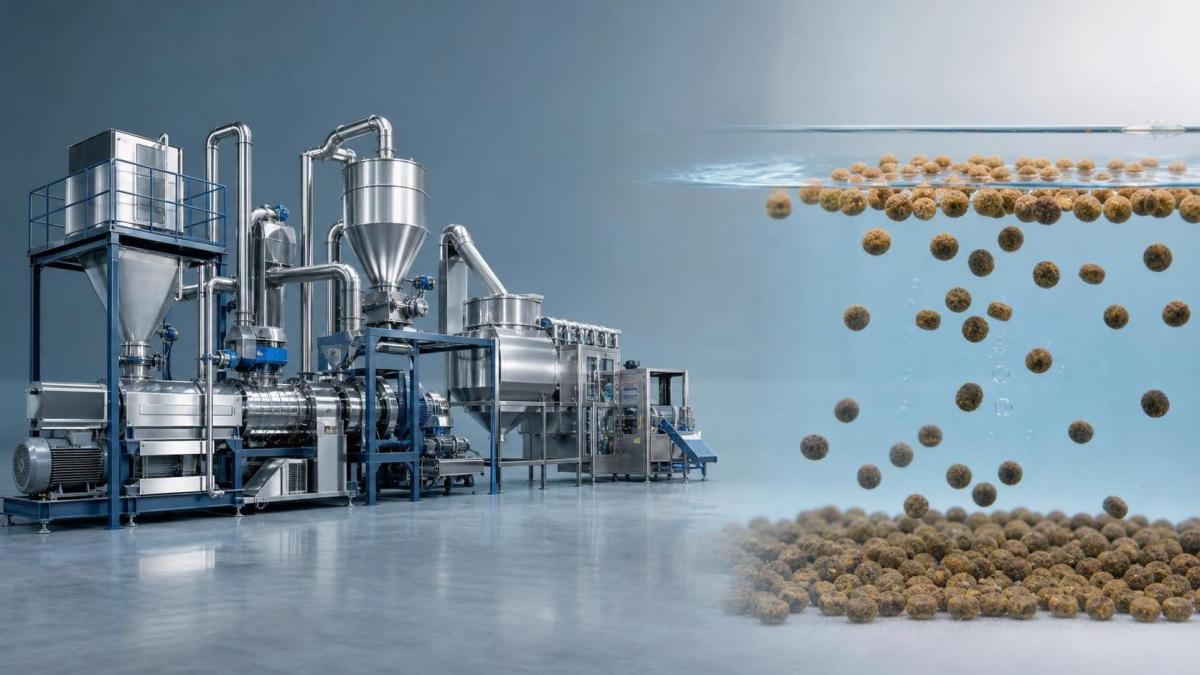
Extruders, particularly in fish feed applications, offer more control over expansion, density, and floating characteristics. They are usually the preferred option for floating and slow-sinking diets, and they can handle wider formulation variation when configured properly. That said, extrusion is not automatically the “better” answer. It is more sensitive to raw material changes, moisture control, screw setup, and operator discipline. If a plant lacks stable process monitoring, an extruder can produce excellent pellets one day and difficult-to-diagnose inconsistency the next.
For technical evaluation, it helps to ask a blunt question early: is the line being selected for the current formula set, or for the likely formula set two to five years from now? If product development may move toward functional feeds, higher oil inclusion, smaller pellet sizes, or species diversification, that future flexibility should be priced into the equipment decision.
What actually defines pellet quality
People often reduce pellet quality to appearance, but technical performance is broader. A clean-looking pellet that breaks during conveying or loses nutrients rapidly in water is not a quality pellet.
The core factors usually include:
- Physical durability during transport and handling
- Water stability appropriate to the target species and feeding behavior
- Consistent size, density, and sink or float performance
- Nutrient retention after thermal processing and post-coating
- Low fines generation at discharge, transfer, and bagging
- Acceptable palatability and intake response in the pond or cage
These outcomes depend on both formula and process. Starch type and level influence binding and expansion. Protein source affects texturization. Oil content changes friction, die behavior, and the room available for post-coating. Moisture profile during forming affects density and structural integrity. Cooling that is too aggressive can create surface cracking; drying that is uneven can leave a moisture gradient inside the pellet, which often shows up later as breakage or mold risk.
For shrimp feed, water stability and low nutrient leaching are usually examined more closely than float behavior. For many fish feeds, buoyancy and digestibility become more central. That sounds obvious, but it matters when reviewing vendor claims. A line optimized for floating tilapia feed may not be the right benchmark for a shrimp feed line, even if the nominal throughput looks attractive.
Drying, cooling, and coating are where expensive nutrients can be lost
Once pellets leave the die or extruder, many teams mentally classify the rest as finishing. That is a mistake. Post-forming steps often determine whether the feed remains commercially usable by the time it reaches the farm.
Drying needs to bring moisture down to a storage-safe range that fits the formulation and local storage conditions, but without case hardening or excessive thermal damage. The exact target depends on product type, packaging, logistics duration, and climate exposure, so it usually needs confirmation against plant practice and market destination. Inconsistent drying also complicates coating because oil pickup and vacuum performance respond differently across unevenly dried pellets.
Cooling is not just about temperature reduction. It stabilizes pellet structure. If the pellet exits with internal stress and is cooled too abruptly or unevenly, fines generation tends to increase later in conveying. This is one of those issues that gets missed during short factory acceptance tests because the damage often becomes visible only after multiple handling points.
Coating deserves close scrutiny, especially for high-value aquafeeds carrying oils, attractants, vitamins, pigments, enzymes, or other functional additions. The question is not simply whether a coating system exists, but whether it can apply liquids uniformly, repeatably, and at the required loading without surface overload. Vacuum coating is often considered where higher liquid inclusion and deeper penetration are needed, but its value depends on pellet porosity, upstream moisture control, and batch consistency.
How to assess a production line without getting distracted by headline capacity
Nameplate throughput is one of the least reliable standalone indicators in aquafeed line selection. A supplier may state output under a favorable formula, pellet diameter, and moisture condition that does not match your intended operation. Technical evaluators usually get better insight by comparing five less glamorous variables:
There is also a compliance dimension. In export-oriented or institutionally financed operations, documentation of materials, hygienic design, emissions handling, and process records may matter almost as much as output. This is one reason engineering reviews in the ACC readership increasingly look beyond machine lists and into documentation maturity, utility assumptions, and supply-chain transparency.
Common mistakes that show up late
A few recurring errors tend to surface after commissioning rather than during procurement.
One is oversizing the line for projected demand while underestimating low-load instability. Another is selecting equipment based on a generic freshwater fish feed assumption when the actual business case includes shrimp feed, marine species, or specialty diets. A third is treating post-coating as an optional add-on instead of part of the nutritional delivery system.
Then there is the operator factor. Highly automated systems still depend on process understanding. If the line requires frequent manual correction because moisture, steam, or die conditions drift, the issue may be design fit rather than staff skill. During evaluation, it is worth asking how much of stable performance depends on an exceptional operator versus a forgiving process window.
A better way to select the line
The best line is usually not the one with the highest theoretical output or the most elaborate configuration. It is the one that matches the intended species, feed portfolio, ingredient reality, utility availability, and quality control discipline of the plant.
In practice, line selection works better when the review starts with a narrow set of technical questions: What pellet behaviors are non-negotiable? Which nutrients must be protected through the process? How variable are the incoming raw materials? What documentation is required for internal QA, lenders, regulators, or export buyers? Once those answers are clear, the equipment discussion becomes much less noisy.
Aquafeed pellet processing is not difficult to sketch, but it is easy to oversimplify. And oversimplification is expensive. A line that can consistently convert a real formulation into stable, nutritionally intact pellets under day-to-day plant conditions is usually a better investment than one that performs beautifully only in a narrow test scenario. That is the distinction technical evaluators should keep in view when comparing proposals.
Related Intelligence
- Commercial Feed PelletFeed Production System Price Trends: Cost Drivers and Budgeting for New LinesFeed production systems price trend insights: compare cost drivers, automation, utilities, compliance, and total ownership costs to budget smarter for new feed lines.
- Commercial Feed PelletHow to Troubleshoot Common Feed Machinery BreakdownsHow to troubleshoot common feed machinery breakdowns with practical checks for blockages, pellet mills, mixers, motors, and preventive maintenance.
- Commercial Feed PelletHow Can Feed Pellet Quality Be Kept Consistent Across Batches?Learn how to ensure feed pellet quality consistency across batches with proven controls for ingredients, conditioning, milling, cooling, testing, and traceable process data.
The Morning Broadsheet
Daily chemical briefings, market shifts, and peer-reviewed summaries delivered to your terminal.
