

The Authority in Global Agricultural Chemistry & Bio-Resources
Choosing Feed Pellet Systems for Fish Farms: Capacity and Pellet Requirements
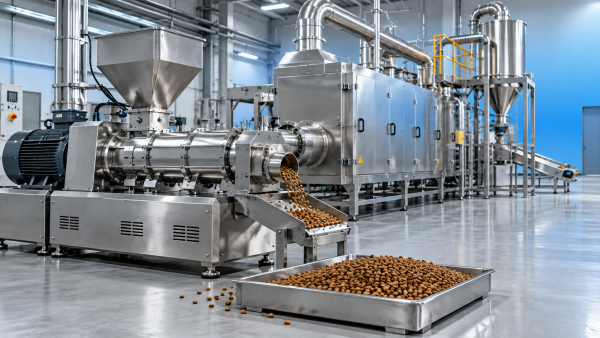
Choose feed pellet systems for fish farms by starting with the required pellet properties, then sizing the entire line around the farm’s peak production schedule—not the extruder’s advertised maximum alone. A suitable system must produce the required size, density and durability at a saleable output that the dryer, cooler and downstream handling equipment can sustain.
A line sized only against annual feed consumption may struggle when seasonal demand concentrates production into a few months. Equally, a machine that meets a tonnage target can still be unsuitable if it cannot make small starter pellets, maintain the required floating behavior or accommodate a high-fat formulation. The practical decision is therefore a combined product and capacity assessment.
Turn feeding demand into a production rate
Begin with expected finished-feed demand by species, life stage and month. Separate routine consumption from seasonal peaks, and account for purchased feed or inventory that can cover periods when the line is not running. The production target should describe saleable finished pellets, not the weight of wet material leaving the extruder.
Divide the quantity required during the limiting period by the realistic production hours available in that period. For example, a requirement of 120 tonnes of finished feed over a month with 160 planned running hours gives an average target of 0.75 tonnes per hour. That is a planning calculation, not an equipment rating: cleaning, formulation changes, maintenance and unplanned interruptions reduce the hours actually available for saleable production.
Use an availability assumption supported by the proposed operating schedule and the complexity of the product range. Then recalculate the required rate using effective production hours. If the line must produce several pellet sizes in short campaigns, changeovers may matter more than they would on a single-product line. Conversely, a farm with adequate storage may be able to run longer campaigns and build inventory before peak feeding periods.
Also distinguish between average demand and the rate needed to recover from downtime. A system with no practical spare capacity may meet the plan only when every shift runs as scheduled. Excessive oversizing has its own cost: larger equipment may operate inefficiently at low throughput, and some machines have a limited stable operating range. Ask suppliers to state both minimum and maximum achievable rates for each representative product.
Write the pellet specification before comparing machines
Pellet diameter is a starting point, not a complete specification. Record the species and life stage, target diameter and length, expected feeding method, and whether the pellet must float, sink slowly or sink rapidly. Specify acceptable ranges for bulk density, moisture, fines and durability where these can be measured consistently. For starter feeds, include the proportion of undersized or oversized particles that can be accepted after screening.
Water stability should be defined against the actual feeding practice. Pellets may need to remain intact long enough for fish to consume them, but a requirement for maximum stability at any cost can lead to unnecessary processing constraints. State the test medium, duration and measurement method when comparing samples; a stability claim without a common test procedure is difficult to evaluate.
Formulation matters as much as die size. Protein sources, starch availability, fiber, oil content and ingredient particle size affect expansion, binding and process behavior. A pellet that floats with one recipe may sink with another at similar machine settings. Provide suppliers with representative formulations or agreed ingredient ranges, including any planned substitutions, rather than asking them to guarantee performance from diameter alone.
Include the nutritional constraints that processing must protect. Thermal exposure, moisture and residence time can affect sensitive ingredients, while drying and subsequent oil application influence the finished pellet. The equipment supplier and nutrition team should agree on process limits and verification methods for the specific formulation; machine output alone cannot establish nutritional adequacy.
Extrusion or pelleting: match the process to the feed
Extrusion is often considered when controlled expansion and floating or slow-sinking products are required. Conditioning, moisture addition, mechanical energy and die configuration influence density and texture. An extruder can offer flexibility, but the achievable range depends on the recipe and operating conditions; it should not be assumed that every formulation can be made into every density at the same throughput.
Conventional pelleting may be appropriate for formulations and feeding applications where a denser, generally sinking pellet is acceptable. A pellet mill compresses conditioned mash through a die, producing a different structure from an expanded extrudate. Its suitability depends on pellet integrity, water stability and the required size range, not simply on a lower initial equipment cost.
For a farm producing both starter and grow-out feed, ask whether one line can cover the full range without unacceptable compromises. Very small products may require different dies, grinding, cutting or screening arrangements. Where one machine cannot reliably cover the range, compare the cost and operating implications of separate equipment, subcontracting a portion of the feed, or limiting on-site production to the products the line handles well.
Find the bottleneck across the complete line
Rated capacity must be traced through grinding, batching, mixing, conditioning, forming, drying or cooling, coating, screening and packing. Each stage should be evaluated on a comparable basis: wet throughput and finished dry-product throughput are not interchangeable. A dryer rated for one incoming moisture level or pellet size may deliver less saleable output under another set of conditions.
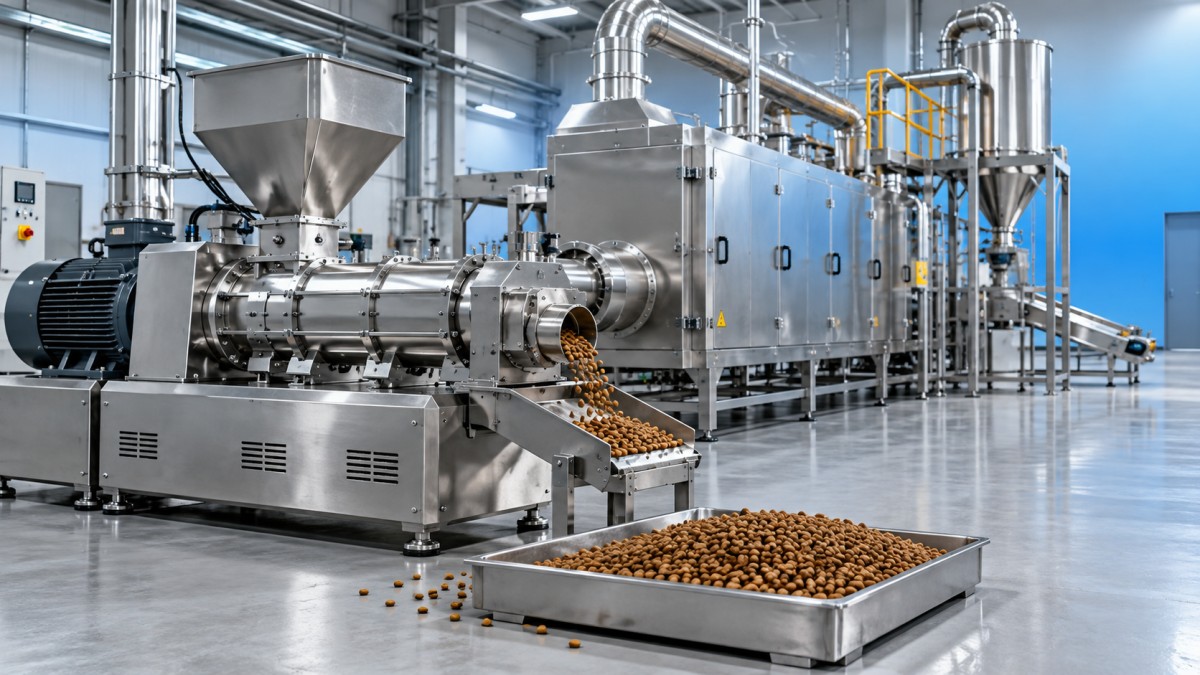
For an extrusion line, request a mass balance showing feed input, added water or steam, moisture removal, coating additions and expected screening returns or losses. The dryer must remove enough moisture to reach the agreed finished specification at the proposed production rate. Its capacity should be assessed for the most demanding combination of incoming moisture, pellet geometry, ambient conditions and final moisture target—not just the largest pellet in a supplier’s standard brochure.
Cooling is similarly consequential. Warm pellets packed before sufficient cooling can create condensation in storage. Excessive drying or rough conveyance can increase breakage, while inadequate drying can undermine storage stability. Agree on the measurement point for final moisture and product temperature, because a sample taken immediately after drying may differ from one taken after cooling and equilibration.
Check whether the mixer batch size, cycle time and intermediate bin capacity can support the forming machine continuously. Shortfalls may appear as repeated stoppages rather than a low nominal machine rating. Conveyors, elevators, screens and bagging equipment also need to handle the planned rate without damaging pellets or creating excessive fines. Where oil is added after forming, verify coating capacity and absorption for the intended pellet structure and oil addition rate.
Compare supplier claims on the same operating basis
A useful quotation identifies the recipe, pellet size, finished moisture and density behind each throughput claim. Ask whether the stated figure is continuous output, a short test rate, wet extrudate or finished saleable feed. The comparison should include the assumptions for raw-material preparation, operating hours, utilities and permitted rejects.
Provide each supplier with the same product matrix and request a response for at least the products that constrain the decision: the smallest pellet, the highest-volume product and the most demanding floating or sinking specification. Where the formulation is not yet final, define a representative range and identify which performance claims remain conditional.
- Capacity: achievable saleable output and stable turndown for each selected product, including changeover assumptions.
- Product quality: agreed methods and acceptance limits for size distribution, density or floatability, moisture, durability and fines.
- Inputs and utilities: ingredient particle-size requirements and expected electricity, water, steam or other utility demand at the stated operating point.
- Operating access: cleaning procedures, wear-part replacement, die changes, spare-parts availability and the skills needed to run the line.
- Interfaces: responsibility for controls, dust management, conveying and performance where equipment comes from more than one supplier.
Do not compare a complete installed line with a forming machine alone. Separate equipment scope from civil works, utility connections, commissioning, operator training and consumable wear parts. A quote can be technically competitive yet leave material integration costs or responsibilities undefined.
Use trials and acceptance criteria to resolve uncertainty
When pellet behavior or throughput is uncertain, a production trial using representative ingredients is more informative than a generic demonstration. Agree in advance on the formulation, raw-material particle size, test duration, operating settings and sampling points. A brief run can demonstrate that pellets can be formed, but it may not establish stable output, dryer performance or consistency over a production shift.
Measure output as finished product that meets the agreed specification. Record material diverted during startup, screening losses and any rework separately. Test floating behavior or sinking rate under the agreed conditions, and examine pellet integrity after conveying as well as immediately after production. If trial equipment differs from the proposed line, document the differences and avoid treating the trial rate as an automatic guarantee of full-scale performance.
Finally, put the acceptance basis into the purchase documentation: product recipes or ranges, feed rates, utility conditions, test methods, run duration and responsibility for supplying ingredients. Where seasonal feed requirements or formulations may change, identify which future products are outside the demonstrated operating envelope. That boundary is more useful than a broad capacity figure that cannot be tied to a defined pellet.
Related Intelligence
- Commercial Feed PelletChoosing Feed Pellet Systems for Fish Farms: Capacity and Pellet RequirementsCompare feed pellet systems for fish farms by capacity, pellet quality and processing needs. Discover how to choose a reliable, efficient production line.
- Commercial Feed PelletLivestock Feed Formulation: Selecting Ingredients by Nutrient Value and DigestibilitySelect livestock feed formulation ingredients by nutrient value, digestibility, and cost. Discover how to compare options, manage variability, and build balanced, cost-effective diets.
- Commercial Feed PelletU.S. Brews to Barns Act Proposes Tax Credit to Strengthen Spent Grain Feed Supply ChainsBrews to Barns Act proposes a tax credit for spent grain donations. Explore how it could help brewers reduce handling costs and farmers strengthen local feed supply chains.
The Morning Broadsheet
Daily chemical briefings, market shifts, and peer-reviewed summaries delivered to your terminal.