

The Authority in Global Agricultural Chemistry & Bio-Resources
Livestock Feed Formulation: Selecting Ingredients by Nutrient Value and Digestibility

Select livestock feed formulation ingredients by their contribution to the animal’s nutrient requirements, using a consistent moisture basis and a species-appropriate digestibility system. Crude protein and purchase price provide an initial screen, but neither establishes feeding value. A lower-priced protein meal loses its advantage when poor amino acid availability requires additional supplementation, while a high-energy ingredient becomes less attractive if its fiber, fat quality, or inclusion limit constrains the complete diet.
The comparison should begin with the intended species, production stage, feed intake, and processing conditions. From there, ingredient selection becomes a question of usable nutrient supply, acceptable inclusion, and confidence in the analytical data. An attractive average composition is insufficient when individual deliveries repeatedly fall outside the formulation assumptions.
Establish a common basis before comparing ingredients
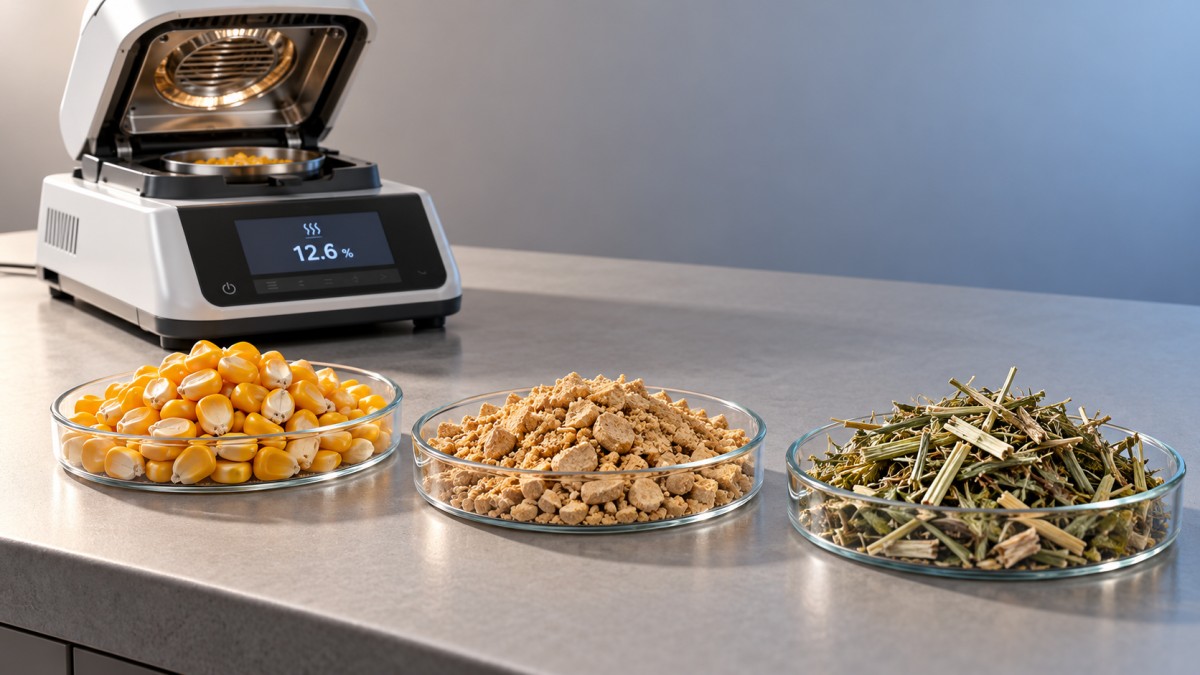
Moisture differences can distort both nutrient and price comparisons. Laboratory results reported on a dry matter basis cannot be entered directly into a formulation built on as-fed values. The same applies to quotations: the purchase price includes water, whereas most nutritional value resides in the dry matter.
As-fed nutrient concentration = dry matter nutrient concentration × dry matter fraction. Conversely, dividing the delivered price by the dry matter fraction expresses cost per unit of dry matter. These conversions clarify comparisons, but they do not account for digestibility, processing losses, or limits on inclusion.
Analytical definitions also matter. Crude fiber, neutral detergent fiber, and acid detergent fiber describe different fractions and are not interchangeable. Total phosphorus cannot substitute for a phosphorus value expressed in the availability system used by the formulation. Likewise, an energy estimate needs an identified species, calculation method, and reporting basis.
Record whether each nutrient value comes from a batch analysis, a supplier average, a prediction equation, or a reference feed table. Mixing these sources without identifying their limitations creates apparent precision while hiding uneven confidence across the ingredient matrix.
Protein value changes with the animal and the processing history
Pigs and poultry: compare digestible amino acids
Crude protein estimates nitrogen-containing material; it does not describe the balance or availability of individual amino acids. Two meals with similar crude protein can supply different amounts of usable lysine, methionine, threonine, or tryptophan. Their value changes with the amino acid that limits the complete diet.
For pigs, standardized ileal digestible amino acid values provide a practical formulation basis. Poultry formulations also use digestible amino acid systems, with the chosen coefficients matched to the applicable species and methodology. Values from different digestibility systems should not be combined without reconciliation. Fecal protein digestibility does not resolve amino acid availability because microbial activity in the hindgut changes the nitrogen recovered in feces.
Processing history helps explain discrepancies between protein concentration and feeding performance. Excessive heating can reduce reactive lysine through Maillard reactions. Total lysine analysis alone does not fully reveal this loss. Conversely, inadequate heat treatment of soybean products leaves residual trypsin inhibitor activity. Urease activity is useful as an indicator of insufficient processing, but a low urease result does not establish that heat damage is absent.
Ruminants: account for rumen degradation and intestinal supply
Ruminant protein evaluation requires a different interpretation. Rumen-degradable protein supports microbial growth when fermentable energy is available at the same time. Rumen-undegradable protein contributes to intestinal protein supply only to the extent that it is digestible after leaving the rumen.
A heat-treated meal with greater rumen escape therefore does not automatically provide more metabolizable protein. Severe heating can increase the fraction escaping rumen degradation while reducing its intestinal digestibility. Ingredient comparisons need to consider both effects within the selected ration model. Nonprotein nitrogen also contributes to crude protein equivalents but does not supply preformed amino acids; its usefulness depends on rumen conditions and the rest of the diet.
Energy and fiber need to be interpreted together
Gross energy measures combustion energy, including portions the animal cannot use. Digestible, metabolizable, and net energy describe progressively different accounting boundaries. Compare ingredients within the energy system used for the complete ration. A metabolizable energy figure for poultry is not a transferable energy value for pigs or cattle.
In pig diets, net energy evaluation accounts for differences in the efficiency with which absorbed nutrients support maintenance and production. This matters when replacing starch-rich grain with protein-rich or fibrous coproducts. A substitution that appears equivalent under one energy measure can change the usable energy supply under another.
Fiber concentration alone also leaves important questions unanswered. In ruminant diets, neutral detergent fiber digestibility affects energy supply and rumen fill, while particle size influences chewing and rumen function. Finely ground fibrous coproducts do not provide the same physical effect as long forage merely because their neutral detergent fiber concentrations are similar.
For pigs and poultry, soluble and insoluble fiber have different consequences. Certain soluble non-starch polysaccharides increase digesta viscosity, restricting nutrient utilization. Fermentable fiber contributes differently according to species and age; young animals generally have less capacity to exploit fibrous materials than mature animals. Enzyme responses depend on the substrate present, enzyme activity, and processing conditions, so an assumed energy credit requires evidence relevant to the actual diet.
Compare ingredient classes against the constraint they introduce
Ingredient categories provide useful starting points, but substitution decisions belong at the level of the complete formula. The following comparisons identify the information most likely to change an inclusion decision.
Coproduct names deserve particular scrutiny. A shared commercial name does not guarantee a shared process. Changes in oil extraction, separation, or drying alter nutrient composition and digestibility. A reference matrix should therefore correspond to the actual material supplied, rather than to the broadest ingredient description.
Separate nutritional limitations from safety exclusions
An antinutritional factor can reduce usable nutrient supply even when routine composition appears acceptable. Phytate binds phosphorus and interacts with other nutrients. Glucosinolates in rapeseed-derived materials and gossypol in cottonseed products create source- and animal-specific constraints. Their significance depends on concentration, inclusion level, processing, and animal susceptibility.
Phytase changes the interpretation of phytate-bound phosphorus, but its nutrient contribution must be credited consistently. Assigning a phytase phosphorus release value while also using an ingredient phosphorus value that already includes that release double-counts the benefit. Calcium supply, dietary phytate, enzyme dose, and survival through feed processing also influence the response.
Contaminants require a separate acceptance decision. A satisfactory protein or energy result cannot compensate for an unacceptable mycotoxin, pesticide residue, or other relevant contaminant result. Mycotoxins are often unevenly distributed within a lot, making representative sampling essential. A clean result from an unrepresentative grab sample provides weak evidence about the shipment.
Blending a suspect ingredient to achieve a lower average concentration is not a default corrective action. Acceptance must follow applicable feed rules, species sensitivity, and the established safety specification. Nutrient optimization begins only after the material is suitable for use.
Build the ingredient matrix around evidence and variability
A certificate of analysis is useful only when the sample represents the delivered lot and the methods measure the properties relevant to formulation. Incremental samples taken across the material stream provide a stronger basis than sampling one accessible surface. Sample preparation matters too: inadequate grinding or mixing creates differences between laboratory subsamples.
Near-infrared spectroscopy supports rapid screening when its calibration covers the ingredient type, composition range, and sample presentation. An unfamiliar coproduct or a substantial process change can fall outside that calibration. Reference laboratory methods are then needed to establish whether the prediction remains reliable. Routine proximate analysis alone cannot directly establish every digestibility coefficient.
Batch variability should influence both the assigned matrix and the permitted inclusion. A highly variable ingredient used at a low inclusion may have little effect on the complete feed. The same variability becomes consequential when the ingredient supplies much of the diet’s limiting amino acid or energy. Applying a blanket nutrient discount to every ingredient obscures this distinction and can unnecessarily increase cost.
Use historical lot results to identify the nutrients that vary, then test their effect on the finished formula. Preserve correlations where evidence supports them: changes in hull content, for example, affect several compositional fractions together. Treating all nutrient values as independent can produce unrealistic scenarios.
Evaluate substitutions inside the complete diet
Cost per unit of digestible lysine or usable energy is a helpful screening measure, but ingredients supply several nutrients simultaneously. A meal with inexpensive digestible lysine can still increase total diet cost if it introduces excess fiber, insufficient energy, or a costly sulfur amino acid deficit.
A useful comparison holds animal requirements and feed specifications constant, introduces the candidate ingredient, and allows the formula to rebalance. The resulting change in total ration cost captures displaced ingredients, supplemental amino acids, mineral adjustments, and relevant enzyme credits. Maximum inclusion constraints should reflect biological and manufacturing limits, including palatability, pellet quality, bulk density, and handling behavior.
Then examine a credible adverse composition scenario. If modest changes in moisture, digestibility, or fiber erase the apparent saving, the economic case rests on tighter material specifications. A formula that repeatedly sits against a fiber ceiling or amino acid minimum also has little room for unaccounted variation.
Before routine adoption, confirm that the candidate behaves as expected during milling, mixing, conditioning, and feeding. Retain representative samples and compare finished-feed results with the formulation assumptions. If performance diverges, investigate nutrient delivery, intake, processing, and ingredient identity separately; increasing the nominal nutrient specification without identifying the cause can leave the original problem unresolved.
Related Intelligence
- Commercial Feed PelletLivestock Feed Formulation: Selecting Ingredients by Nutrient Value and DigestibilitySelect livestock feed formulation ingredients by nutrient value, digestibility, and cost. Discover how to compare options, manage variability, and build balanced, cost-effective diets.
- Commercial Feed PelletU.S. Brews to Barns Act Proposes Tax Credit to Strengthen Spent Grain Feed Supply ChainsBrews to Barns Act proposes a tax credit for spent grain donations. Explore how it could help brewers reduce handling costs and farmers strengthen local feed supply chains.
- Commercial Feed PelletHow Do You Accurately Compare Feed Machinery Output Capacity?Learn how to compare feed machinery output capacity accurately using matched specs, sustained tests, and energy data. Avoid costly sizing mistakes and choose the right system.
The Morning Broadsheet
Daily chemical briefings, market shifts, and peer-reviewed summaries delivered to your terminal.