

The Authority in Global Agricultural Chemistry & Bio-Resources
How Do You Accurately Compare Feed Machinery Output Capacity?
How Do You Accurately Compare Feed Machinery Output Capacity?
Two feed machines rated at the same tonnes per hour can deliver very different results under actual production conditions. One rating may describe mash entering a pellet press; another may refer to screened, cooled pellets ready for storage. Both figures can be technically correct without being commercially comparable.
Understanding how to compare feed machinery output capacity accurately means looking beyond nameplate ratings to formulation, moisture, particle size, pellet dimensions, and finished-feed quality. The practical task is to establish a common measurement basis, test sustained performance, and check whether the rest of the mill can support it.
For the feed-processing procurement decisions covered by AgriChem Chronicle, the useful question is not simply “Which machine produces more?” It is “Which system reliably delivers the required quantity of acceptable feed under our operating conditions?”
Define what counts as output before comparing quotations
Ask each supplier where its capacity is measured. A pellet mill discharge rate is not the same as finished-feed output after cooling, crumbling, screening, and fines removal. Similarly, an extruder’s wet discharge includes moisture that may subsequently leave in the dryer.
For a complete line, a useful commercial measure is net conforming finished feed per elapsed production hour. “Conforming” means the product meets the agreed specification; “elapsed” means the clock does not stop whenever a minor interruption occurs. If you also need the machine’s steady-state processing rate, record that separately.
Keep gross processed mass, internal recycle, and final accepted product distinct. Returned fines passing through the pellet mill twice must not become two tonnes of reported finished production. Record opening and closing work-in-process inventories so a test cannot appear stronger simply by emptying material already held in coolers or bins.
Also confirm the unit. Metric tonnes, short tons, and volumetric throughput are different measures. A conveyor specified in cubic metres per hour needs an agreed bulk density before its rating can be compared with mass throughput.
Give every supplier the same feed specification
There is no reliable universal correction factor that converts a catalogue rating into your mill’s output. Capacity depends on the material and the processing task. Two quotations should therefore reference the same recipe, input condition, and finished-product requirements.
A supplier trial on an easy-running formulation is not necessarily misleading, but it may be irrelevant to your production plan. Include a representative high-volume recipe and a demanding recipe that you genuinely expect to manufacture. Do not select an extreme formulation that will almost never run unless that capability is commercially necessary.
For mixers, examine the complete batch cycle: charging, mixing, liquid addition, discharge, and any waiting time. Dividing batch mass by mixing time alone overstates practical hourly capacity. Mixing uniformity must also be demonstrated at the proposed fill level and cycle time.
Separate moisture effects from real production gains
Moisture can make a throughput comparison look better without increasing the amount of feed solids processed. This matters especially when comparing conditioned mash, wet extrudate, and dried finished feed.
Dry-matter throughput = measured mass throughput × (1 − moisture fraction)
For illustration only, 10 tonnes per hour at 15% moisture contains 8.5 tonnes per hour of dry matter. At 12% moisture, the same measured mass contains 8.8 tonnes of dry matter. These are arithmetic examples, not equipment benchmarks.
Dry-matter normalization helps expose unequal measurement conditions, but it does not make two processes equivalent. Different moisture levels also affect processing behaviour, drying demand, storage suitability, and product quality. Compare finished output at the agreed moisture specification, and use dry matter as a supporting check rather than a substitute for a production trial.
Test sustained capacity, not the best few minutes
A short peak-rate demonstration tells you that a machine can reach a particular operating point. It says much less about whether operators can hold that point without plugging, excessive fines, unstable moisture, or repeated adjustment.
Agree on a stabilization period and a measurement window long enough to reveal normal operating constraints. The appropriate duration depends on the process and contract; a universal test length would be misleading. Record interruptions and their causes rather than quietly removing them from the calculation.
During the run, capture mass flow, motor load, energy use, relevant temperatures, moisture, quality samples, and operator interventions. Record the installed configuration too: a capacity claim tied to one die, screen, or screw arrangement may not apply after that configuration changes.
- Use calibrated weighing equipment and identify the measurement boundary.
- Take representative samples throughout the test, not just during the most stable interval.
- Document recipe batches, raw-material moisture, and equipment wear condition.
- Record scrap, returned fines, and material held inside the line.
- Distinguish machine-caused stops from external supply interruptions.
Product quality is a pass condition, not a footnote. Pellet durability comparisons require the same test method and sample preparation. Fines depend partly on where sampling occurs. Aquafeed may also need agreed density, floatability, or water-stability checks. A higher rate achieved by relaxing these requirements is a different operating duty.
Follow the material through the whole line
A larger pellet press cannot compensate for a feeder that starves it. Nor can a faster extruder overcome a dryer that cannot remove the required water load. Walk the proposed process from intake to dispatch and compare each stage on a compatible mass and moisture basis.
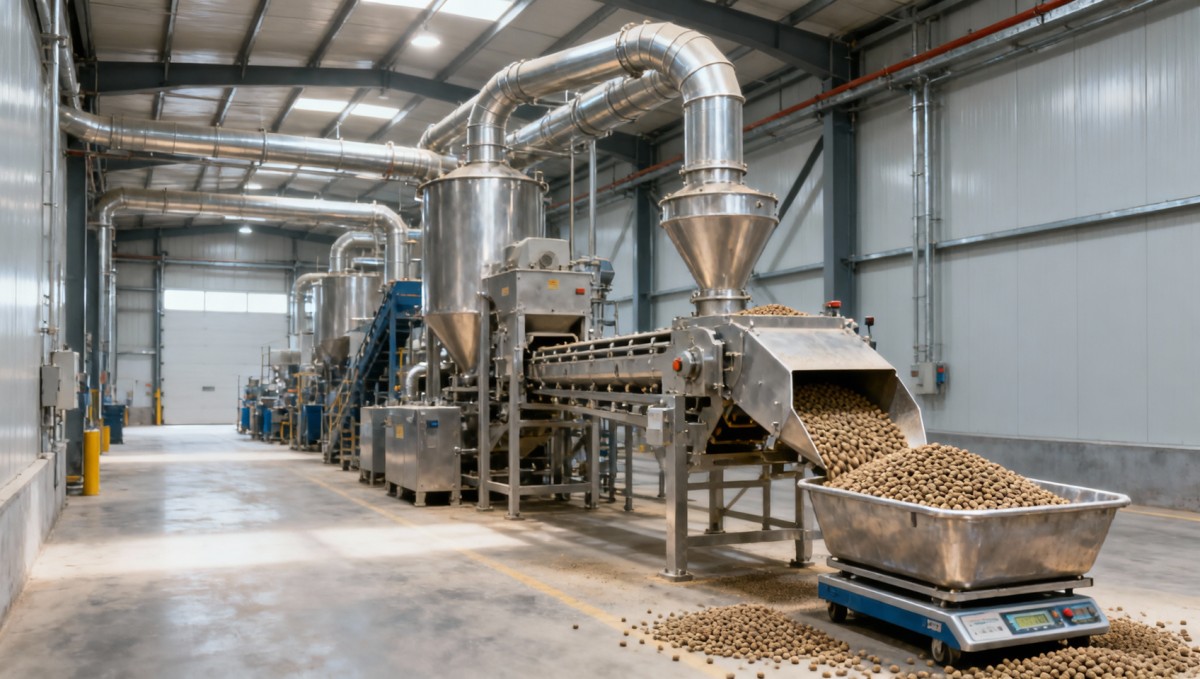
Look beyond the obvious processing machines. Elevators, transfer conveyors, dust extraction, liquid dosing, surge bins, and bagging can all restrict output. Buffer storage can absorb short mismatches; it cannot eliminate a persistent capacity deficit.
Dryer comparisons deserve particular care. Ask for both product throughput and water-evaporation duty at specified inlet and outlet conditions. For coolers, clarify inlet product temperature and the required discharge condition relative to ambient air. A rating without those conditions leaves too much room for interpretation.
The bottleneck can move when recipes change. Fine grinding may constrain one feed, while conditioning, drying, or screening constrains another. Build the line-capacity assessment around your actual product mix rather than assuming one weakest machine governs every product.
Compare energy at the same output boundary
Installed motor power is not energy consumption. A larger motor may operate below its rating, while a smaller machine may draw heavily and still deliver less acceptable product.
Specific electrical energy = measured electricity consumption in kWh ÷ accepted finished tonnes
Use the same equipment boundary for both offers. Comparing one press’s main-drive consumption with another supplier’s complete line consumption is meaningless. Identify whether feeders, conditioners, fans, conveyors, and screening equipment are included.
Report steam and dryer fuel separately, with their measurement basis stated. A machine may use less electricity while requiring more thermal input. Neither figure should disappear into a vague claim of “low energy consumption.”
For operating-cost comparisons, include consumable wear, cleaning, labour, and product loss where credible information exists. Treat supplier estimates as estimates until the assumptions and supporting records are available.
Turn the comparison into an acceptance agreement
Before placing an order, put the promised performance into a testable schedule: recipe, input properties, machine configuration, utilities, measurement location, minimum accepted throughput, quality limits, energy boundary, and test duration. Define how deviations, failed runs, and retests will be handled.
Factory testing can establish useful evidence, but site acceptance must address the installed line and available utilities. Where a full representative trial is impossible before purchase, identify the remaining uncertainty explicitly rather than converting a supplier’s projection into a verified guarantee.
Then check the production schedule. Multiply demonstrated rates by the available hours for each product, allowing for planned maintenance, cleaning, recipe changes, and other expected downtime. Keep this scheduling allowance separate from the measured test rate so losses are neither hidden nor counted twice.
The strongest offer is not necessarily the one with the highest headline tonnage. It is the one whose documented, sustained output meets your feed specifications and production schedule without depending on utilities, downstream capacity, or operating conditions your mill cannot provide.
Related Intelligence
- Commercial Feed PelletU.S. Brews to Barns Act Proposes Tax Credit to Strengthen Spent Grain Feed Supply ChainsBrews to Barns Act proposes a tax credit for spent grain donations. Explore how it could help brewers reduce handling costs and farmers strengthen local feed supply chains.
- Commercial Feed PelletHow Do You Accurately Compare Feed Machinery Output Capacity?Learn how to compare feed machinery output capacity accurately using matched specs, sustained tests, and energy data. Avoid costly sizing mistakes and choose the right system.
- Commercial Feed PelletFire Quickly Extinguished in Grinder Bin at Baiada’s Cardiff Feed Mill in AustraliaBaiada’s Cardiff feed mill fire was reportedly contained quickly. Explore grinder bin safety, restart uncertainties and key supply continuity checks for feed buyers.
The Morning Broadsheet
Daily chemical briefings, market shifts, and peer-reviewed summaries delivered to your terminal.
