

The Authority in Global Agricultural Chemistry & Bio-Resources
What to Evaluate in Energy Efficient Pellet Systems for Lower Operating Costs?
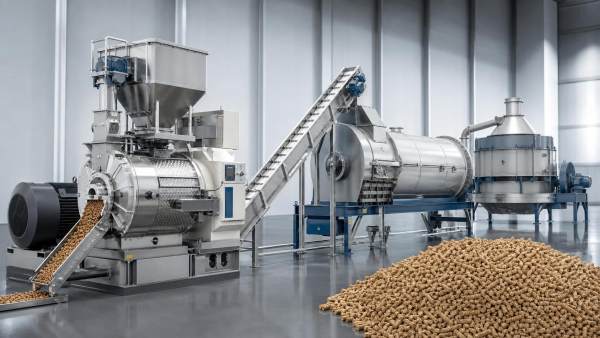
What to Evaluate in Energy Efficient Pellet Systems for Lower Operating Costs?
For procurement teams comparing pellet production lines, energy efficiency has moved well beyond a sustainability talking point. In biomass, feed, and related primary processing operations, it directly affects conversion cost per ton, maintenance budgets, spare-parts planning, and even contract risk when plants are expected to run at steady commercial volumes. A system that looks efficient on a brochure can still become expensive in practice if it struggles with raw material variation, requires frequent die changes, or forces the plant into unstable throughput.
That is why the real question is not whether a supplier claims to offer energy efficient pellet systems. It is what, exactly, makes the system efficient under your operating conditions, and whether that efficiency holds up across seasons, shift patterns, and feedstock changes.
Across the sectors covered by AgriChem Chronicle, especially feed and grain processing, forestry machinery, and industrial bio-based production, buyers are increasingly asking for a more disciplined view: not only motor power and nameplate capacity, but also energy consumption at stable output, moisture tolerance, conditioning quality, wear behavior, emissions controls, and the vendor’s ability to document performance assumptions. That shift is sensible. In regulated and cost-sensitive supply chains, procurement decisions are rarely undone by one headline specification; they are undone by hidden operating penalties.
Start with cost per ton, not installed kilowatts
A common mistake is comparing pellet systems mainly by connected load or the rated efficiency of major drives. Those figures matter, but they are incomplete. Lower operating cost is usually determined by total energy consumed per ton of acceptable pellets at the target moisture range and required durability. If one system uses slightly less power but produces more fines, requires more rework, or cannot hold output when raw material density changes, the apparent savings disappear.
Ask suppliers to clarify the test basis behind any energy claim. Was it measured on wood residues, agricultural biomass, aquatic feed ingredients, compound feed, or another material? What was the input particle size, moisture content, and conditioning temperature? Was the stated output net finished product, or gross line throughput before rejects and recirculation? Without those details, two “efficient” systems may not be comparable at all.
For procurement, the most useful framing is practical: what energy input is required to produce one ton of in-spec pellets, repeatedly, with the raw materials your plant actually buys?
Material adaptability often decides the real economics
Many pellet lines perform well only within a narrow band of feedstock conditions. That may be manageable in a tightly controlled process, but less so in industrial environments where incoming material can vary by season, supplier, storage condition, or pre-processing quality. Biomass streams can shift in fiber length, ash content, and moisture. Feed formulations can change with grain markets or protein sourcing. Each variation influences compression behavior, die load, and heat generation.
An energy efficient pellet system should therefore be evaluated for flexibility, not only peak performance. Can it maintain acceptable pellet quality across realistic raw material ranges without excessive operator intervention? Does it need very fine grinding to avoid power spikes? How sensitive is it to moisture drift? Does the conditioner, feeder, and press control logic respond smoothly, or does the line swing between overload and underfeeding?
These are not minor engineering details. If a line demands tightly preconditioned material to achieve its quoted efficiency, the plant may simply shift energy use upstream into drying, grinding, or screening. From a procurement standpoint, that is still operating cost.
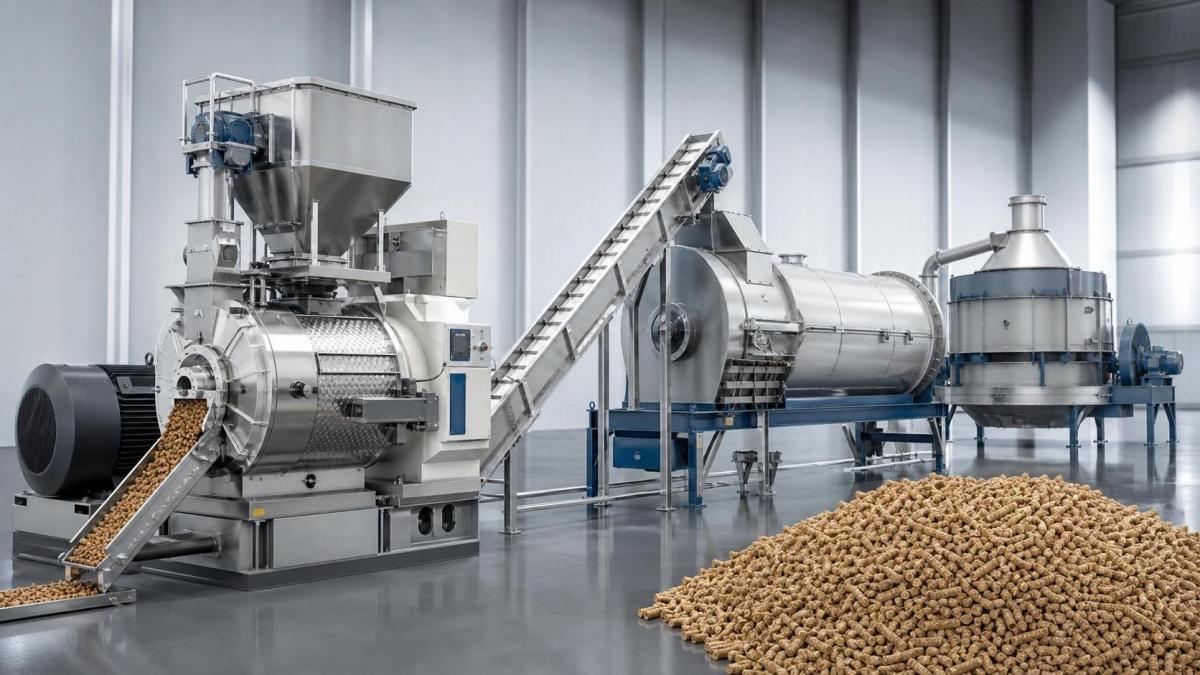
The press is only one part of the energy picture
Buyers sometimes focus too heavily on the pellet mill itself. In reality, line efficiency depends on system integration. Feeders, conditioners, hammer mills, dryers, coolers, conveyors, aspiration systems, and control architecture all influence the final energy bill. A well-designed press can still underperform if upstream material delivery is inconsistent or if downstream cooling creates bottlenecks that force stop-start operation.
This is especially important when comparing retrofits against complete new lines. In a retrofit, the pellet press may be efficient, but legacy auxiliaries can erase the benefit. Variable frequency drives, load balancing, automated lubrication, airflow optimization, and better process controls can reduce energy waste, yet only if the system is engineered as a line rather than sold as a stand-alone machine.
Ask for a process map showing where energy is consumed and where the supplier expects savings to come from. If that conversation stays limited to the main motor, the proposal may be too shallow for serious cost modeling.
Throughput stability matters more than short test-run performance
Procurement teams usually inherit the consequences of unstable production even if operations owns the equipment day to day. When throughput drops unpredictably, unit costs rise, labor utilization worsens, delivery schedules slip, and maintenance becomes reactive. In pellet plants, unstable running often shows up as roller slip, die choking, excessive vibration, or repeated manual adjustments to feed rate and steam addition.
A useful supplier discussion is not “What is maximum capacity?” but “At what sustained throughput can this line operate while keeping pellet quality, wear rate, and specific energy within an acceptable band?” Those are very different questions. A machine that reaches an attractive headline capacity during a controlled demonstration may be less economical than a slightly smaller unit that runs predictably for long campaigns.
If plant uptime is critical, procurement should also look at startup behavior and product changeover losses. In sectors with multiple recipes or varying biomass inputs, the cheapest system on paper can become expensive if every change introduces cleanout waste, process instability, or long rebalancing periods.
Wear parts, maintenance access, and service intervals are not secondary issues
Energy efficiency and maintenance are closely linked. As dies, rollers, screens, and bearings wear, power draw can rise while pellet quality falls. That means the operating cost of a pellet system is partly a maintenance-engineering question. Buyers should not evaluate energy claims without understanding wear-part life under their likely raw materials.
There is no honest universal lifespan for dies or rollers because material type, contamination, and operating discipline differ too much. Still, suppliers should be able to explain how die geometry, metallurgy, roller adjustment, lubrication, and cooling design affect service intervals. They should also explain what happens when wear begins: does the machine remain controllable, or does performance deteriorate quickly?
Maintenance access is another overlooked cost factor. If routine inspection, die change, or roller replacement requires long stoppages or specialized technicians, downtime cost can exceed the value of marginal energy savings. Spare-parts availability, local service coverage, and documented preventive maintenance routines deserve the same scrutiny as electrical efficiency.
Controls, instrumentation, and operator dependence
Some systems are genuinely efficient because the control strategy keeps the process in a narrow, optimized operating window. Others are efficient only when handled by an exceptionally skilled operator. Procurement teams should be wary of the second type, particularly for facilities with staffing turnover or multi-shift operation.
Useful questions include whether the line monitors load trends, temperature, feeder stability, steam or moisture input, and pellet quality indicators in real time. Can operators see why energy consumption is rising, or only that it has risen? Are alarms predictive or merely reactive? Can the supplier provide data access that supports plant-level cost tracking and continuous improvement?
In increasingly regulated and audit-conscious supply chains, better instrumentation also helps with traceability. ACC’s readership will recognize this from adjacent sectors such as APIs and aquaculture systems: the ability to document process conditions is not just useful for engineering. It also supports quality assurance, procurement validation, and supplier accountability.
Compliance, dust, noise, and environmental controls still affect cost
Lower power use does not automatically mean lower compliance burden. Pellet production can involve dust handling, explosion-risk considerations, emissions from dryers or combustion systems, and workplace noise exposure. Depending on market and plant type, these issues may influence permitting, insurance, installation scope, and operating procedures.
This is where procurement should ask a broader project question: what additional equipment or design measures are required for the proposed system to meet local environmental and safety expectations? A supplier may quote an efficient core machine, while the buyer later absorbs the cost of aspiration upgrades, guarding modifications, dust collection, or control changes needed for site approval.
No single regulatory checklist fits every geography. The right approach is to request clear boundary definitions: what is included, what assumptions were made, and which safety or environmental obligations remain with the owner or EPC contractor.
Use a procurement matrix that reflects operational reality
When buyers evaluate energy efficient pellet systems, a simple capital-cost comparison is usually too crude. A more reliable matrix includes at least these categories: specific energy under defined conditions, sustained throughput, raw material flexibility, pellet quality consistency, wear-part regime, maintenance downtime, automation level, utility requirements, compliance scope, and after-sales support.
A matrix like this does not eliminate uncertainty, but it makes supplier claims easier to compare and exposes where assumptions differ.
A cheaper system can still be the expensive choice
In pellet projects, the wrong buying decision is not always the one with the highest purchase price. It is often the system whose performance assumptions are least aligned with plant reality. If your material quality shifts, if labor is limited, if spare parts are slow to arrive, or if local compliance requirements are strict, those factors will shape operating cost more than a narrow capital saving.
The better procurement approach is disciplined and slightly skeptical. Request test conditions, utility assumptions, wear-part expectations, and operating boundaries in writing. Ask what happens outside the ideal range. Clarify which parts of line efficiency come from the pellet press and which depend on upstream and downstream equipment. And if a proposal cannot show how it performs in a real industrial environment, treat “energy efficient” as an incomplete claim rather than a decision-ready conclusion.
For organizations navigating complex industrial sourcing, that level of scrutiny is no longer excessive. It is the practical standard for buying equipment that must earn its economics over years, not during a sales presentation.
Related Intelligence
- Commercial Feed PelletFeed Production System Price Trends: Cost Drivers and Budgeting for New LinesFeed production systems price trend insights: compare cost drivers, automation, utilities, compliance, and total ownership costs to budget smarter for new feed lines.
- Commercial Feed PelletHow to Troubleshoot Common Feed Machinery BreakdownsHow to troubleshoot common feed machinery breakdowns with practical checks for blockages, pellet mills, mixers, motors, and preventive maintenance.
- Commercial Feed PelletHow Can Feed Pellet Quality Be Kept Consistent Across Batches?Learn how to ensure feed pellet quality consistency across batches with proven controls for ingredients, conditioning, milling, cooling, testing, and traceable process data.
The Morning Broadsheet
Daily chemical briefings, market shifts, and peer-reviewed summaries delivered to your terminal.
