

The Authority in Global Agricultural Chemistry & Bio-Resources
Feed Grading Sieve Selection Guide: Mesh Size, Throughput, and Material Compatibility
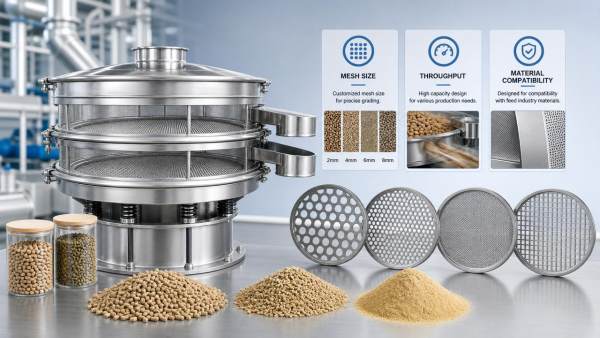
Selecting the right feed grading sieve is not just about separating particles. It shapes pellet uniformity, fines control, line stability, cleaning frequency, and long-term operating cost across feed and grain processing.
In practice, technical evaluation usually comes down to three linked questions. What mesh size gives the target cut point, what throughput must the line sustain, and which sieve material survives the product and cleaning regime.
That is where many selection errors happen. A feed grading sieve may look correct on paper, yet still underperform when bulk density shifts, moisture rises, or abrasive ingredients shorten screen life.
For sectors tracked by AgriChem Chronicle, from feed and grain processing to tightly regulated primary industries, equipment decisions increasingly need clear technical logic, traceable specifications, and compatibility with quality-focused operations.
Start with the separation target, not the catalog
A good feed grading sieve selection starts with the product outcome. Before comparing models, define the acceptable top size, fines percentage, and the real process window across normal and peak loads.
That sounds simple, but it changes the whole decision. If the cut point is vague, the line often ends up over-screening usable product or passing too many fines downstream.
The image below highlights the three variables that should be checked together before approving any feed grading sieve specification.
[Image 01: Feed grading sieve selection factors covering mesh size, throughput, and material compatibility]
- Define the real cut point first. Record target particle distribution, allowable oversize, and acceptable fines, then match the feed grading sieve opening to product specification, not nominal machine labeling.
- Test with production material, not lab-only samples. Bulk density, fat level, moisture, and pellet fragility can shift screening behavior enough to make a theoretically correct sieve perform poorly.
- Review the full process path. Upstream crumbler settings and downstream packing tolerances often reveal whether the feed grading sieve should prioritize tighter classification or gentler material handling.
- Set acceptance limits before trials. A useful benchmark includes throughput, carryover, blinding rate, and reject percentage, so selection stays measurable rather than based on visual impressions.
Why mesh size needs context
Mesh size is usually the first number compared, but it is only meaningful in context. Opening shape, open area, wire diameter, and deck motion all influence the actual separation result.
A smaller aperture does not automatically improve quality. It may reduce throughput, increase blinding, and force more recirculation, which can raise energy use and create unnecessary product degradation.
Check throughput under real operating stress
The next filter is capacity. A feed grading sieve that meets the cut point but cannot hold output under production peaks becomes a bottleneck very quickly.
Real throughput depends on more than deck area. It also reflects feed rate consistency, particle spread across the screen, vibration behavior, and how quickly near-size material clears the aperture.
- Size for peak demand, not average demand. If line utilization is high, the feed grading sieve should maintain performance during surge loading without sharply increasing bypass or screen blinding.
- Verify residence time on the screen deck. Material that moves too fast misses the intended separation, while material that stays too long reduces capacity and can generate excess fines.
- Look at feed distribution hardware. Poor inlet spread often makes one side of the feed grading sieve overload early, causing uneven wear and unstable grading results across shifts.
- Track throughput together with reject rate. A machine can appear productive while actually recycling too much usable product, which hides the real cost of a weak selection decision.
A practical plant-floor scenario
Consider a pellet line that runs well during morning shifts but struggles when moisture rises in afternoon batches. The first reaction is often to install a finer screen or increase vibration.
Often, the better answer is different. The feed grading sieve may be correctly sized for cut point, but undersized for sticky material at peak load. In that case, aperture design or open area matters more than nominal mesh reduction.
Material compatibility decides service life
Material selection is where short-term savings often become long-term cost. The right feed grading sieve material must match abrasion level, corrosion risk, cleaning chemistry, and hygiene expectations.
This matters across broader industrial settings too. ACC regularly covers sectors where validated material compatibility supports both operational reliability and confidence in audit-facing documentation.
- Match sieve material to ingredient behavior. Mineral-heavy or sand-contaminated feed streams wear carbon steel quickly, while acidic or salt-bearing formulations may require stainless options for stable service life.
- Review cleaning chemicals before approval. A feed grading sieve that resists product abrasion may still fail early if washdown agents, sanitizers, or alkaline cleaners attack the surface or welds.
- Check sanitary finish where cross-contamination control matters. Smoother surfaces simplify cleaning, reduce residue retention, and support traceability expectations in more tightly managed processing environments.
- Include frame and fastening materials in the review. Compatibility failures often start at joints, clamps, or edge reinforcement rather than at the main screen surface itself.
Do not ignore wear pattern evidence
Used screens tell a very honest story. Localized thinning, edge tearing, polish marks, or repeated blinding patterns can reveal mismatched material choice, poor feed spread, or an unstable operating window.
When reviewing a replacement feed grading sieve, compare wear history with batch composition and cleaning logs. That usually gives a better answer than switching material grades based only on supplier preference.
Points that are easy to miss during evaluation
Several practical details are often left out of specification sheets. They look minor at purchase stage, yet they strongly affect uptime, labor, and quality consistency once the line is running.
- Confirm how quickly screens can be changed. A technically ideal feed grading sieve loses value if changeover time is long and every maintenance stop interrupts a tightly scheduled line.
- Ask for tolerance data, not just nominal dimensions. Small deviations in aperture consistency can alter grading performance enough to affect downstream packaging, blending, or pellet quality metrics.
- Check spare part standardization across machines. Shared components simplify inventory and reduce downtime risk, especially in facilities balancing multiple product formats or seasonal operating patterns.
- Review documentation quality. A feed grading sieve supported by material certificates, traceable manufacturing details, and clear maintenance instructions is easier to validate internally and sustain over time.
Another common field condition
In mixed-product plants, one screen often gets pushed across several recipes. That can work, but only if the selected feed grading sieve is evaluated against the most demanding product, not the easiest one.
The highest-risk recipe usually combines high moisture, fragile pellets, and variable particle shape. If the screen holds performance there, it is much more likely to remain stable across the rest of the schedule.
A simple path to a better decision
A strong selection process does not need to be complicated. It just needs to connect the process target, trial evidence, and lifecycle factors in one decision record.
- Create a short evaluation sheet. Include target particle range, hourly capacity, product moisture, cleaning method, and expected wear risk before comparing any feed grading sieve options.
- Run side-by-side trials when possible. Compare at least two screen configurations under the same material and loading conditions, then measure output quality, blinding, and cleaning time.
- Use total operating cost as the final check. The best feed grading sieve is rarely the cheapest unit price if it causes frequent replacement, lost throughput, or unstable product grading.
- Document the approval basis clearly. That makes future replacement easier, supports internal technical review, and reduces repeated selection errors when product requirements change.
If the next decision is still unclear, start with plant data rather than brochures. Review actual size distribution, peak load behavior, and past wear evidence, then narrow the feed grading sieve choice from there.
That approach is usually faster, more defensible, and more useful for long-cycle operations where consistency matters as much as nameplate performance.
Related Intelligence
- Commercial Feed PelletFire Quickly Extinguished in Grinder Bin at Baiada’s Cardiff Feed Mill in AustraliaBaiada’s Cardiff feed mill fire was reportedly contained quickly. Explore grinder bin safety, restart uncertainties and key supply continuity checks for feed buyers.
- Commercial Feed PelletHow to Build a Sanitary Feed Production Plan That Reduces Cross-ContaminationSanitary feed production planning: reduce cross-contamination with smarter sequencing, validated flushing, material segregation, and traceable sanitation controls.
- Commercial Feed PelletFeed Pellet Mill Sourcing: How to Vet Suppliers for Capacity, Quality, and SupportFeed pellet mill sourcing made smarter: vet suppliers for proven capacity, pellet quality, lifecycle cost, factory controls, commissioning, and reliable after-sales support.
The Morning Broadsheet
Daily chemical briefings, market shifts, and peer-reviewed summaries delivered to your terminal.
