

The Authority in Global Agricultural Chemistry & Bio-Resources
China’s New Outbound Investment Rules Reshape Agri-Tech Deals
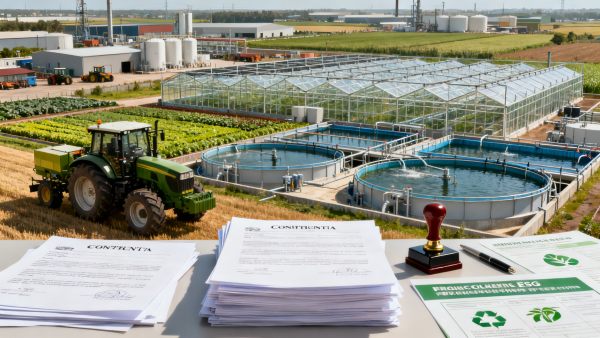
China’s new rules on outbound investment take effect on July 1, 2026, setting clearer filing and approval thresholds for overseas greenfield projects, acquisitions, and joint ventures while placing greater emphasis on ESG due diligence and coordination with host-country compliance requirements. For companies involved in agricultural machinery, smart greenhouse systems, RAS systems, and other asset-heavy overseas projects, this is worth close attention because it may affect deal timing, transaction structures, and the stability assessment of cross-border cooperation involving Chinese investors.
What the new regulation formally covers
The confirmed information indicates that the State Council’s regulation on outbound investment will come into force on July 1, 2026. It clarifies graded filing and approval standards for overseas greenfield investment, mergers and acquisitions, and joint venture projects. The regulation also strengthens ESG due diligence requirements and calls for better coordination with compliance obligations in host countries.
The same information also confirms that the policy directly affects heavy-asset companies expanding abroad in segments such as agricultural machinery, smart greenhouses, and RAS systems. In addition, where overseas buyers participate in joint investment with Chinese companies or enter into technology licensing cooperation, they need to assess the Chinese investor’s compliance qualifications and the stability of project execution at the same time.
Where the immediate pressure points may appear
Deal structuring in heavy-asset expansion
From an industry perspective, companies pursuing overseas acquisitions, greenfield builds, or joint ventures in agricultural equipment, controlled-environment agriculture, and aquaculture infrastructure may feel the impact first. The reason is straightforward: the new rules speak directly to project classification, approval pathways, and compliance coordination, all of which are closely tied to transaction sequencing and structuring.
Cross-border partners in co-investment and licensing
Overseas buyers and partners may also be affected, particularly when cooperation depends on a Chinese party’s outbound investment compliance. Analysis shows that for joint investment or technology licensing arrangements, counterparties may need to examine not only commercial terms but also whether the Chinese side has the qualifications and procedural readiness needed for stable project implementation.
Suppliers and delivery-chain participants
Equipment suppliers, system integrators, and service providers connected to overseas project delivery may need to watch for changes in project timing. Observably, when filing, approval, ESG review, and host-country compliance coordination become more prominent, the effect may appear in procurement schedules, contract milestones, and delivery planning rather than only at the investment decision stage.
What companies should monitor now
Watch how compliance classification is applied in practice
What deserves closer attention is the practical distinction between policy wording and real transaction handling. Businesses involved in outbound agricultural equipment, smart greenhouse, or RAS projects should closely follow how greenfield, acquisition, and joint venture cases are classified for filing or approval purposes in actual implementation.
Review ESG diligence as a transaction condition
Analysis shows that ESG due diligence should not be treated as a side issue. For asset-heavy overseas projects, it may increasingly influence transaction preparation, internal review, partner selection, and documentation readiness, especially where project execution depends on multiple jurisdictions and approval steps.
Check counterpart qualification in shared projects
For overseas buyers, licensors, and co-investors, a practical focus is whether the Chinese partner’s compliance status is sufficient to support timeline certainty. This is particularly relevant where the business model depends on joint capital deployment, phased construction, or long delivery cycles.
Prepare for timing and communication adjustments
Companies across procurement, supply chain, and project delivery functions may need contingency planning around transaction timing. Observably, if compliance review becomes a more visible part of project advancement, customer communication, supplier coordination, and milestone setting may need earlier alignment.
Why this reads as more than a procedural update
Analysis shows that this development is not only about adding a formal rule effective date. It also signals that outbound investment compliance for Chinese companies is becoming more structurally linked to ESG review and host-country regulatory coordination. For sectors built around equipment, infrastructure, and long implementation cycles, that combination matters because compliance affects not just approval risk but also whether a transaction can proceed on the expected commercial timetable.
At the same time, it is more appropriate to understand this as a policy signal with immediate operational relevance rather than as a completed industry outcome. The confirmed information shows direction and scope, but the exact business impact will still depend on how companies, counterparties, and project teams adjust their processes in response.
How the market may need to interpret it
A balanced reading is that the new rules create a clearer compliance frame for outbound investment while also raising the practical importance of diligence, coordination, and transaction design. For agricultural machinery, smart greenhouse, and RAS-related overseas activity, the key issue is not simply whether projects can move forward, but how smoothly they can be structured and executed under the updated requirements.
Current industry attention is therefore best placed on execution risk, partner screening, and timetable management. It is more appropriate to understand this development as both a near-term compliance change and a longer-term signal that cross-border projects involving Chinese investors may face closer procedural scrutiny.
Basis of this article and what still needs verification
This article is based on the user-provided news title, event date, and event summary. The content has been written within that factual scope and does not add unverified project details, company names, market data, or regulatory references beyond the provided information.
For this type of development, commonly relevant source categories may include official government notices, company disclosures, industry association updates, authoritative media reporting, and related standards or compliance documents. A specific official source link was not provided in the input, so further verification remains necessary. Follow-up attention should focus on any subsequent official clarifications, implementation guidance, and market responses related to filing standards, ESG diligence expectations, and host-country compliance coordination.
Related Intelligence
- Smart GreenhouseGreenhouse Equipment for Vertical Farming: Choosing Lighting and VentilationChoose greenhouse equipment for vertical farming with confidence. Compare lighting, airflow, and moisture control to improve crop uniformity and manage costs. Explore the guide.
- Smart GreenhouseSelecting Greenhouse Propagation Equipment for Hot, Humid Southeast Asian NurseriesGreenhouse propagation equipment Southeast Asia: discover how to select resilient irrigation, ventilation, benches, and automation for hot, humid nurseries.
- Smart GreenhouseWhat Are the Biggest Challenges in Agri-Tech Adoption in 2026?What are the biggest challenges in agri tech adoption for 2026? Explore cost, data, connectivity, skills, compliance, and ROI barriers.
The Morning Broadsheet
Daily chemical briefings, market shifts, and peer-reviewed summaries delivered to your terminal.
