

The Authority in Global Agricultural Chemistry & Bio-Resources
Vacuum Dryer Commercial Buying Guide: Key Specs for Food, Herbs, and Heat-Sensitive Products
Why a Vacuum Dryer Commercial System Needs a Technical Review
Selecting a vacuum dryer commercial unit is rarely a simple price comparison. In food, herbs, extracts, and heat-sensitive materials, drying quality directly affects value, shelf life, compliance, and downstream processing.
That is why technical review matters early. A lower-cost machine can become expensive fast if it causes aroma loss, uneven moisture, product scorching, or long cycle times.
For industries covered by AgriChem Chronicle, the purchasing decision usually sits inside a wider system. Raw material variability, regulatory documentation, sanitation design, and energy cost all shape the real return.
The best approach is practical. Start with product behavior under vacuum, then match the equipment specifications to quality targets, cleaning needs, utility conditions, and audit expectations.
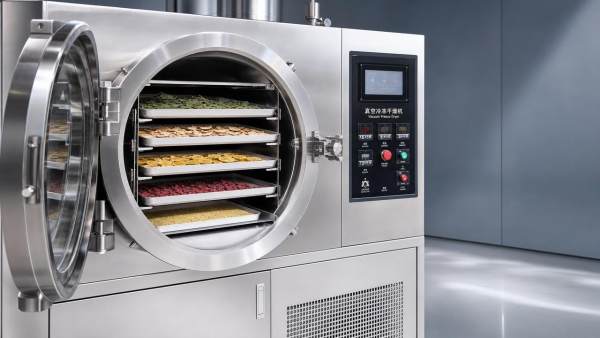
[Image 01: Vacuum dryer commercial chamber, tray layout, and control panel overview]
The points below focus on what usually matters most when comparing one vacuum dryer commercial option against another in real procurement work.
Core Specifications That Actually Change Performance
- Check the usable temperature range, not just the maximum value. Stable low-temperature drying is often more important than peak heat when processing herbs, enzymes, fruit pieces, or botanical extracts.
- Review the vacuum level in absolute pressure terms. A vacuum dryer commercial system with poor vacuum stability can create longer cycles, inconsistent moisture removal, and repeatability problems batch after batch.
- Confirm heating uniformity across trays, shelves, or contact surfaces. Uneven heat transfer often causes overdried edges, wet centers, and avoidable quality variation in sensitive product lots.
- Match chamber volume to true loading pattern. Nameplate capacity looks attractive, but airflow path, tray spacing, and product thickness decide whether the equipment performs at rated throughput.
- Ask for condenser capacity and solvent or vapor handling data. This is critical when moisture removal is high, or when volatile compounds must be recovered safely and efficiently.
- Evaluate control precision for temperature, pressure, and hold time. A vacuum dryer commercial platform with reliable recipe control reduces operator dependency and makes validation much easier.
A quick way to compare suppliers
When quotations arrive, normalize the data first. Put all suppliers into the same comparison sheet using actual drying conditions, product loading assumptions, and guaranteed cycle times.
If one supplier gives only broad claims like “high efficiency” or “fast drying,” treat that as a warning sign. Reliable vendors usually provide measurable operating windows and test references.
Product-Specific Factors Often Missed Early
Not every material behaves the same under vacuum. That sounds obvious, yet many buying mistakes happen because equipment is selected around generic capacity instead of product physics.
For herbs, aroma retention is usually a bigger issue than moisture removal alone. If the vacuum dryer commercial setup runs too hot, valuable volatile compounds can drop before the batch is finished.
For food ingredients, appearance and texture may matter just as much as dryness. Case hardening, color darkening, or clumping can create downstream quality complaints even when moisture targets are met.
For extracts or fine chemical intermediates, residue, solvent traces, and cleanability usually move to the front of the decision. In these cases, a vacuum dryer commercial system must support both process stability and validation records.
Food applications
In food processing, ask for evidence on moisture uniformity, clean-in-place options, and food-contact surface finish. Drying speed matters, but product appearance and sanitation often decide long-term suitability.
It also helps to review utility consumption per kilogram of removed water. That number is often more useful than headline power ratings when comparing lifecycle cost.
Herbs and botanicals
Herbs usually need gentler temperature control and careful tray loading. Overpacking reduces effective drying, while thin loading may improve quality but cut commercial productivity too far.
A pilot trial is worth requesting here. Even a short run can reveal aroma loss, leaf breakage, or unexpected shrinkage before a full-scale vacuum dryer commercial purchase moves forward.
Heat-sensitive powders and intermediates
These materials often require tighter control of endpoint moisture and wall adhesion. Ask how the chamber design handles sticking, powder recovery, and cleaning verification after each batch.
What to Verify Before Comparing Cost
- Separate purchase price from total operating cost. A vacuum dryer commercial machine with stronger controls and better heat transfer may cost more upfront but save labor, energy, and rejected product.
- Check utility requirements in detail, including steam, hot water, chilled water, compressed air, and power quality. Site limitations can force expensive modifications after the order is placed.
- Verify cleaning time between batches. Fast changeover is often overlooked, yet it directly affects real throughput when multiple products or seasonal raw materials share one dryer.
- Review spare parts availability and vacuum pump service intervals. A technically good system becomes risky if replacement components have long lead times or poor regional support.
- Ask whether performance data comes from factory water tests or real product trials. The difference matters because difficult materials rarely behave like standard demonstration loads.
- Confirm documentation scope early. For regulated sectors, the vacuum dryer commercial supplier should clearly define manuals, certificates, FAT support, and traceability records before contracting.
Compliance, Materials, and Supply Chain Confidence
In ACC-covered sectors, equipment selection often intersects with audit pressure. The machine is not just a dryer. It becomes part of a documented process chain that may face customer, regulatory, or export review.
Start with contact materials. Stainless grade, gasket compatibility, weld finish, and surface roughness all matter when products are acidic, sticky, aromatic, or contamination-sensitive.
Then check records. A solid vacuum dryer commercial supplier should provide material certificates, instrumentation details, and clear maintenance instructions without hesitation.
If the process links to GMP, FDA-aligned expectations, or export quality systems, ask how the design supports calibration, cleaning validation, and batch data retention. This reduces future retrofitting risk.
Supply chain transparency matters too. Lead time, sourced components, and after-sales structure should be reviewed with the same seriousness as chamber size or vacuum depth.
Common Procurement Mistakes That Create Long-Term Cost
One frequent mistake is choosing capacity based on wet feed weight alone. In reality, batch geometry, tray depth, and final moisture target define how much usable throughput the dryer can deliver.
Another is accepting broad temperature claims without checking control accuracy under vacuum. A vacuum dryer commercial system may reach a setpoint but still drift enough to affect heat-sensitive batches.
It is also common to underrate unloading and cleaning labor. If dried material is fragile, sticky, or dusty, poor ergonomics will show up quickly in daily operating cost.
Finally, do not skip reference checks. Similar applications often reveal more than polished sales documents, especially when comparing cycle repeatability and service responsiveness.
A Practical Shortlist for Final Evaluation
- Request a side-by-side matrix covering vacuum range, temperature stability, cycle time, utilities, cleaning method, documentation, and spare parts. This keeps the vacuum dryer commercial comparison objective.
- Prioritize product trial evidence using materials close to the intended application. Performance on real herbs, food ingredients, or sensitive intermediates is more useful than generic factory demonstrations.
- Score supplier responsiveness during technical clarification. Fast, precise answers often predict stronger support during installation, commissioning, and later troubleshooting.
- Review footprint, loading ergonomics, and maintenance access with the site team. Small layout issues can become expensive once the vacuum dryer commercial unit is installed in production.
- Use a total-cost model over three to five years. Include utilities, labor, preventive maintenance, downtime risk, validation effort, and expected reject reduction.
Making the Next Decision Easier
A strong vacuum dryer commercial decision usually comes from disciplined comparison, not from the longest feature list. The right unit is the one that protects product value while staying predictable in daily operation.
For food, herbs, and other heat-sensitive products, the most useful questions stay practical: Can it dry gently, repeatably, cleanly, and at the required throughput without creating hidden compliance or operating costs?
If those answers are supported by real trial data, clear documentation, and credible service capability, the shortlist becomes much easier to defend. That is usually where a better purchase outcome starts.
Related Intelligence
- Natural IngredientsFreeze-Dried Fruit Ingredients: A Packaging Checklist for Bulk StorageBuying freeze dried fruit ingredients? Use this bulk packaging checklist to assess moisture barriers, seals, and pack sizes, reduce waste, and protect quality from storage to production.
- Natural IngredientsBotanical Ingredient Prices in Europe: Comparing Quotes by Grade and Order VolumeCompare Europe botanical ingredients price quotes by grade and order volume. Discover how potency, testing, delivery, and inventory costs reveal real savings before you buy.
- Natural IngredientsMayonnaise vs. Salad Dressing: Ingredient and Texture DifferencesMayonnaise vs. salad dressing: discover key ingredient, texture, stability, and application differences to choose the right product for every recipe.
The Morning Broadsheet
Daily chemical briefings, market shifts, and peer-reviewed summaries delivered to your terminal.
