

The Authority in Global Agricultural Chemistry & Bio-Resources
How to Evaluate a Natural Ingredients Supplier for Traceability, MOQ, and Export Compliance
How to Evaluate a Natural Ingredients Supplier for Traceability, MOQ, and Export Compliance
Choosing the right natural ingredients supplier is no longer just about price or availability.
Full traceability, workable MOQ terms, and export compliance now shape supply security.
This guide explains how to assess a natural ingredients supplier with a practical, risk-based sourcing framework.
Why supplier evaluation now goes beyond price
Natural ingredients supply chains are more exposed than many buyers expect.
Raw material origin, seasonal harvest shifts, and changing customs rules affect every shipment.
That is why a natural ingredients supplier must be judged on operational evidence, not claims.
In practice, three factors drive most sourcing risk.
- Traceability proves where materials come from and how they were handled.
- MOQ terms determine whether supply is commercially realistic.
- Export compliance protects delivery schedules and market access.
A low quote can look attractive.
But if the natural ingredients supplier cannot document origin or ship legally, total cost rises fast.
Start with traceability, not the catalog
A capable natural ingredients supplier should map the product back to source.
That includes farm, collection region, processor, batch, and shipment record.
If the chain breaks at any stage, quality and compliance risks increase.
Ask for documents before discussing long-term pricing.
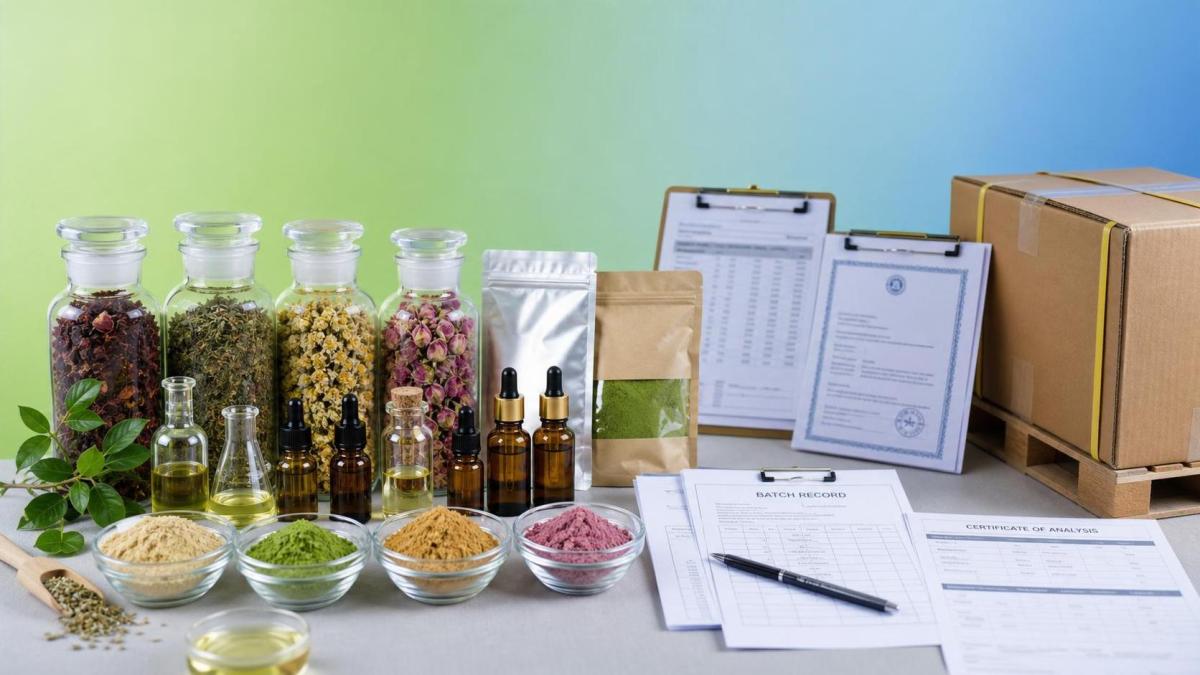
- Batch records linked to specific lots.
- Certificate of analysis from each batch.
- Supplier qualification records for upstream sources.
- Storage and transport controls.
- Recall procedure with response times.
A strong natural ingredients supplier can usually provide these quickly.
Delays, vague answers, or inconsistent records are early warning signs.
This matters even more for botanical extracts, oils, powders, and nutraceutical inputs.
These categories often face variation in potency, contamination risk, and origin-sensitive regulations.
How to test traceability in a real sourcing process
Paper compliance alone is not enough.
A natural ingredients supplier should also show control under pressure.
One simple method is a trace-back exercise during qualification.
Request one recent lot and ask the supplier to trace it backward in full.
Then check how fast they respond and whether documents align.
Look closely at these details:
- Does the lot code match the test report?
- Do harvest dates support the claimed production timeline?
- Are subcontractors disclosed clearly?
- Is there a documented chain of custody?
This process often reveals more than a polished capability deck.
A reliable natural ingredients supplier treats traceability as daily discipline, not a sales tool.
Evaluate MOQ terms as a supply strategy issue
MOQ is often discussed too late.
Yet MOQ directly affects inventory cost, cash flow, and flexibility.
A natural ingredients supplier may offer a good unit price but require excessive volume.
That creates hidden carrying costs and higher obsolescence risk.
The better question is not just, “What is your MOQ?”
It is, “What production logic drives that MOQ?”
Useful follow-up questions include:
- Is MOQ based on extraction yield, packaging size, or batch setup time?
- Can trial orders use a different MOQ?
- Can mixed SKUs share one production run?
- Is there a forecast-based MOQ reduction option?
A flexible natural ingredients supplier usually explains the cost structure behind minimums.
That transparency helps separate legitimate factory constraints from rigid sales policy.
Compare MOQ against total landed cost
MOQ should never be reviewed in isolation.
It must be compared with freight, warehousing, lead time, and demand variability.
This is where supplier evaluation becomes a cost-control exercise.
A natural ingredients supplier with modest MOQ flexibility can outperform a cheaper rival.
That is especially true when demand is unstable or product shelf life is tight.
Verify export compliance before onboarding
Export compliance is often treated as paperwork.
In reality, it determines whether the order clears customs on time.
A natural ingredients supplier must understand both origin-country and destination-market requirements.
This includes product classification, labeling, documents, and restricted substance rules.
For cross-border ingredient trade, ask for evidence on:
- HS code consistency across recent shipments.
- Phytosanitary, health, or origin certificates where required.
- Ingredient specifications aligned with importing market standards.
- Experience with FDA, EU, or other regional declarations.
- Packaging and labeling for export transit.
If the natural ingredients supplier has shipped into your target market before, risk drops significantly.
If not, qualification should be stricter and shipment planning more conservative.
Watch for compliance gaps that create hidden cost
Some export issues do not appear until cargo is already moving.
That delay can wipe out any negotiated savings.
Common red flags include incomplete ingredient naming, mismatched invoices, and outdated test methods.
Another warning sign is dependence on a forwarder for all compliance knowledge.
A serious natural ingredients supplier should own its export documentation process.
It should also know when third-party lab validation is necessary.
From a cost perspective, compliance capability is part of supplier reliability, not an optional extra.
Use a practical scorecard for final selection
A simple scorecard keeps sourcing decisions objective.
It also helps compare each natural ingredients supplier on the same basis.
Use weighted scoring instead of price-only ranking.
- Traceability depth: 30%.
- MOQ and supply flexibility: 25%.
- Export compliance readiness: 25%.
- Commercial terms and payment risk: 10%.
- Communication speed and issue handling: 10%.
You can adjust the weighting by product type and regulatory exposure.
For example, botanical extracts may require heavier traceability weighting.
New market entry may require heavier export compliance weighting.
This approach turns natural ingredients supplier selection into a repeatable sourcing process.
Final takeaway for better sourcing decisions
The best natural ingredients supplier is not always the lowest-cost option on paper.
The better choice is the supplier that reduces uncertainty across the full supply chain.
Start with traceability, test MOQ logic against real demand, and verify export compliance early.
That sequence helps prevent quality disputes, working capital strain, and customs delays.
In real sourcing work, disciplined evaluation usually saves more than aggressive negotiation.
Use these checkpoints to build a shortlist that is commercially sound, audit-ready, and easier to scale.
Related Intelligence
- Natural IngredientsIndustrial-Scale Agricultural Sourcing: Key Criteria for Reliable SupplyIndustrial scale agri sourcing made reliable: assess supplier capacity, traceability, landed cost, logistics, and resilience to protect production continuity.
- Natural IngredientsHow Microencapsulated Botanical Ingredients Improve Stability and Controlled ReleaseMicroencapsulated botanical ingredients enhance stability, protect sensitive actives, and enable controlled release for reliable performance across demanding applications.
- Natural IngredientsHow to Evaluate Bioactive Compounds for Nutraceuticals by Stability, Efficacy, and FormatBioactive compounds for nutraceuticals should be evaluated by stability, efficacy, and format. Learn how to compare ingredients, reduce formulation risk, and choose options that perform in real products.
The Morning Broadsheet
Daily chemical briefings, market shifts, and peer-reviewed summaries delivered to your terminal.
