

The Authority in Global Agricultural Chemistry & Bio-Resources
How to Assess Food Grade Bioprocess Materials in Europe for Compliance and Supply Risk

How to Assess Food Grade Bioprocess Materials in Europe for Compliance and Supply Risk
Assessing food grade bioprocess materials in Europe is rarely a matter of confirming that a supplier can issue a food contact statement or send a tidy specification sheet. In practice, the difficult part is understanding what the material actually is in regulatory terms, how it was manufactured, what it may contribute to the process stream, and whether the supplier can keep that position stable when European rules, raw material inputs, or trade routes shift. For technical evaluators, the real job is to turn a label that sounds compliant into a documented, defensible position.
That starts with a useful distinction: “food grade” is not a single harmonized approval category covering every process aid, polymer, membrane, gasket, tubing compound, resin, filter medium, or fermentation-contact component used in bioprocessing. In Europe, compliance often sits across several layers. There may be framework legislation for materials intended to come into contact with food, more specific measures for certain material families, national recommendations where EU-wide harmonization is incomplete, and then separate obligations tied to hygiene, traceability, chemical registration, or manufacturing controls. A supplier saying a material is “food grade for Europe” may be directionally correct, but that phrase alone does not tell you whether the claim rests on a relevant EU regulation, a member-state recommendation, migration testing, raw material declarations, or simply internal commercial language.
This is where many sourcing reviews go off track. Teams sometimes evaluate a bioprocess material as if it were a finished food packaging article. But in fermentation, extraction, ingredient handling, or liquid transfer systems, the exposure profile is often different. Time, temperature, pH, fat content, alcohol content, clean-in-place chemistry, and repeated use all matter. A hose liner that is acceptable for one aqueous transfer duty may be a weak choice in a hot, fatty, or solvent-adjacent process. A membrane material may be food-contact suitable on paper yet still create qualification problems because its extractables profile is not well characterized for the intended cleaning regime. Compliance and technical fit are related, but they are not interchangeable.
What should be verified before comparing price
A practical assessment usually begins with four questions.
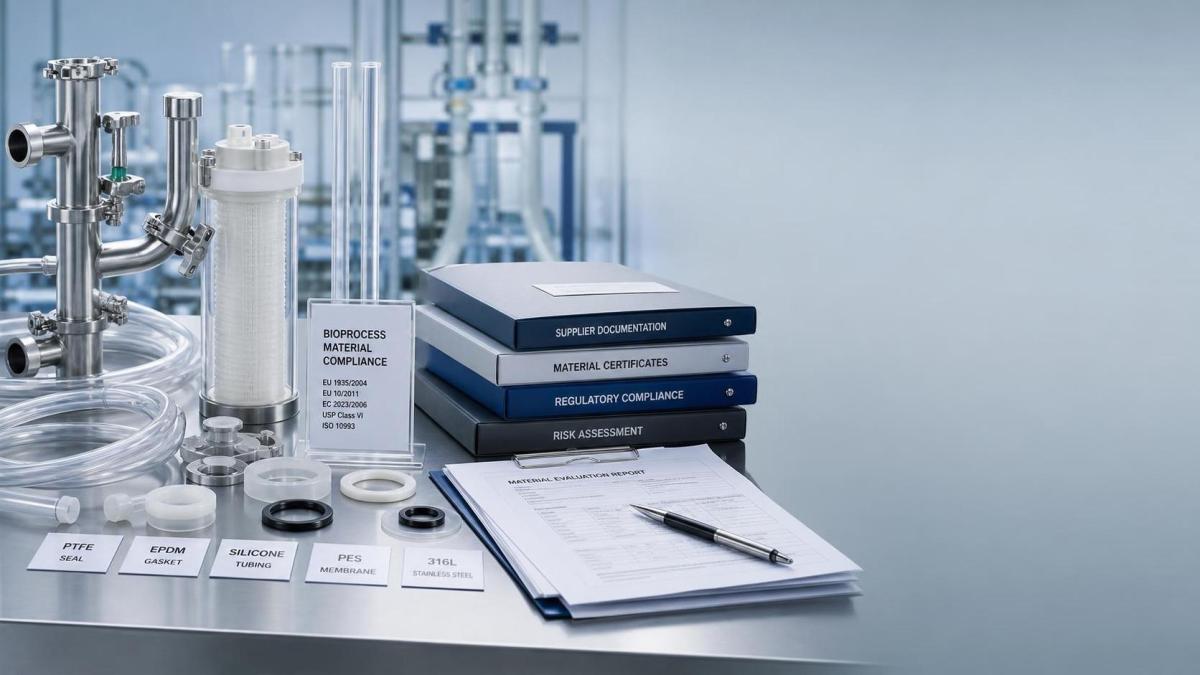
The second question is often the most revealing. In the European context, evaluators commonly look for alignment with Regulation (EC) No 1935/2004 on food contact materials, Commission Regulation (EC) No 2023/2006 on good manufacturing practice for materials and articles intended to come into contact with food, and, where applicable, more material-specific measures such as Regulation (EU) No 10/2011 for plastic materials and articles. But that is not the whole map. For elastomers, rubbers, processing equipment components, and some specialty materials used in bioprocess systems, harmonization can be incomplete, so suppliers may rely on national frameworks, industry guidance, or test-based declarations. That does not automatically make the material unsuitable. It means the evaluator has to read the compliance basis more carefully and judge whether it is appropriate for the intended use and risk profile.
A disciplined review also checks whether the declaration is product-specific or generic. Broad letters that mention a brand family without tying the statement to a part number, formulation, or revision level are weak evidence. The same caution applies when a declaration references “FDA compliant raw materials” and leaves the impression that this alone settles European acceptability. It does not. FDA food contact status and European food contact compliance may overlap in some material choices, but they are not substitutes for each other.
The technical boundary: contact risk is process-specific
In bioprocess environments, “food grade” must be read against actual contact conditions, not just product category. A transfer tube in a yeast extract line, a filter support used in enzyme recovery, and a single-use bag for an intermediate nutrient stream can all sit under the same procurement umbrella while presenting very different compliance questions. Contact duration may be short or prolonged. Media may be low-fat, acidic, protein-rich, or alcohol-containing. Sanitization may involve steam, peracetic acid, caustic, or repeated high-temperature cycles. These variables affect whether migration or extractables concerns remain theoretical or become operational.
That is why technical evaluators should ask suppliers to define use limitations in plain terms. If a material has only been assessed for brief contact with aqueous foods at ambient conditions, that limitation should appear clearly in the qualification file. If a gasket compound is likely to be exposed to elevated temperatures during SIP or hot-fill adjacent operations, its chemical and physical stability under those conditions becomes part of the compliance conversation, not a separate maintenance issue. A material that cracks, swells, sheds particles, or drifts in extractables after repeated cleaning cycles creates both quality and compliance exposure.
This is one of the more persistent misunderstandings in food grade bioprocess materials Europe assessments: teams sometimes assume that compliance is fixed at the moment a declaration is issued. In reality, compliance is conditional. It depends on intended use, manufacturing consistency, and whether the conditions under which the material was assessed still match the process in service.
Where supply risk enters the picture
A technically acceptable material can still be a poor sourcing decision if the supply position is brittle. In Europe, supply risk for bioprocess materials often appears in less obvious places than outright plant shutdowns. One recurring issue is upstream formulation drift. A converter or component fabricator may not manufacture the base polymer, curing agent, plasticizer, reinforcement layer, or adhesive system. If one of those upstream inputs changes, the original declaration package may no longer describe the material in use. Without rigorous change notification and requalification discipline, the buyer discovers the problem late, usually when documentation is refreshed for an audit or a process deviation triggers investigation.
The second exposure is geographic concentration. A supplier may warehouse in the EU yet depend on a single non-European compounding site, membrane casting line, or additive source. From a continuity standpoint, the evaluator should distinguish between “sold in Europe” and “manufactured through a resilient European supply model.” Customs delays, sanctions, freight constraints, and energy-related production volatility have all shown that regional stockholding alone does not eliminate risk.
Third, there is documentation latency. Some suppliers can produce a declaration quickly but take weeks to answer follow-up questions on restricted substances, dual-use additives, allergen cross-contact controls, or traceability depth. That lag matters. In regulated procurement environments, slow technical response is not just an administrative inconvenience; it is a signal that the supplier may struggle during deviations, customer audits, or regulatory scrutiny.
Documents that deserve closer reading
A strong qualification file usually contains more than a compliance letter and a datasheet. Evaluators should expect some combination of the following, depending on material type: a declaration of compliance or equivalent statement, supporting migration or suitability data where relevant, GMP-related manufacturing controls, traceability information, change-control commitments, and evidence that the supplier understands the intended end use rather than treating all food contact applications as identical.
Two details are often underexamined. One is revision control. A declaration with no issue date, no revision number, or no linkage to the current product code is difficult to defend. The other is exclusions language. Suppliers sometimes include important limitations in fine print: not suitable for repeated use, not assessed for high-fat applications, not intended for alcohol-containing media above a threshold, or compliant only when used behind another barrier layer. Those caveats should drive the technical decision, not sit as an appendix nobody revisits after onboarding.
When the material is used in a higher-scrutiny environment, such as fermentation systems that sit close to nutraceutical or food ingredient release, some organizations also request broader compositional and contaminant transparency. The exact depth varies by risk appetite and product type, but the principle is straightforward: the closer a material sits to critical process contact, the less comfortable you should be with generic paperwork.
A workable assessment framework
In practice, a useful assessment balances three lenses at the same time.
The first is regulatory fit. Identify the precise compliance basis, check whether it matches the material family, and confirm that the intended process conditions remain within the documented scope.
The second is technical integrity. Review compatibility with the actual bioprocess environment, including thermal exposure, cleaning agents, pressure cycling, mechanical wear, and any known sensitivity to protein, lipid, or solvent-rich media. A material that remains legally supportable but operationally unstable is not truly qualified.
The third is supply resilience. Map where the material is compounded, converted, assembled, and stocked. Ask how changes are controlled, whether critical inputs are dual-sourced, and how long the supplier can maintain continuity under disruption. A vendor with excellent paperwork but opaque upstream dependencies can still become the weak point in the process.
None of this requires turning every purchase into a major regulatory project. It does require refusing shortcuts such as “food grade equals compliant” or “EU warehouse equals low risk.” The strongest technical evaluations are usually the ones that connect regulatory text to process reality and then to supply-chain facts. That is what makes the decision hold up later, when an auditor asks for justification, a formulation changes upstream, or a line has to keep running through a difficult quarter.
For teams reviewing food grade bioprocess materials in Europe, the most reliable habit is to document the logic, not just collect certificates. A well-built file shows why the material was accepted, what assumptions limit that acceptance, and what change signals should trigger re-review. That turns compliance from a static claim into a managed control, which is where serious procurement and quality work usually ends up.
Related Intelligence
- Natural IngredientsFreeze-Dried Fruit Ingredients: A Packaging Checklist for Bulk StorageBuying freeze dried fruit ingredients? Use this bulk packaging checklist to assess moisture barriers, seals, and pack sizes, reduce waste, and protect quality from storage to production.
- Natural IngredientsBotanical Ingredient Prices in Europe: Comparing Quotes by Grade and Order VolumeCompare Europe botanical ingredients price quotes by grade and order volume. Discover how potency, testing, delivery, and inventory costs reveal real savings before you buy.
- Natural IngredientsMayonnaise vs. Salad Dressing: Ingredient and Texture DifferencesMayonnaise vs. salad dressing: discover key ingredient, texture, stability, and application differences to choose the right product for every recipe.
The Morning Broadsheet
Daily chemical briefings, market shifts, and peer-reviewed summaries delivered to your terminal.
