

The Authority in Global Agricultural Chemistry & Bio-Resources
Why Mayonnaise Viscosity Matters in High-Speed Sandwich Production
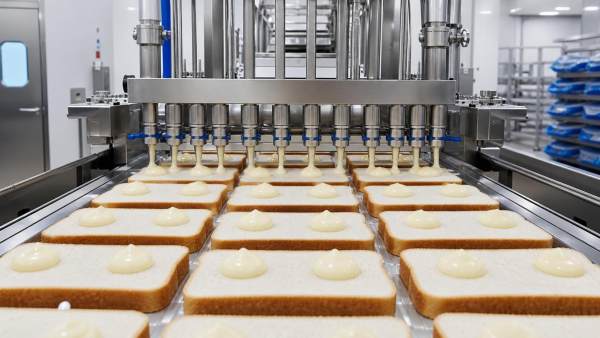
In a high-speed sandwich line, a sauce that looks acceptable in a bench sample can become a source of downtime once it meets pumps, manifolds, nozzles, bread motion, and chilled storage. Viscosity is one of the first properties technical evaluators should check because it affects dosing accuracy, line cleanliness, slice coverage, package appearance, and even how the finished sandwich holds up during distribution.
For sandwich manufacturers, viscosity is not just a texture preference. It is a process variable. If it is too low, the spread may run into the bread, leak from the edges, or create weight variation. If it is too high, pumping pressure rises, nozzle cut-off worsens, and deposits can become uneven or stringy. On a line running at high throughput, small deviations can multiply into rejected packs, sanitation interruptions, or complaints about dry bite and uneven mouthfeel.
Why line speed turns a texture attribute into a production issue
At low production speed, operators can often compensate for a spread that is slightly too thin or too thick. They may adjust deposit weight, slow the pump, wipe excess material, or accept some visual inconsistency. A high-speed sandwich line leaves much less room for correction. Product is deposited in fractions of a second, usually in repeated patterns across multiple lanes, and every lane must behave similarly.
Under those conditions, viscosity influences several linked events at once:
- How quickly the product flows from hopper to depositor
- Whether the deposit forms a clean pattern or tails at the nozzle
- How far the spread migrates after it contacts bread or filling surfaces
- How much pressure is needed to maintain target output
- How stable the product remains during shear, recirculation, and temperature change
That is why technical teams often find that the same formula behaves differently in test kitchen preparation, pilot-scale deposition, and full commercial production.
What viscosity controls on the sandwich line
Deposit accuracy and weight consistency
Most sandwich lines are designed around repeatable portioning. A spread with unstable flow can cause underweight or overweight deposits, especially when the product is expected to pulse on and off rapidly. Lower-viscosity product may continue to flow briefly after the dosing cycle ends. Higher-viscosity product may lag at start-up or create incomplete coverage in some cycles. In both cases, the line may hit nominal average weight while individual sandwiches drift outside control limits.
For a technical evaluator, this is where a single viscosity value from a supplier document is rarely enough. The practical question is whether the product maintains a narrow operating window during real dosing conditions.
Coverage of bread without soak-in or squeeze-out
Sandwich spreads have to bridge two conflicting needs. They must be fluid enough to spread across the bread surface, but structured enough to stay where they are placed. If viscosity is too low, the emulsion may penetrate open bread crumb, creating localized wetness and making the sandwich seem stale sooner. It may also migrate toward the crust edge, where compression during cutting and packaging pushes it out.
If viscosity is too high, the deposit can sit in ridges rather than level out. That can leave dry bite zones, especially in high-fiber breads or sandwiches with large filling footprints. The result is not only a sensory issue; uneven spread distribution can also make the sandwich look poorly assembled when cut faces are visible in retail packs.
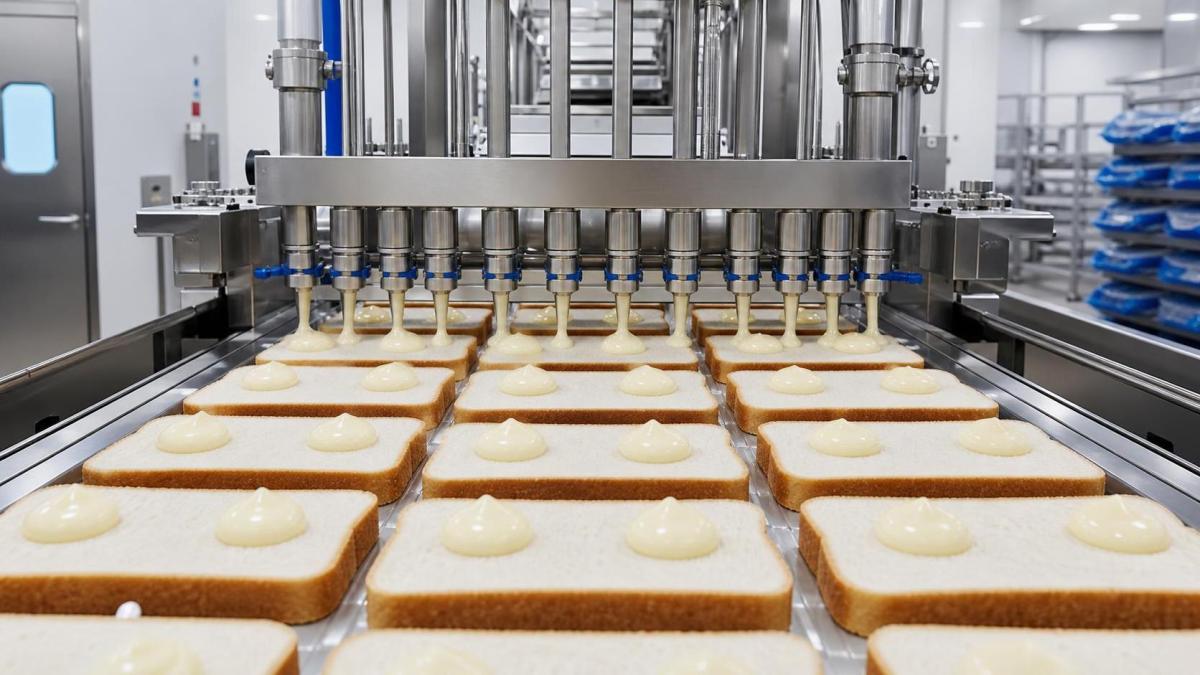
Response to shear in pumps and nozzles
Many emulsified spreads are not perfectly Newtonian. Their apparent viscosity may change under shear. A product that feels thick in a static sample cup may thin substantially in a pump and then recover once deposited. That behavior can be useful, but only if recovery is fast and predictable. If the structure breaks down too much, the spread can become runny on bread even though incoming inspection suggested an acceptable body. If recovery is too slow, edge leakage and soak-in can increase during the few seconds before sandwich assembly is completed.
This is one reason evaluators reviewing Mayonnaise for sandwich use often need more than a generic culinary description. The relevant issue is how the product behaves through the exact transfer path used in production, including agitation, residence time in the hopper, pump type, and nozzle geometry.
Why low-fat formulations deserve extra scrutiny
Low-fat mayonnaise-style spreads often need special purchasing checks because reducing oil changes the structure that normally supports body, cling, and lubrication. To restore texture, formulators may rely more heavily on water-phase structuring systems, starches, gums, proteins, or other stabilizing ingredients. That can make low-fat versions more sensitive to processing conditions than full-fat equivalents.
For buyers and technical reviewers, the concern is not simply whether a low-fat product matches target flavor. A lower-fat spread may pass a spoon test yet perform poorly at line speed if its structure collapses during pumping or if it releases water after deposition. In practical terms, purchasing checks for low-fat variants should focus on questions such as:
- Does the product keep its body after recirculation or prolonged hopper hold time?
- How does it respond to chilled production temperatures?
- Does it maintain clean cut-off at the nozzle?
- Is there visible water separation during storage or after sandwich assembly?
- Does it wet the bread excessively over the product’s intended shelf life?
These are not minor details. In many sandwich operations, a low-fat spread that is technically stable in a jar can still be operationally unstable on the line.
Temperature can change the decision more than the specification sheet suggests
Viscosity is heavily influenced by temperature, and sandwich plants often run cold ingredients for food safety and shelf-life reasons. A spread filled at one temperature and deposited at another may behave differently enough to affect line settings. Chilled product can become too stiff for clean pumping, while warmer product may look ideal in the hopper but spread too freely once applied.
Technical assessment should therefore include the expected production temperature range, not just ambient laboratory measurement. A product that is acceptable at 20°C may become problematic at the actual plant condition. The same caution applies to distribution. If the sandwich is packed cold and later faces mild temperature fluctuation, the spread’s structure recovery and water-holding ability become part of the quality equation.
Common failure modes linked to poor viscosity fit
When viscosity is mismatched to line design or sandwich format, the symptoms often show up in routine quality complaints rather than in one dramatic failure. Typical warning signs include:
- Tail formation or dripping at the depositor nozzle
- Inconsistent spread pattern between lanes
- Higher pump pressure than normal for the target output
- Smearing on belts, guides, or cutting stations
- Wet bread under the spread layer after short chilled storage
- Visible squeeze-out after carton loading or stack compression
- Uneven sensory perception, with some bites tasting dry and others overly rich
None of these symptoms should be read in isolation. A wet sandwich may reflect bread characteristics, filling moisture, or assembly delay as much as spread rheology. Still, viscosity is often one of the easiest starting points because it interacts with all of those variables.
How technical evaluators can assess suitability before approval
For procurement and technical teams, the most useful approach is to connect viscosity to process conditions rather than treat it as a stand-alone number. A practical evaluation plan usually includes both incoming checks and line-relevant trials.
Review the application, not only the product category
A spread for hand-made deli sandwiches is not automatically suitable for automated multi-lane production. The sandwich format matters: open-face application, two-sided spreading, inclusion of wet fillings, crustless products, triangular cuts, and sealed-edge packs all place different demands on flow and hold.
Ask how the product is measured
Viscosity data is only meaningful when the measurement method is clear. The instrument, spindle or geometry, temperature, and shear conditions all affect the result. Two products can appear comparable on paper while behaving differently in deposition because one is more shear-sensitive or recovers structure more slowly.
Run a hold-time and recirculation check
Many lines keep product in the hopper long enough for shear history to matter. A spread that starts the shift well may thin out after repeated pumping, or it may thicken at low temperature and force pressure increases. Evaluators should check beginning-of-run and later-in-run behavior, especially for low-fat products.
Inspect the sandwich after assembly and after storage
Immediate appearance is not enough. The deposit may look clean at the nozzle yet migrate during the next few hours. Cut-face inspection, bread wetting, and edge leakage after chilled storage can reveal whether the selected viscosity truly fits the sandwich system.
Balancing viscosity with other purchasing factors
Viscosity should not be isolated from the broader buying decision. A technically suitable spread also has to fit ingredient policy, sensory target, shelf-life needs, and supply consistency. In purchasing practice, the right choice is often a compromise between processability and eating quality.
What often gets missed during supplier comparison
One common mistake is approving a spread after a static sensory review without simulating production stress. Another is focusing on target viscosity while ignoring spreadability, adhesion, and post-shear recovery. Technical evaluators also sometimes overlook the interaction between the spread and bread type. Dense bread, soft enriched bread, toasted surfaces, and seeded slices can all change how the same formulation performs.
Low-fat options require even more discipline here. Because they often depend on carefully tuned water-phase structure, they may be less forgiving when exposed to temperature fluctuation, aggressive pumping, or delays between deposition and sandwich closure. A buyer may see comparable cost and label positioning across suppliers, yet the real difference appears only during extended production.
The practical decision point
In high-speed sandwich manufacturing, viscosity matters because it sits at the junction of process control and finished product quality. It influences whether the line can deposit cleanly, whether the bread remains intact, whether visual standards are met, and whether a lower-fat formulation behaves as expected under commercial conditions.
For technical evaluation teams, the key question is not whether a spread is thick or thin in general terms. It is whether its flow profile, shear behavior, and recovery characteristics match the actual sandwich line, product temperature, bread system, and storage profile. When those factors are checked early, viscosity becomes a controllable specification rather than a recurring source of production variability.
Related Intelligence
- Natural IngredientsIndustrial-Scale Agricultural Sourcing: Key Criteria for Reliable SupplyIndustrial scale agri sourcing made reliable: assess supplier capacity, traceability, landed cost, logistics, and resilience to protect production continuity.
- Natural IngredientsHow Microencapsulated Botanical Ingredients Improve Stability and Controlled ReleaseMicroencapsulated botanical ingredients enhance stability, protect sensitive actives, and enable controlled release for reliable performance across demanding applications.
- Natural IngredientsHow to Evaluate Bioactive Compounds for Nutraceuticals by Stability, Efficacy, and FormatBioactive compounds for nutraceuticals should be evaluated by stability, efficacy, and format. Learn how to compare ingredients, reduce formulation risk, and choose options that perform in real products.
The Morning Broadsheet
Daily chemical briefings, market shifts, and peer-reviewed summaries delivered to your terminal.
