

The Authority in Global Agricultural Chemistry & Bio-Resources
Erythritol Powder Bulk Buying Guide: Purity Grades, Packaging Options, and MOQ
What matters most when buying erythritol powder bulk?
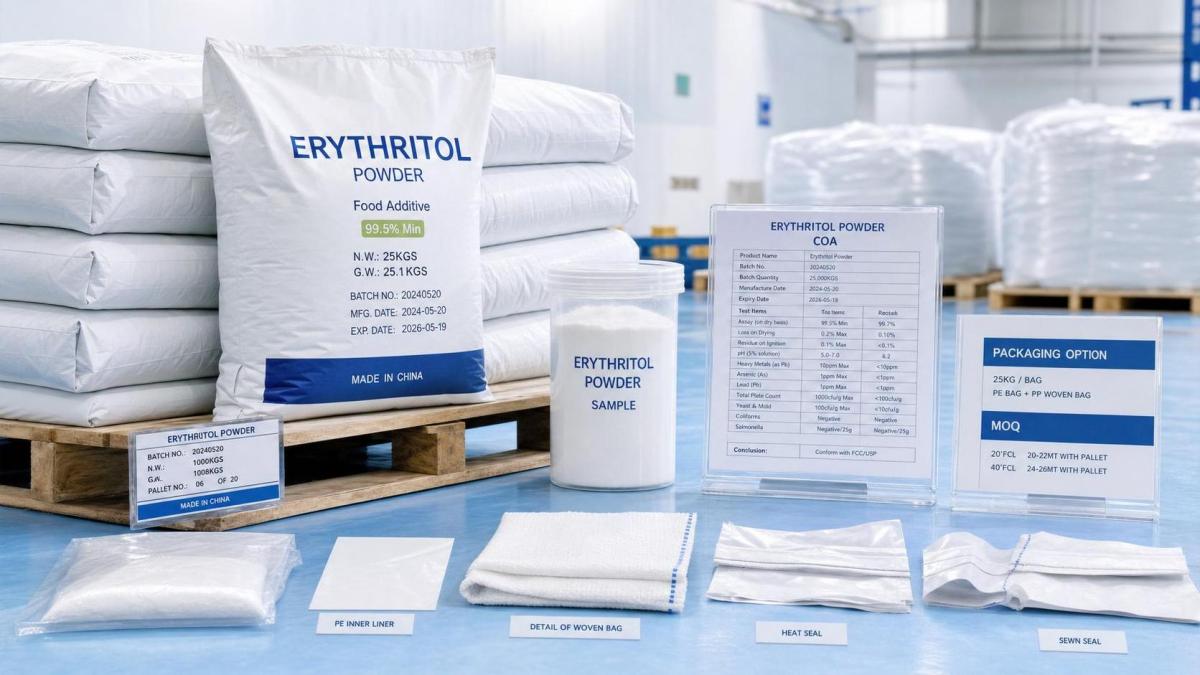
A good erythritol powder bulk decision starts with risk control, not just unit price.
In practical terms, purity grades, packaging stability, freight conditions, and MOQ structure shape the real landed cost.
That is why bulk sweetener sourcing now looks more like fine chemical evaluation than a simple commodity purchase.
AgriChem Chronicle often tracks this shift across regulated supply chains, where documentation quality can matter as much as production volume.
For erythritol powder bulk, small differences in specification can affect blending behavior, label compliance, and shipment acceptance.
A reliable buying framework should answer four questions early.
- Is the purity grade aligned with the intended formulation and market?
- Will the packaging protect flowability and product integrity during storage and transit?
- Does the supplier provide complete regulatory and traceability records?
- Is the MOQ commercially workable without creating avoidable inventory pressure?
Once these basics are clear, cost comparisons become far more meaningful.
Are all purity grades suitable for the same use case?
Not really. The term erythritol powder bulk sounds uniform, but grades often differ in assay level, particle distribution, and impurity limits.
A food application may accept one specification, while nutraceutical or pharma-adjacent uses may require tighter documentation and cleaner impurity profiles.
The more sensitive the downstream formula, the less room there is for “close enough” sourcing.
A common mistake is treating a high assay number as the only indicator.
In reality, buyers should review several points together.
- Assay range and testing method consistency
- Moisture limit and caking tendency
- Mesh size or particle size distribution
- Residual solvents, heavy metals, and microbiological limits where relevant
- Country-specific compliance statements
If several suppliers quote similar purity, ask for recent COAs from multiple lots.
That approach reveals whether the spec is stable or just attractive on paper.
A quick comparison table helps narrow the shortlist
The table below works as a practical screening tool before moving into sampling or contract discussion.
Which packaging option makes the most sense for erythritol powder bulk?
Packaging is often treated as a logistics detail, but it directly affects usable yield.
Erythritol is generally stable, yet powder condition can still change if moisture barriers are weak or handling is rough.
The most common options are 25 kg bags, jumbo bags, or customized industrial packs.
The better choice depends on storage setup, unloading equipment, and consumption rate.
For many buyers, 25 kg multilayer bags with inner liners offer a useful balance.
They are easier to inspect, simpler to segregate by lot, and less disruptive if one unit is damaged.
Jumbo bags can lower packaging cost per ton, but they need better warehouse discipline.
If discharge systems are not designed for them, labor savings may disappear.
- Check whether inner liners are food-contact compliant where required.
- Ask about pallet wrap, corner protection, and container loading pattern.
- Confirm whether each pallet carries clear batch labels and net weight data.
- Review shelf life assumptions under humid or hot transit conditions.
In short, packaging should support both product integrity and warehouse efficiency.
How should MOQ be evaluated beyond the headline number?
MOQ is not just a volume threshold. It is a signal about supplier flexibility, production economics, and your own inventory risk.
A low MOQ can look attractive during qualification, but pricing may become uncompetitive after freight and handling are added.
A high MOQ may improve price per kilogram, yet it can lock working capital into slow-moving stock.
A more useful question is whether MOQ aligns with monthly usage, safety stock policy, and lot approval timing.
When comparing erythritol powder bulk offers, review MOQ in these terms.
- Sample quantity for lab and pilot validation
- Minimum commercial order for standard pricing
- Full container economics versus partial shipment surcharges
- Ability to hold stock or schedule call-off deliveries
- Tolerance for mixed documentation or split lots
More experienced buyers often negotiate around structure rather than only asking for a lower MOQ.
For example, a supplier may keep the nominal MOQ but allow phased release, fixed-price windows, or trial-to-contract conversion.
What documentation separates a dependable supplier from a risky one?
This is where many erythritol powder bulk comparisons become clearer.
If the paperwork is thin, inconsistent, or slow to arrive, supply risk is already visible.
In cross-border trade, missing technical records can delay customs clearance or customer approval more than a price gap ever would.
AgriChem Chronicle regularly highlights this issue across fine chemicals and ingredient markets, where traceability is now part of commercial credibility.
At minimum, expect a current COA, SDS, specification sheet, and manufacturer identity.
Depending on destination and application, additional files may be necessary.
- Statement of origin and production site details
- GMP, ISO, HACCP, or other site certifications where relevant
- Non-GMO, allergen, and contaminant declarations
- Batch traceability and retention sample policy
- Change notification procedure for raw materials or process shifts
One useful test is simple: ask how quickly the supplier can provide a complete document pack for a recent lot.
Fast, coherent responses usually indicate mature internal controls.
Where do hidden costs and common buying mistakes usually appear?
The visible quote rarely tells the full story.
With erythritol powder bulk, hidden costs often sit in rejected lots, repacking labor, delayed approvals, moisture damage, or oversized safety stock.
A cheaper source can become expensive once those factors are measured across a quarter.
Another recurring mistake is comparing suppliers on a single shipment basis.
A better approach is to compare twelve-month reliability, average lot consistency, and documentation responsiveness.
That longer view is especially useful when input markets become volatile.
- Do not approve a supplier based only on one polished sample lot.
- Do not ignore packaging damage rates in humid-season shipping.
- Do not accept vague answers on process changes or subcontracting.
- Do not separate MOQ discussion from freight mode and storage cost.
The more disciplined method is to build a simple comparison sheet and score each offer against the same operational criteria.
That makes erythritol powder bulk sourcing easier to defend internally and easier to improve over time.
So what is the smartest next step before placing a large order?
Start by defining the non-negotiables.
That usually means target purity, acceptable packaging format, required documents, and an MOQ range that fits actual turnover.
Then compare suppliers using the same checklist, not separate email impressions.
For erythritol powder bulk, the strongest offer is often the one with fewer downstream surprises, not the lowest opening quote.
In real sourcing programs, confidence comes from repeatable evidence: stable lot data, clear packaging controls, workable MOQ terms, and transparent compliance records.
That is also the standard increasingly reflected in industry reporting from AgriChem Chronicle, where supply chain transparency and technical accuracy are treated as commercial essentials.
If a purchase decision is approaching, the practical move is to request current lot documents, verify packaging samples, test MOQ assumptions against annual demand, and compare total landed risk before contract release.
Related Intelligence
- Natural IngredientsIndustrial-Scale Agricultural Sourcing: Key Criteria for Reliable SupplyIndustrial scale agri sourcing made reliable: assess supplier capacity, traceability, landed cost, logistics, and resilience to protect production continuity.
- Natural IngredientsHow Microencapsulated Botanical Ingredients Improve Stability and Controlled ReleaseMicroencapsulated botanical ingredients enhance stability, protect sensitive actives, and enable controlled release for reliable performance across demanding applications.
- Natural IngredientsHow to Evaluate Bioactive Compounds for Nutraceuticals by Stability, Efficacy, and FormatBioactive compounds for nutraceuticals should be evaluated by stability, efficacy, and format. Learn how to compare ingredients, reduce formulation risk, and choose options that perform in real products.
The Morning Broadsheet
Daily chemical briefings, market shifts, and peer-reviewed summaries delivered to your terminal.
