

The Authority in Global Agricultural Chemistry & Bio-Resources
Tank Size Vendor Comparison: Verify Usable Volume, Tolerances, and Lead Times

A tank quotation can look reassuringly simple: a stated capacity, a diameter, a height, a material grade, and a delivery date. Yet procurement teams know that a “10,000-litre tank” is not necessarily a tank that will hold 10,000 litres in service, fit through an existing access route, tolerate a process chemical, or arrive when a shutdown window begins.
A meaningful tank size vendor comparison therefore starts with a change in perspective. The question is not, “Which supplier offers the largest nominal capacity for the lowest price?” It is, “Which proposed tank delivers the required operating volume, fits the installation, meets the duty conditions, and can be supplied with evidence we can defend?” That distinction matters whether the tank will store liquid fertilizer, process water, feedstock, API intermediates, edible oils, aquaculture treatment chemicals, or washdown effluent.
For buyers in primary industries and fine-chemical operations, a tank is rarely an isolated purchase. It affects batch consistency, safety systems, cleaning procedures, civil works, pump sizing, regulatory documentation, and production continuity. The most useful vendor comparison is therefore one that turns unlike quotations into a common, technically comparable basis.
Start with usable volume, not the number on the nameplate
Nominal volume is often the first source of confusion. A supplier may describe a tank as 20 m³ based on its total geometric capacity, while the process can only access 17.5 m³ because of a dished bottom, a low-level outlet position, required heel volume, internal fittings, or a mandated freeboard allowance. In a batch process, that difference can be the margin between one complete production run and an inconvenient top-up.
Ask each vendor to state capacity in clear operating terms:
- Gross or brimful volume: the maximum theoretical volume before overflow.
- Working volume: the intended safe fill range during normal operation.
- Usable or drainable volume: the quantity that can actually be withdrawn through the specified outlet under the proposed tank geometry.
- Residual heel: liquid remaining after normal drainage, particularly important for costly chemicals, hygiene-sensitive products, and changeover operations.
- Freeboard: the unfilled headspace needed for agitation, foaming, thermal expansion, surge, or safe handling.
These definitions should appear in the technical offer, not merely in a sales drawing. If a tank supports formulation, blending, or dosing, request a volume-versus-level chart. This lets engineering teams verify level transmitter ranges, calibration points, low-level alarms, and pump protection logic. It also prevents a familiar late-stage dispute: the supplier delivered the contracted vessel, but the site cannot run the planned batch size.
For vertical cylindrical tanks, operating volume is influenced by more than shell height. Cone angles, bottom slope, outlet nozzle elevation, internal coils, agitator shafts, baffles, manways, and dip pipes all displace liquid or alter what can be recovered. Horizontal tanks introduce another issue: liquid level is not linearly related to volume. A small change in level at the upper arc may represent a very different volume change than the same level movement near the centerline.
Put dimensional tolerances beside the site drawings
Two tanks with the same stated volume can have very different footprints. One vendor may use a taller, narrower design to minimize floor area; another may propose a wider vessel that reduces height but complicates transport and access. Neither approach is automatically better. The correct choice depends on the site.
Before issuing a request for quotation, assemble a controlled dimensional brief. Include maximum available height, clear door widths, crane or forklift limits, maintenance access, foundation dimensions, nozzle connection locations, required aisle clearance, and overhead obstructions. If the tank will be placed outdoors, account for wind exposure, bund walls, pipe rack elevations, drainage gradients, and inspection access.
Then ask suppliers to provide both nominal dimensions and fabrication tolerances. A drawing that says “diameter 2,500 mm” is useful, but procurement needs to know whether the actual finished diameter may vary, how shell roundness is controlled, how flange face locations are referenced, and whether support leg spacing can be adjusted. Tolerances become especially significant when a tank is sliding into an existing containment bay or connecting to fixed pipework that cannot easily move.
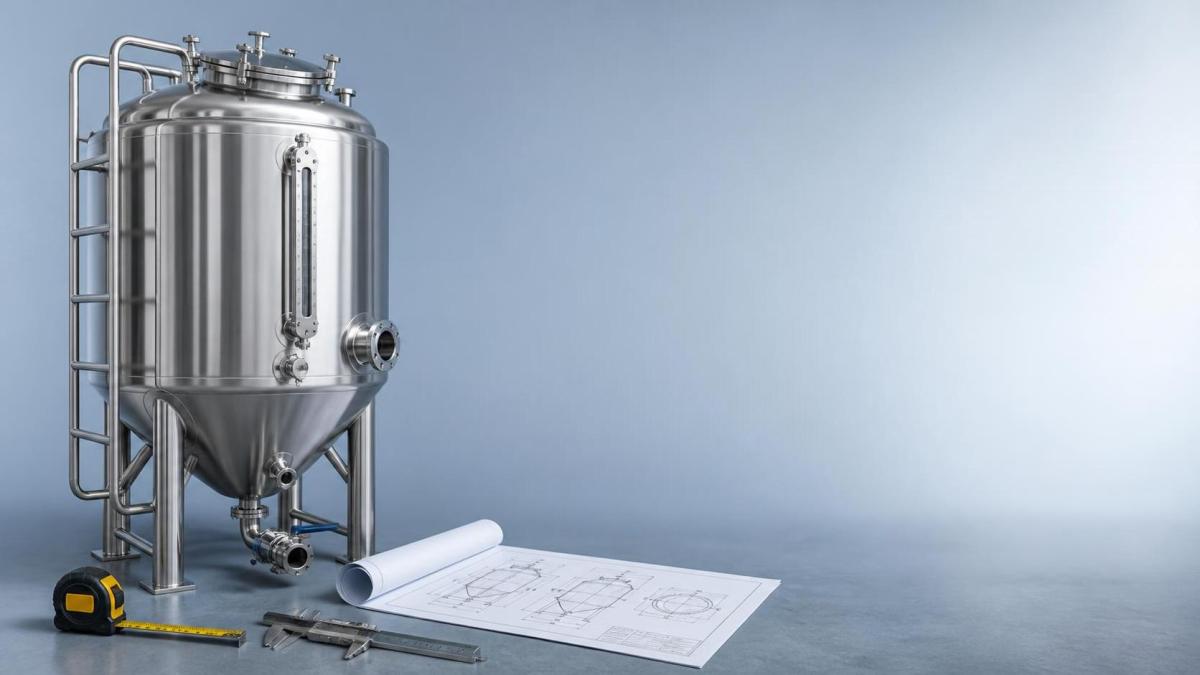
Do not overlook transportation dimensions. The vessel may fit inside the building but be impossible to move through the final route without removing handrails, ductwork, or door frames. Require vendors to identify shipping orientation, transport envelope, lifting points, estimated delivered weight, and any field assembly assumptions. A split-shell or site-welded solution may solve an access problem, but it changes inspection, qualification, schedule, and commercial risk.
A comparison sheet should separate process fit from fabrication quality
Many procurement teams compare tanks with a single scoring table. That can work, provided the table does not reduce technical suitability to a few broad labels. A practical method is to use two linked reviews: one for process and installation fit, and another for manufacturing assurance.
In the process review, compare usable capacity, operating pressure and temperature, fluid density, viscosity, solids content, agitation requirements, drainability, cleaning method, and connection requirements. A tank intended for dry bulk, for example, needs a different conversation about hopper angle, flow aids, bridging, and discharge equipment than a tank holding aqueous process liquid. Likewise, an aquaculture dosing tank may require UV resistance, secure chemical containment, and accurate low-volume drawdown, while a pharmaceutical intermediate vessel may place far greater emphasis on cleanability, surface finish, and traceable wetted materials.
In the fabrication review, examine material certificates, welding procedures, inspection plans, surface treatment, pressure testing, passivation where relevant, and final documentation. The goal is not to demand every possible document for every service. It is to match evidence to risk. A non-hazardous water buffer tank and a vessel handling corrosive or regulated material should not be evaluated through identical documentation expectations.
Material compatibility is a system question
Material selection is frequently reduced to a short phrase: “stainless steel,” “polyethylene,” or “carbon steel lined.” That is too broad to support a purchase decision. Compatibility depends on the exact chemical composition, concentration, temperature, residence time, cleaning chemicals, exposure to sunlight, and potential contaminants. Even compatible base materials can fail at gaskets, bolts, sight glasses, valve seats, or lining seams.
Give vendors the actual service envelope where possible: chemical name, concentration range, pH, maximum and minimum temperature, operating pressure or vacuum, expected cycles, cleaning regime, and any trace solvent or chloride exposure. Ask them to identify all wetted components, not only the shell. If the vendor makes a compatibility recommendation, request the basis for it and any limitations. This is particularly important for bio-extracts, active ingredients, fertilizers, oxidizing agents, and saline applications, where a small process variation can change the corrosion picture.
A sensible buyer also distinguishes between vendor confirmation and independent process responsibility. The tank manufacturer can confirm what it is supplying; the owner’s engineering, EHS, and process teams must still determine whether that specification is suitable for the intended duty. That shared boundary should be explicit before a purchase order is released.
Ask what “compliant” means in the offered scope
Terms such as “GMP-ready,” “FDA suitable,” “EPA compliant,” or “built to standard” can be useful starting points, but they are not complete specifications. Regulations apply differently according to location, product, pressure category, storage volume, emissions risk, sanitation requirements, and end use. A supplier’s statement may refer to material suitability, a weld standard, a design code, or a prior project experience—not necessarily compliance of the finished installation.
Instead of accepting broad claims, ask direct questions:
- Which design and fabrication code is being applied, and to which parts of the tank?
- Is the offered vessel atmospheric, pressure-rated, vacuum-rated, or designed only for a limited venting condition?
- Which certificates will be supplied for plate, pipe, fittings, welders, coating, lining, and testing?
- What inspections occur during fabrication, and can the buyer or a third-party inspector witness them?
- Are internal finishes, weld treatments, and cleanability requirements included or excluded?
- Which accessories are supplied by the vendor, and which are assumed to be sourced or installed by others?
This is where a tank size vendor comparison reveals hidden gaps. One quotation may include a vent, level connection, ladder, platform, and calibrated sight gauge; another may show only the vessel shell. A lower opening price can become the higher installed cost once necessary safety and operational components are added.
Lead time should be tested, not accepted at face value
Quoted lead time is often interpreted as the period from purchase order to delivery. In reality, it may begin only after approved drawings, receipt of a deposit, finalization of nozzles, or release of customer-supplied components. It may also exclude freight, site unloading, commissioning support, or documentation closeout. For projects tied to seasonal planting, harvest intake, plant turnarounds, or regulated manufacturing campaigns, these distinctions are not administrative details. They are schedule risk.
Request a milestone schedule rather than a single delivery promise. It should show design submission, approval deadline, material procurement, fabrication start, inspection hold points, factory acceptance testing where applicable, dispatch readiness, and anticipated arrival. Ask what conditions could move each milestone. Specialty alloy availability, custom flanges, lining cure times, vendor engineering workload, and transport permits can all influence the real date.
Vendor capacity matters as much as stated lead time. A supplier with a short standard schedule but limited fabrication slots may be less dependable than a manufacturer with a slightly longer but well-documented production plan. Review how the vendor manages changes, whether they fabricate critical components in-house, and who owns responsibility for purchased accessories. Procurement should also clarify the consequences of late approvals from the buyer’s side; ambiguity here can turn a manageable delay into a contested claim.
Build the RFQ around decisions that cannot be corrected cheaply later
The most expensive tank errors are usually embedded before fabrication begins. Changing a nozzle location after delivery, increasing a support load after civil works are complete, or discovering inadequate vacuum resistance during commissioning is far more disruptive than spending additional time on the RFQ package.
A strong request for quotation should include a process data sheet, preferred layout or space envelope, design conditions, material requirements, required connections, utility needs, access and cleaning expectations, inspection requirements, delivery location, and required documentation. Where information is uncertain, identify it as an assumption and require the supplier to list any design dependencies. This is better than allowing each vendor to make different silent assumptions.
When comparing responses, normalize them. Convert capacities to the same definition, distinguish included equipment from optional equipment, compare delivered weight and footprint, and separate freight from ex-works pricing. Mark every deviation. A vendor that clearly states exceptions may be easier to work with than one whose quotation appears complete but leaves critical scope unaddressed.
The final decision: choose the tank that protects the operation
Price still matters, and procurement teams are right to challenge unexplained cost differences. But the lowest purchase price is not a reliable indicator of lowest lifecycle cost. A tank that drains poorly can waste valuable product. A marginally sized vessel can limit production. Incomplete documentation can delay qualification. A missed delivery window can leave an entire process line waiting for a component that looked routine on the original capital list.
The best supplier is not necessarily the one with the most polished proposal. It is the one whose offer makes capacity, tolerances, materials, inspection, responsibilities, and lead-time assumptions visible enough for the buyer to make a confident decision.
For procurement professionals, that is the practical value of a disciplined tank size vendor comparison: it replaces broad capacity claims with operational facts. When usable volume, installation fit, compliance evidence, and schedule realism are all evaluated together, the selected tank is far more likely to perform as planned long after the quotation has been forgotten.
Related Intelligence
- RAS SystemsSustainable Aquaculture Practices That Cut Feed Waste and Protect Fish Farm Water QualitySustainable aquaculture for fish farms: reduce feed waste, protect water quality, and build resilient, efficient systems with practical strategies.
- RAS SystemsDrum Filter System Price: How Flow Rate, Micron Rating, and Automation Affect CostDrum filter system price depends on flow rate, micron rating, automation, materials, and lifecycle costs. Compare quotes confidently and choose the right system.
- RAS SystemsHow to Specify Large-Scale Fish Farming Equipment for High-Output RAS ProjectsLarge scale fish farming equipment guide for high-output RAS projects—specify tanks, filtration, oxygen, automation, and redundancy for reliable growth.
The Morning Broadsheet
Daily chemical briefings, market shifts, and peer-reviewed summaries delivered to your terminal.
