

The Authority in Global Agricultural Chemistry & Bio-Resources
How to Specify Large-Scale Fish Farming Equipment for High-Output RAS Projects
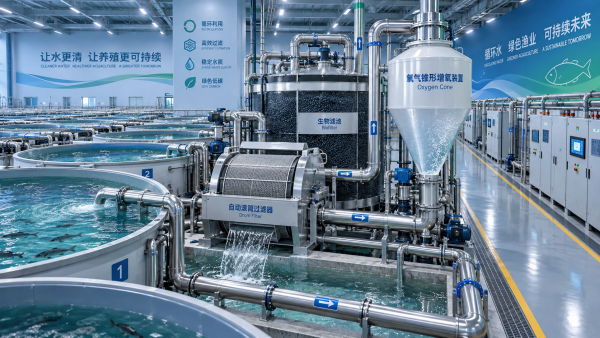
At the point where a recirculating aquaculture system moves from concept drawings to equipment schedules, the conversation changes. A projected annual harvest is no longer just a commercial target; it becomes a chain of hydraulic, biological, mechanical, and operational assumptions. If one link is underspecified—a drum filter with insufficient peak solids capacity, an oxygen system without redundancy, a biofilter that cannot recover after a feeding increase—the entire production plan may be exposed.
For project managers, specifying large scale fish farming equipment for a high-output RAS project is therefore an engineering exercise before it is a purchasing exercise. The objective is not to assemble a list of tanks, pumps, filters, and sensors. It is to create an integrated production environment that maintains stable water quality, protects fish welfare, supports predictable harvest volumes, and remains serviceable under real operating conditions.
The most reliable specifications begin with production biology and work outward to equipment performance, building layout, utility demand, controls, and vendor accountability. That order matters. Buying components first and attempting to make them fit a production plan later is one of the costliest mistakes in industrial aquaculture development.
Begin with the production envelope, not the equipment catalogue
A supplier may offer an impressive range of RAS modules, but no catalogue can answer the central project question: what must the system reliably produce, and under what conditions? Before comparing vendors, define the production envelope in enough detail for engineering decisions to be tested rather than assumed.
This should include the cultured species, target harvest size, annual output, stocking strategy, survival assumptions, feed rate profile, temperature range, feed conversion expectations, grading practices, and harvest rhythm. A facility producing fish continuously has different equipment requirements from one operating in seasonal batches, even where annual tonnage appears similar.
Feed loading is particularly important because it drives the size and duty of much of the treatment train. Solids removal, biofiltration, oxygen transfer, carbon dioxide stripping, alkalinity management, sludge handling, and make-up water demand all respond to the amount and timing of feed entering the system. A design based only on standing biomass can look adequate on paper while underperforming during peak feeding periods.
Project teams should ask suppliers to state clearly which design inputs they have used. “Capacity” without a declared feed rate, water temperature, oxygen target, and stocking density is not a meaningful basis for comparing large-scale fish farming equipment.
Think in process trains: every tank is downstream of a treatment decision
High-output RAS facilities work best when they are specified as linked process trains rather than isolated pieces of equipment. Water leaving a culture tank carries suspended solids, dissolved carbon dioxide, ammonia, fine organic matter, and a changing microbial load. The treatment sequence must remove or control these loads in a way that suits the species and production density.
A typical process train may include culture tanks, mechanical solids separation, fine filtration, biofiltration, degassing, oxygenation, disinfection or pathogen-control stages where appropriate, temperature control, and a return-water loop. The exact arrangement varies by species, site water quality, biosecurity policy, and operating philosophy. What should not vary is the discipline of defining performance at each handoff.
For example, the solids-removal stage should not be specified simply as “one drum filter per module.” The specification should address hydraulic flow, screen opening, expected solids load, backwash demand, bypass arrangements, maintenance access, and performance when the screens are partially fouled. Likewise, a biofilter should be assessed not only by nominal media volume, but by ammonia conversion duty at the intended temperature, its oxygen requirements, alkalinity consumption, start-up strategy, and resilience during loading fluctuations.
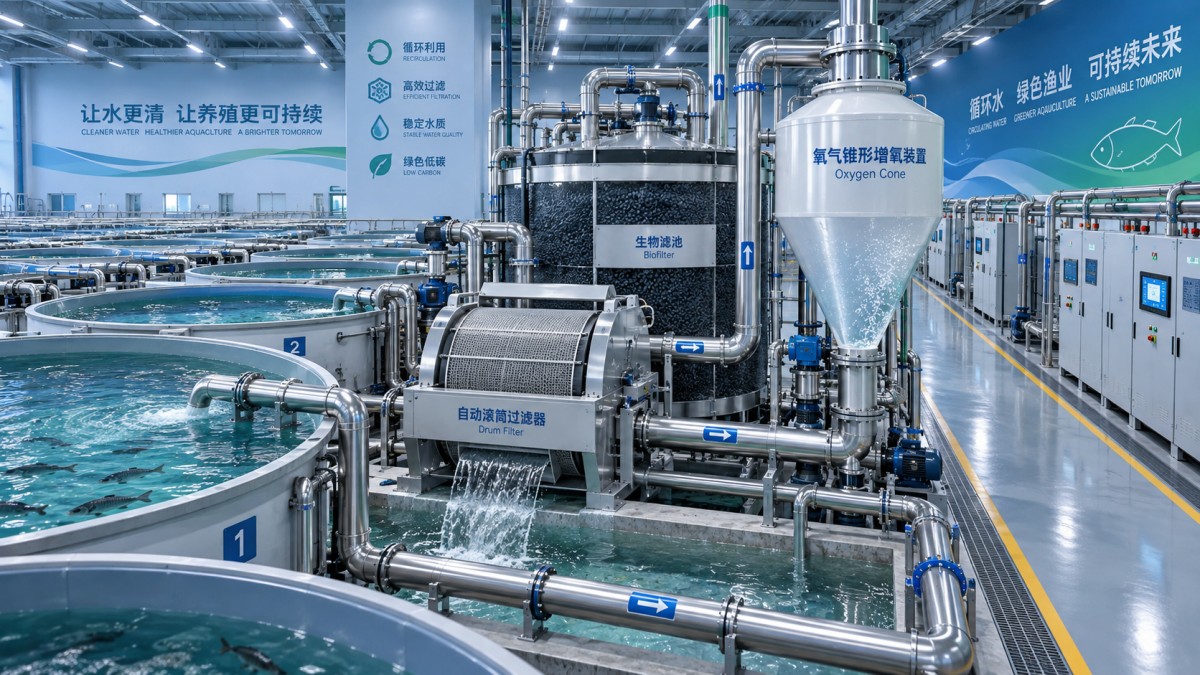
A useful review question is: if this component loses performance, what happens in the next six hours? That question reveals why a high-output RAS needs more than nominal capacity. It needs margin, alarms, isolation capability, and recovery pathways.
Tank selection is a fish-management decision as much as a civil one
Culture tanks establish the daily operating rhythm of the farm. Their geometry affects fish circulation, waste collection, grading, harvesting, cleaning, observation, and staff safety. Round tanks are widely used because they can support rotational flow and central solids collection, but the correct choice depends on species behaviour, biomass management, building constraints, and harvesting method.
When evaluating tanks, look beyond volume. Confirm the intended water velocity, inlet and outlet configuration, self-cleaning performance, floor slope or center-drain arrangement, overflow protection, sightlines for operators, and compatibility with nets, graders, lifts, and harvest pumps. A tank that appears efficient in a layout drawing can become labor-intensive if operators cannot safely inspect fish or remove mortalities without interrupting water flow.
Material choice also deserves practical scrutiny. Tank construction must withstand continuous exposure to water, cleaning agents, salts where relevant, UV exposure in semi-open installations, and the physical demands of large fish and equipment movement. Request details on structural support, surface finish, joints, penetrations, and repair methods. Long-term serviceability often matters more than a modest difference in initial cost.
Water quality equipment should be specified against peak duty and failure duty
The difficult moment in an RAS is rarely a calm, average day. It is the warm afternoon when feeding is high, a screen is clogging, incoming water quality changes, and a pump or blower is taken offline for maintenance. Equipment selection should reflect both peak operating duty and credible failure scenarios.
Mechanical filtration needs enough practical capacity to manage solids before they break down into smaller particles and dissolved organic loads. Include provisions for automatic cleaning, inspection, wastewater routing, and access for changing screens or seals. If filtration backwash enters a sludge system, that downstream system must be sized and operated as part of the same decision.
Oxygenation and degassing deserve special attention because dissolved oxygen and carbon dioxide conditions can change rapidly with feed rate, temperature, and biomass. Select oxygen cones, low-head oxygenators, diffusers, blowers, stripping columns, or degassing units according to actual hydraulic conditions and required transfer performance. The equipment should be evaluated alongside oxygen storage or generation, emergency supply, distribution piping, control valves, and monitoring points—not as separate line items.
Heating, chilling, and heat recovery may be decisive in projects located in climates with large seasonal variation. The relevant question is not merely whether the system can reach a target temperature. It is whether it can hold that temperature economically while dealing with ventilation losses, make-up water, pump heat, biofilter activity, and changing external conditions. Early coordination between RAS engineers and building-services engineers prevents expensive redesign later.
Redundancy is not a luxury when biology cannot pause
Fish do not wait for spare parts, technician travel, or an electrical contractor’s availability. A commercially serious RAS specification should distinguish between equipment that can be temporarily unavailable and equipment whose loss creates an immediate animal welfare or production risk.
Pumps, blowers, oxygen supply, emergency power, alarms, and critical monitoring commonly require defined redundancy or emergency backup. The appropriate level depends on risk tolerance, species sensitivity, operating density, local infrastructure, and the response time of the site team. Rather than prescribing redundancy generically, write down the event the system must survive: loss of a duty pump, utility power interruption, oxygen delivery failure, control-system outage, or a blocked tank outlet.
For each event, identify the detection method, automatic response, manual intervention, available response time, and recovery procedure. This transforms redundancy from a vague promise into an operable design requirement. It also exposes hidden dependencies—for instance, a standby pump is of limited value if it shares the same vulnerable electrical panel, suction header, or control logic as the primary unit.
Automation should make the farm easier to operate, not harder to understand
Automation is essential in large-scale fish farming equipment, but an overcomplicated control system can create a new form of risk. The goal is not a dashboard full of data. It is a control architecture that helps operators see developing problems early, act consistently, and retain manual control when necessary.
At a minimum, determine which parameters require continuous measurement, how sensors will be calibrated, where readings will be taken, and which values trigger alarms or process responses. Dissolved oxygen, temperature, pH, oxidation-reduction potential where used, water level, flow, pressure, and power status are common priorities. Depending on system design, ammonia, nitrite, carbon dioxide, turbidity, salinity, and ozone residual may also be operationally important.
Sensor maintenance should be treated as a planned operating task, not an afterthought. A sensor that is difficult to reach, clean, verify, or replace soon becomes a weak point in the decision chain. Require a clear sensor schedule, calibration procedures, local indication for critical assets, alarm escalation logic, data retention terms, and cybersecurity responsibilities for remote access.
Good automation also respects the experience of farm staff. Operators should be able to understand why a pump started, why an alarm appeared, and what conditions must be restored before normal operation resumes. A black-box system may look sophisticated during commissioning but become frustrating during a real incident.
Biosecurity and cleanability belong in the equipment specification
In intensive aquaculture, disease control is shaped by building design and daily handling as much as by water-treatment technology. Equipment layouts should support separation between production zones, controlled movement of personnel and tools, hygienic removal of mortalities, and cleaning routines that do not compromise the system’s biological stability.
Specify drainability, clean-in-place requirements where applicable, smooth and accessible surfaces, isolated tank groups, quarantine provisions, and routes for feed, fish, waste, and staff. Dead legs in pipework, inaccessible channels, and poorly planned floor drainage can create persistent sanitation problems. Similarly, equipment rooms need enough space to perform maintenance without carrying contamination through culture areas.
Compliance requirements should be assessed early with local regulators, veterinary authorities, water-discharge agencies, and workplace safety bodies. Depending on the jurisdiction, the project may need to demonstrate control of effluent, sludge storage, chemical handling, oxygen safety, noise, energy systems, construction materials, and fish-health procedures. Imported equipment can be technically sound yet still create delays if its electrical, pressure-vessel, or documentation standards do not align with local requirements.
Compare suppliers by engineering evidence, not headline claims
When several vendors appear capable, a structured technical comparison is more valuable than a broad list of features. Ask each supplier to respond to the same design basis and provide a defined scope boundary. Otherwise, one quotation may include controls, commissioning, training, pipework, and spares while another includes only core skids.
References can be useful, but they should be interpreted carefully. A supplier may have installed a system for a different species, water temperature, production density, or regulatory environment. Ask what was learned during commissioning, how the equipment has performed after sustained production, and which design revisions were made in later installations. The most informative answers are usually specific and measured, not promotional.
Make lifecycle cost visible before contracts are signed
Capital expenditure tends to dominate early conversations because it is visible and immediate. Yet over the life of a high-output RAS, energy, oxygen, labor, maintenance, consumables, water treatment, waste handling, and downtime can outweigh small differences in purchase price. The least expensive equipment package is not necessarily the lowest-cost production platform.
Request an operating model that separates fixed and variable consumption and identifies the assumptions behind each estimate. Pumping head, blower efficiency, oxygen source, thermal loads, pumping hours, backwash frequency, and water-exchange rate should all be visible. Where assumptions are uncertain, use sensitivity ranges rather than accepting a single optimistic figure.
Maintainability should carry real weight in the selection process. Can a pump seal be changed without draining a process line? Are valves reachable? Is there lifting access for large motors or screens? Can an isolated unit be serviced while the farm continues operating? These are practical questions, but they strongly influence labor costs, unplanned downtime, and the confidence of the operating team.
A specification that survives handover
The final equipment specification should read like a shared operational contract between the project owner, engineering team, supplier, and future farm manager. It should define process duties, materials, instrumentation, control philosophy, installation interfaces, acceptance tests, documentation, training, spare parts, warranties, and commissioning responsibilities.
Factory acceptance testing and site acceptance testing should be planned before manufacture, especially for packaged treatment units, controls panels, oxygen systems, and automated feeding equipment. Define what will be tested, which instruments will be calibrated, what records must be delivered, and how performance shortfalls will be handled. Commissioning is not merely the final milestone; it is the first period in which equipment, biology, and people must work as one system.
For project managers, the strongest decision is rarely the one with the most equipment or the lowest quotation. It is the option whose design assumptions are transparent, whose risks are acknowledged, and whose components can be operated and maintained by the team that will inherit the farm. In high-output RAS, that clarity is what turns a collection of large-scale fish farming equipment into a dependable production asset.
Related Intelligence
- RAS SystemsSustainable Aquaculture Practices That Cut Feed Waste and Protect Fish Farm Water QualitySustainable aquaculture for fish farms: reduce feed waste, protect water quality, and build resilient, efficient systems with practical strategies.
- RAS SystemsDrum Filter System Price: How Flow Rate, Micron Rating, and Automation Affect CostDrum filter system price depends on flow rate, micron rating, automation, materials, and lifecycle costs. Compare quotes confidently and choose the right system.
- RAS SystemsHow to Specify Large-Scale Fish Farming Equipment for High-Output RAS ProjectsLarge scale fish farming equipment guide for high-output RAS projects—specify tanks, filtration, oxygen, automation, and redundancy for reliable growth.
The Morning Broadsheet
Daily chemical briefings, market shifts, and peer-reviewed summaries delivered to your terminal.
