

The Authority in Global Agricultural Chemistry & Bio-Resources
Comparing Battery Cage System Costs by Capacity, Tiers, and Materials
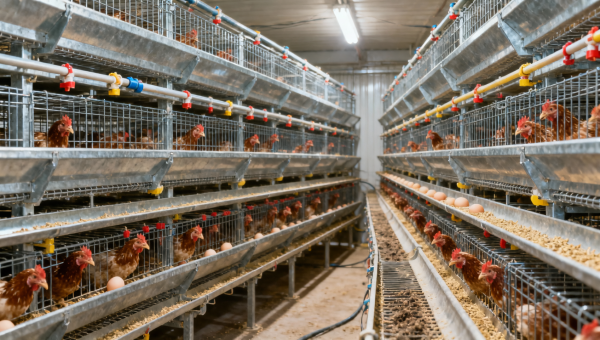
Quoted equipment prices can look comparable until the scope is unpacked. A poultry battery cage system is not a single item: it is a structural assembly tied to watering, feeding, egg collection, manure handling, electrical controls, installation, and the building that supports it. Two proposals with the same nominal bird capacity may differ substantially in steel mass, usable cage area, automation boundaries, corrosion protection, and commissioning responsibility.
For technical evaluators, the useful question is rarely “Which quotation is lowest?” It is whether the quoted system provides the required capacity, welfare configuration, durability, and operating interface at an acceptable lifecycle cost. Capacity, tier count, and materials are the main cost drivers, but they only become meaningful when reviewed alongside layout assumptions and supplier scope.
Start with a comparable definition of capacity
Capacity is often stated as the number of birds a house can hold, but this figure alone is not sufficient for comparison. A supplier may calculate capacity from the total cage positions, while a project team may need to account for required stocking density, unusable end sections, service aisles, or space reserved for equipment access. The same building footprint can produce different bird counts depending on cage width, depth, compartment design, and the adopted welfare framework.
Before comparing proposals, evaluators should define capacity in a schedule that includes:
- target flock size and intended bird type;
- net usable cage area per bird under the project’s applicable rules;
- number of rows, cage banks, tiers, and house length;
- allowances for walkways, cross aisles, feed-drive access, and egg collection ends;
- spare capacity, if any, for phased stocking or flock management; and
- which ancillary equipment is included in the capacity-related price.
A low cost per bird can be misleading if it assumes a denser arrangement than the owner can operate or permit. Conversely, a lower-density layout may raise the initial cage cost per housed bird while reducing redesign risk where welfare rules, customer specifications, or export-market requirements are stricter.
Regulatory context should be checked before the layout is frozen. In the European Union, Council Directive 1999/74/EC establishes minimum standards for the protection of laying hens and sets conditions for enriched cages, alternative systems, and conventional cages. It should not be treated as a universal design specification; national rules, customer programs, and destination-market requirements can impose different conditions. Source: Council Directive 1999/74/EC, Official Journal of the European Communities, 19 July 1999.
Why larger systems do not scale in a straight line
Increasing capacity generally lowers certain unit costs because engineering, container loading, controls, and site mobilization can be spread over more bird places. That benefit has limits. Longer houses require more intermediate structural support, additional drive sections, more feed and water distribution points, greater cable and pipe runs, and careful attention to voltage drop, pressure balance, and belt tracking.
At small and medium capacities, an entry-level arrangement may use simpler feed delivery and local egg collection. At larger capacities, more automation can become operationally justified because manual collection, manure removal, and feed management consume more labor hours and become harder to control consistently. The higher initial purchase price is not automatically a penalty; it may reflect equipment needed to prevent bottlenecks at the chosen scale.
Technical reviewers should ask suppliers to separate the cage package from capacity-dependent peripherals. A quote should show, at minimum, the number of cage units, feed trough length, nipple drinker count and configuration, egg belt length, manure belt length, drive motors, control panels, and end-of-line equipment. This makes it possible to see whether an apparent unit-price advantage comes from a genuinely simpler system or from omitted components.
Freight economics also change with scale. Large systems can fill containers more efficiently, but oversized components, partial shipments, damaged galvanizing during transport, and multiple delivery batches can introduce cost and schedule exposure. The quotation should state packing method, loading responsibility, shipment split, and whether fasteners, hangers, electrical cabinets, and installation tools are included in the shipped scope.
Tier count: higher density brings structural and maintenance trade-offs
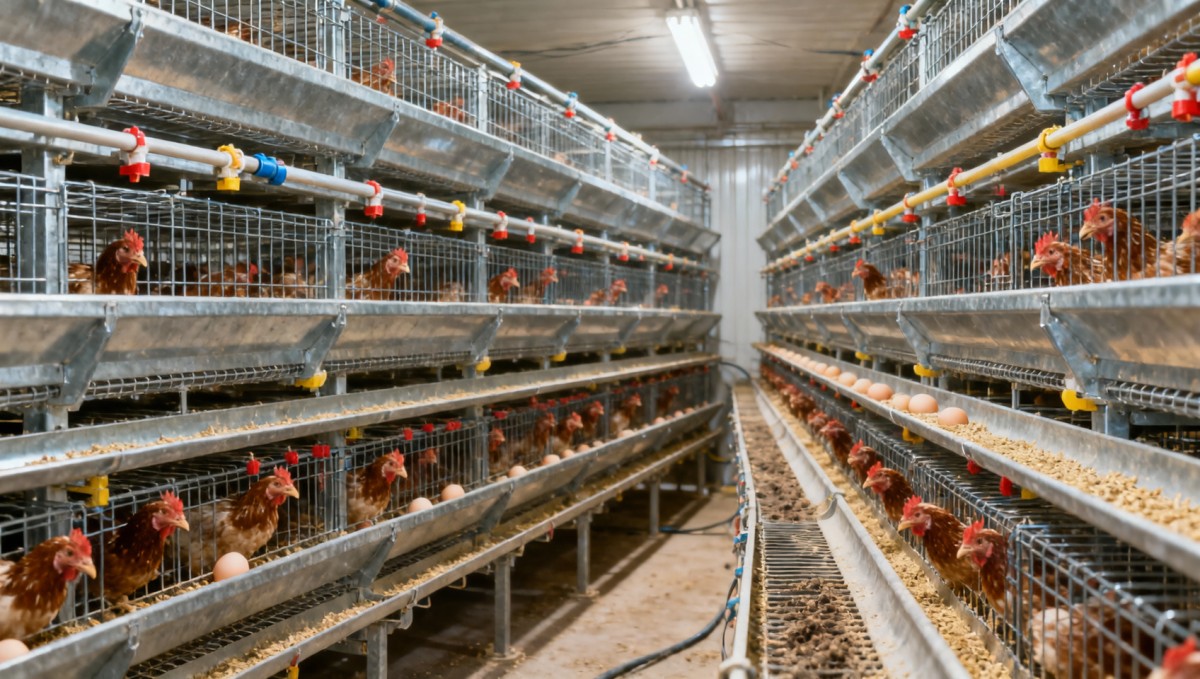
Moving from a lower-tier arrangement to a multi-tier system can increase housed birds per square metre of building footprint. That can reduce the building cost allocated to each bird place, particularly where land, roofing, and utility connections are expensive. Yet each added tier changes more than the vertical dimension of the cage bank.
Higher systems usually require stronger legs, braces, anchors, and load paths. They may need more robust manure belt support, longer lift or collection arrangements, additional access provisions, and more careful installation tolerances. A deviation in floor level or anchoring can become more consequential as the rack height increases. The house must also provide sufficient clearance for top-tier maintenance, ventilation equipment, lighting, and safe access.
Tier count should be assessed with manure strategy and ventilation, not as an isolated structural variable. More birds in the same footprint increase heat, moisture, dust, and ammonia-management demands. If the ventilation concept cannot maintain suitable conditions through the full vertical cage profile, savings in building footprint may be offset by production, corrosion, or maintenance problems. Environmental design should be reviewed by qualified project specialists against local climate and operating conditions.
Accessibility has a cost implication as well. A configuration that makes a failed drinker line, belt tensioner, or feed drive difficult to reach may appear economical in the bill of materials but can create longer outages. Evaluators should inspect access points for daily inspection, belt cleaning, lubrication where applicable, motor replacement, and emergency manual operation.
Materials determine more than the steel price
Cage frames, wire mesh, feed troughs, fasteners, legs, and manure-belt supports may use different materials or protective treatments within the same system. Comparing them only by nominal material grade misses the conditions that drive corrosion and wear.
Galvanized steel is commonly used because it offers a practical balance of cost and corrosion resistance. However, technical teams should establish whether components are hot-dip galvanized after fabrication, pre-galvanized before forming, or use another coating system. Welded areas, cut edges, sharp bends, drainage points, and locations where manure or wash water can accumulate deserve specific attention. The coating process, coating continuity, and post-fabrication treatment may influence field durability more than a broad statement that the system is “galvanized.”
ISO 1461:2009 specifies general requirements and test methods for hot-dip galvanized coatings on fabricated iron and steel articles. It can be a useful reference when a supplier claims hot-dip galvanizing, although it does not replace a project-specific material specification or inspection plan. Source: ISO 1461:2009, Hot dip galvanized coatings on fabricated iron and steel articles — Specifications and test methods, International Organization for Standardization.
Wire selection also deserves close review. Cage mesh must retain shape under bird contact, cleaning, and long-term loading while avoiding poorly finished cut ends or joints that could create injury or cleaning issues. Mesh gauge, aperture, wire coating, weld quality, and the stiffness of the cage floor should be requested as documented parameters rather than inferred from photographs.
Plastic components can be appropriate for drinker cups, pipe fittings, egg-contact surfaces, or selected guards, but their value depends on polymer type, ultraviolet exposure where relevant, chemical compatibility with cleaning products, and availability of replacement parts. Stainless steel may be justified at localized points exposed to aggressive moisture or chemical cleaning, though using it everywhere may not be the most economical design. The correct approach is to match material selection to the corrosion zone, cleaning method, and expected service access.
Reading a poultry cage price without losing the scope
When reviewing a battery cage system in poultry price, the main discipline is to identify the pricing unit and its exclusions. A per-set figure, a per-bird figure, and a delivered-project figure answer different questions. None is useful unless the evaluator knows whether the price includes automation, controls, site installation, civil works, freight, duties, commissioning, training, and spare parts.
Normalizing proposals into a comparison sheet is often more reliable than asking suppliers to revise prices repeatedly. Use a common set of columns for bird places, cage rows, tiers, steel treatment, feed system, drinker system, egg collection, manure removal, motors, controls, packing, freight basis, installation supervision, warranty terms, and exclusions. Add a separate section for building interfaces, including anchor layout, floor flatness tolerance, drainage, utility load, water filtration, and ventilation responsibility.
This process often reveals scope gaps early. One supplier may include a main control panel but exclude field wiring; another may include cage assembly but exclude the equipment needed to transfer eggs from the house. Neither approach is necessarily incorrect, provided the boundary is clear and the owner can accurately price the remaining interfaces.
Questions that expose quality and delivery risk
Supplier questions should test whether the proposed configuration can be built, installed, and maintained as described. Broad assurances are less useful than traceable answers. Technical evaluation can include the following requests:
- Provide general arrangement drawings showing row spacing, tiers, service aisles, support locations, and equipment drives.
- List the material and protective treatment for each major component, including mesh, legs, troughs, brackets, and fasteners.
- State which components are factory assembled, which are site assembled, and what installation tools or skilled labor are assumed.
- Identify inspection points before shipment, including dimensional checks, coating inspection where specified, and verification of motors and controls.
- Clarify the source and specification of purchased items such as gear motors, nipples, belts, sensors, and electrical components.
- Provide an itemized spare-parts recommendation for commissioning and the first operating period, without assuming that every part must be purchased upfront.
- Explain warranty start date, exclusions related to installation or water quality, and the procedure for obtaining replacement parts.
For systems shipped internationally, documents should match the physical package. Packing lists, component labels, drawings, and installation manuals reduce the chance that similar-looking parts are mixed during assembly. This matters particularly for multi-tier systems, where a misplaced bracket or drive component can delay a whole row.
Choose the lowest defensible lifecycle cost
The cheapest acceptable system is not necessarily the one with the lowest initial equipment total. A useful evaluation weighs initial spend against expected corrosion exposure, labor requirements, availability of maintenance access, replacement-part dependency, energy and water interfaces, and the consequences of a failure during a production cycle.
Capacity should be validated against usable area and operating rules. Tier count should fit the building, ventilation strategy, and maintenance capability. Materials should be specified by component and exposure condition rather than described in generic terms. Once these foundations are defined, price comparisons become far more meaningful: technical teams can distinguish a genuine cost reduction from a missing scope item, an unsuitable density assumption, or a durability compromise that will surface after installation.
Related Intelligence
- Poultry Housing & CagingHow Cage Specifications Affect Poultry Housing Costs in NigeriaLocally made poultry cage price in Nigeria: compare cage specifications, housing costs, durability, ventilation, manure systems, and installation factors for smarter poultry investment.
- Poultry Housing & CagingWhat Determines Battery Cage Prices in Nigeria Beyond Bird Capacity?Battery cage price in Nigeria depends on more than capacity. Compare steel, automation, logistics, and installation scope for a smarter poultry investment.
- Poultry Housing & CagingBuilding a Poultry Farm Equipment Solution Around Flock Size and LayoutPoultry farm equipment solution planning for flock size and layout—optimize feeding, water, ventilation, automation, and future expansion.
The Morning Broadsheet
Daily chemical briefings, market shifts, and peer-reviewed summaries delivered to your terminal.
