

The Authority in Global Agricultural Chemistry & Bio-Resources
Sustainable Aquaculture Practices That Cut Feed Waste and Protect Fish Farm Water Quality
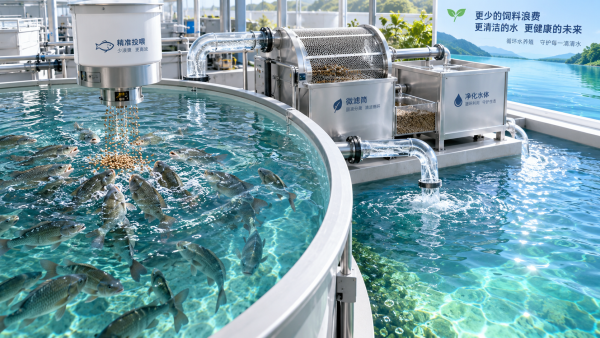
Feed waste and deteriorating water quality are usually treated as separate problems. In a working fish farm, they are the same operational chain. Uneaten pellets, poorly digested feed, and excess nutrient loading become oxygen demand, suspended solids, ammonia risk, algae pressure, and higher treatment costs. Sustainable aquaculture for fish farms works when it manages that chain from feed specification through to water discharge or reuse, rather than relying on a single corrective technology at the end.
The practical starting point is not “Which equipment should we buy?” It is “Where does feed stop becoming fish biomass?” A farm that cannot answer that question by production unit, feeding period, and biomass stage will struggle to size aeration, filtration, sludge handling, or water exchange correctly. Better sustainability outcomes generally begin with tighter operating control, then use infrastructure to handle the remaining load.
Map the feed-to-water pathway before expanding capacity
Aquaculture projects often add tanks, cages, raceways, or ponds based on nominal production capacity. The more useful design input is the expected daily feed load at peak biomass, including the feed that will be rejected, lost during delivery, or excreted as dissolved and solid waste. This is the load that determines whether a water-management system remains stable during warm weather, stock grading, harvest delays, or a short-term disruption in feeding behavior.
Begin with a simple operating map for each production area:
- Species, life stage, stocking pattern, and expected biomass progression.
- Feed type, pellet size, feeding frequency, storage conditions, and delivery method.
- Where fish feed actively, where pellets accumulate, and where water currents carry fine particles.
- How quickly solids can be separated before they break down into smaller particles or dissolved nutrients.
- Which water-quality variables trigger action, who reviews them, and what action follows.
This map exposes design gaps early. For example, a feed barge may distribute pellets effectively in calm conditions but create drift losses in changing currents. A tank may have adequate total water turnover but still contain low-flow zones where solids settle. A pond may look healthy during normal feeding but lose oxygen margin after several days of high appetite. These are not minor operational details; they determine whether the system can absorb variation without a water-quality event.
For new builds, treat peak feeding periods as the governing operating condition. For existing sites, use the map to identify the first constraint before adding more equipment. Installing a larger filter will not solve waste created by inconsistent feeding. Adding sensors will not help if staff have no defined response when readings move outside the farm’s operating range.
Precision feeding is the highest-leverage waste-control measure
Feed is both the largest recurring input and the source of much of the farm’s nutrient burden. The objective is not simply to feed less. Underfeeding can impair growth uniformity and increase competition, while overfeeding converts expensive feed into water-treatment demand. The aim is to match the ration, pellet characteristics, and feeding schedule to actual appetite and environmental capacity.
A practical feeding program combines planned rations with live observation. Biomass estimates and expected growth set the baseline, but operators should adjust delivery based on feeding response, temperature, dissolved oxygen conditions, health status, and recent handling. A fixed schedule with no feedback is easy to administer, but it often produces waste when fish appetite shifts.
Choose control methods that fit the production system
Feed selection matters, but it should not be reduced to a label claim. Pellet durability, water stability, particle size, palatability, nutrient balance, and consistency between batches all affect how much feed is actually consumed and retained. A pellet that breaks down before fish can take it creates fine solids that are harder to capture. Conversely, a feed that remains physically stable but is poorly accepted can still raise waste. Procurement and farm teams should evaluate feed alongside the delivery system and the species’ feeding behavior, not as an isolated purchasing decision.
Feeding records need to be usable, not elaborate. At minimum, capture feed issued, feed delivered, observed response, mortality or health events, water-quality exceptions, and changes in biomass assumptions. Reviewing these records by unit can show whether a poor feed-conversion trend is likely caused by formulation, feeder calibration, stock condition, oxygen stress, or simple over-allocation.
Capture solids while they are still manageable
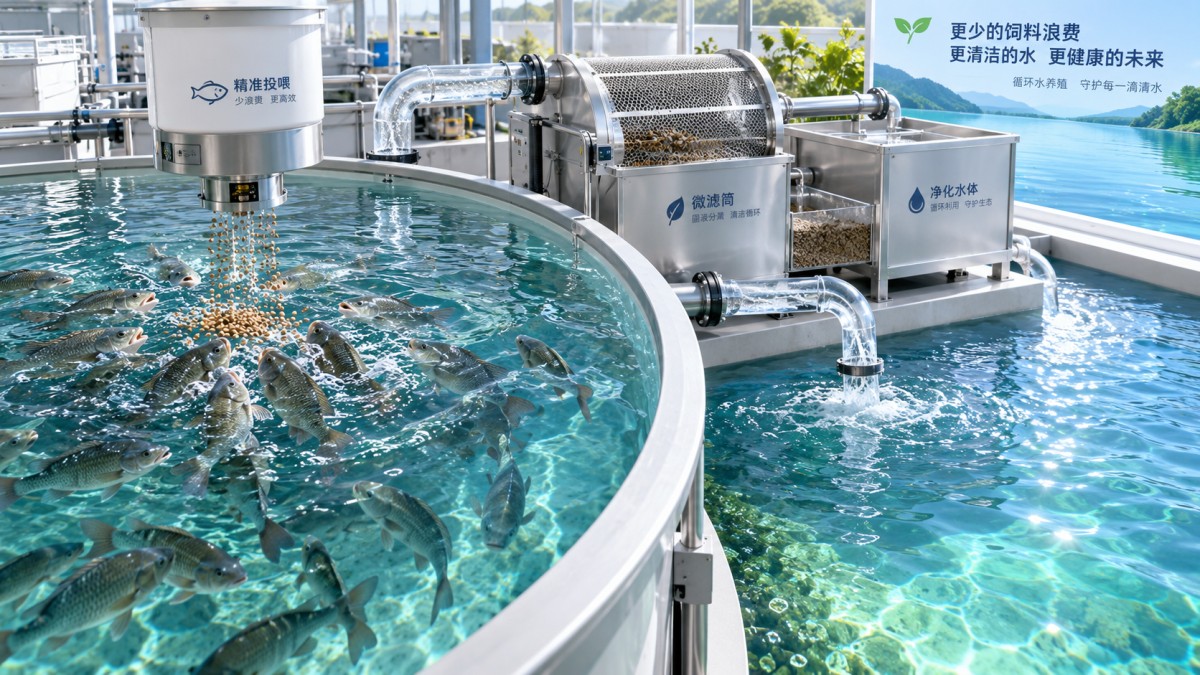
Once uneaten feed and fecal material remain in water, their character changes. Larger particles can often be directed toward collection points or mechanical separation. As they break apart, they become harder to remove and contribute more rapidly to biological oxygen demand and nutrient release. That is why the most effective waste-control designs focus on early capture rather than only downstream treatment.
In tank-based systems, hydraulic design deserves the same scrutiny as major equipment selection. Inlets should support the intended circulation pattern, while drains and collection points should remove settled solids without creating areas of excessive turbulence or stagnant flow. Pipework, screens, and separators also need access for inspection and cleaning. A layout that works in a commissioning test may perform differently after biofouling, partial blockage, or changing fish size alters how solids move through the system.
Mechanical separation should be matched to the type and volume of solids the farm produces. Screens, settling devices, swirl separators, and other solids-removal equipment each have different practical strengths. The right choice depends on particle characteristics, flow variability, available footprint, maintenance capability, and how collected sludge will be managed. It is a mistake to select a separator solely from a supplier’s nominal flow rating. The real question is whether it will perform under the site’s solids load and continue to do so when staff are busy with production work.
Sludge handling is often omitted from early project scope. Yet separated solids still require storage, dewatering, treatment, transfer, or a permitted reuse or disposal route. If this route is inconvenient, operators may delay cleaning or bypass the intended process. A sustainable design makes waste handling routine: clear access, safe washdown, protected storage, and a defined responsibility for each step.
Protect water quality with response-based monitoring
Water-quality monitoring becomes valuable when it changes decisions. A dashboard full of readings is not a control system unless the farm has thresholds, escalation paths, and operating responses. The most relevant parameters vary by species and system, but dissolved oxygen, temperature, pH, nitrogen compounds, turbidity or suspended solids, and flow performance commonly reveal whether feeding and waste management remain in balance.
Continuous instruments are useful where conditions can change quickly or where a failure would affect a large biomass. They are not a substitute for manual cross-checks, calibration, cleaning, and observation of fish behavior. Sensors can drift, foul, lose communication, or report a value that is technically valid at one point in the system but unrepresentative of the area where fish are stressed.
Build monitoring around decisions such as these:
- When dissolved oxygen margin narrows, reduce or pause feeding before increasing biological waste loading.
- When suspended solids rise, inspect feeding behavior, separator performance, drain flow, and cleaning status before assuming a water-exchange problem.
- When nitrogen indicators trend upward, check whether solids are bypassing removal, whether biofiltration is receiving an abrupt load increase, and whether the feed plan has changed.
- When water quality differs between units, compare actual feed delivery and hydraulic conditions rather than relying only on system-wide averages.
This response logic is more valuable than a generic alarm threshold because it connects a reading to a manageable cause. It also prevents a common error: treating water exchange as the default remedy for every issue. Exchange can dilute a problem, but it may increase intake risk, discharge volume, pumping demand, and dependence on external water conditions. It should be part of the farm’s operating strategy, not a substitute for feed and solids control.
Design resilience into aeration, backup power, and operating procedures
Lower feed waste improves water quality, but it does not eliminate the need for resilience. Oxygen demand can rise after feeding, during warm periods, when solids accumulate, or when biological treatment performance changes. Aeration and oxygenation capacity should be considered alongside backup power, equipment redundancy, alarms, access to emergency equipment, and the time required for staff to respond.
Projects sometimes specify redundant hardware but overlook shared points of failure. Two blowers do not provide meaningful redundancy if they rely on the same electrical panel, intake location, control system, or poorly maintained distribution line. The same principle applies to pumps, feeders, communications, and monitoring devices. Review failure modes in terms of what happens to fish and water quality during the first minutes and hours, not merely whether a spare unit exists on the equipment list.
Operating procedures should reflect the farm’s actual constraints. A response plan that requires several trained people on site is weak if night shifts are lightly staffed. A water-quality alarm that does not identify the unit, urgency, and initial response wastes time. Procedures become more dependable when they are short, role-specific, and tested during ordinary operations rather than stored only in a project handover file.
Scale sustainable aquaculture in phases, not by copying a layout
Successful sustainable aquaculture for fish farms is site-specific because water source, climate, species, production density, labor model, discharge route, and market schedule all change the balance of risk. A recirculating system may justify detailed automation and treatment integration where land or water availability is constrained. A pond or cage operation may gain more from improved feed delivery, environmental observation, and localized waste controls than from importing a complex tank-system design.
Phased expansion makes this easier to manage. Start by establishing consistent feeding records, routine water-quality response, and reliable solids handling in a representative production area. Then use the operating data to refine feeder capacity, drainage, treatment sizing, and staffing procedures before replicating the design. This avoids locking in assumptions that looked reasonable during planning but fail under real biomass and daily workload.
Documentation also matters during procurement. Equipment specifications should state the operating duty, expected variation in load, maintenance access, controls integration, cleaning requirements, consumables, and service support. Feed supply agreements should address consistency, delivery conditions, traceability, and how deviations will be handled. These details protect the project from a familiar failure mode: components that work individually but do not function as a coherent production system.
What to verify before approving the next investment
Before approving a feeder upgrade, treatment package, or capacity expansion, review one production cycle through four questions. How much feed is delivered and where does it go? How quickly are solids removed? What water-quality changes occur after feeding and at peak biomass? Can the team respond safely when a pump, sensor, or power source fails?
The answers will usually point to the right priority. If feed distribution is inconsistent, improve delivery and observation before adding treatment capacity. If solids are accumulating in predictable zones, correct hydraulics and cleaning access. If readings are available but responses vary by operator, standardize the decision process. If the system runs well only under ideal conditions, invest in resilience before increasing stock.
For projects that need to compare feed processing, aquaculture technology, and supply-chain considerations across disciplines, technical intelligence is most useful when it connects equipment claims to operating conditions. That is the practical value of focused sector analysis such as the aquaculture and feed coverage published by AgriChem Chronicle: it helps project teams frame procurement around system performance, traceability, and operational fit rather than headline specifications alone.
Feed waste will never be eliminated completely. The workable target is a farm where losses are detected early, captured efficiently, and prevented from becoming a water-quality crisis. That approach protects fish health, makes operating costs more visible, and gives expansion plans a sounder technical basis.
Related Intelligence
- RAS SystemsSustainable Aquaculture Practices That Cut Feed Waste and Protect Fish Farm Water QualitySustainable aquaculture for fish farms: reduce feed waste, protect water quality, and build resilient, efficient systems with practical strategies.
- RAS SystemsDrum Filter System Price: How Flow Rate, Micron Rating, and Automation Affect CostDrum filter system price depends on flow rate, micron rating, automation, materials, and lifecycle costs. Compare quotes confidently and choose the right system.
- RAS SystemsHow to Specify Large-Scale Fish Farming Equipment for High-Output RAS ProjectsLarge scale fish farming equipment guide for high-output RAS projects—specify tanks, filtration, oxygen, automation, and redundancy for reliable growth.
The Morning Broadsheet
Daily chemical briefings, market shifts, and peer-reviewed summaries delivered to your terminal.
