

The Authority in Global Agricultural Chemistry & Bio-Resources
How to Plan Grain Storage Capacity and Flow for a Food Processing Plant
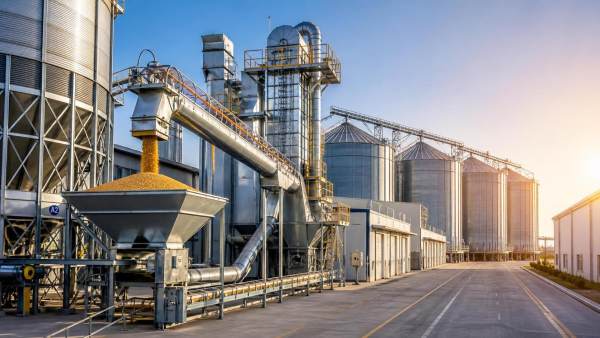
A grain processing line can appear adequately supplied on a normal weekday and still fail at the first difficult harvest window. Trucks arrive faster than expected, incoming moisture varies by load, the dryer is occupied, and production continues pulling from the same bins that receiving needs to fill. The visible symptom is usually a queue at the scale or a stopped mill. The less visible consequences are more serious: grain sits too long in trucks, wet material is routed into the wrong storage, operators make hurried bin switches, and traceability becomes harder to maintain.
This is why grain storage planning for processing plants is not simply a matter of adding up annual grain demand and selecting enough silo volume. Storage, receiving, drying, cleaning, conveying, and production consumption operate on different clocks. A workable design must absorb the mismatch between those clocks without turning every busy delivery day into an operational exception.
When evaluating a new facility, an expansion, or a recurring congestion problem, start with the material journey rather than the silo catalogue. Follow one load from the gate through sampling, weighing, unloading, conditioning, storage, reclaim, cleaning, and final process feed. At each handoff, ask a practical question: “If the next step is unavailable for two hours, where can this grain wait safely?” The answer often reveals the actual capacity requirement.
Start with the operating pattern, not the annual tonnage
Annual consumption is useful for budgeting supply, but it does not describe the most demanding day. A plant may use grain steadily throughout the year while receiving it in short seasonal bursts, under restricted delivery hours, or from several suppliers whose arrival patterns overlap. Designing for average receipts can leave receiving equipment overwhelmed precisely when the business needs it most.
Build the planning basis around a set of operating scenarios. These do not need invented precision; they need to expose realistic pressure points. Typical scenarios include a normal production day, a peak harvest receiving day, a wet-grain day when drying is required, a day with one storage bin unavailable for sanitation or maintenance, and a period when production changes formulation or grain class.
For each scenario, define the following inputs:
- Expected production consumption by grain type, grade, and shift.
- Maximum likely receiving volume during the available delivery window.
- Typical and upper-range incoming moisture, foreign material, and temperature conditions.
- Required segregation between crop types, grades, supplier lots, treated and untreated material, or food-safety hold status.
- Time needed for sampling, quality release, cleaning, drying, cooling, and bin changeovers.
- Planned downtime for conveyors, bucket elevators, dust-control equipment, and process lines.
The objective is not to predict every arrival perfectly. It is to identify which combination of events creates the longest queue, the highest moisture risk, or the greatest chance that production loses its feed source. Capacity that appears excessive on a yearly spreadsheet can be essential when viewed through these short-duration operating conditions.
Separate the grain by its job in the system
A common planning error is treating all stored grain as interchangeable inventory. In reality, a plant usually needs several kinds of capacity, each serving a different operational purpose. If all volume is assigned to long-term storage, the facility may have plenty of grain but nowhere to put the next wet or unapproved load.
This functional separation is especially important where the incoming material is variable. A dry, clean lot may move directly toward assigned storage after approval. A wetter lot may need a separate route, and a load awaiting laboratory review may need to remain isolated. Combining these paths too early can create a quality problem that no later conveyor arrangement can correct.
Find the bottleneck by tracing rates through the whole route
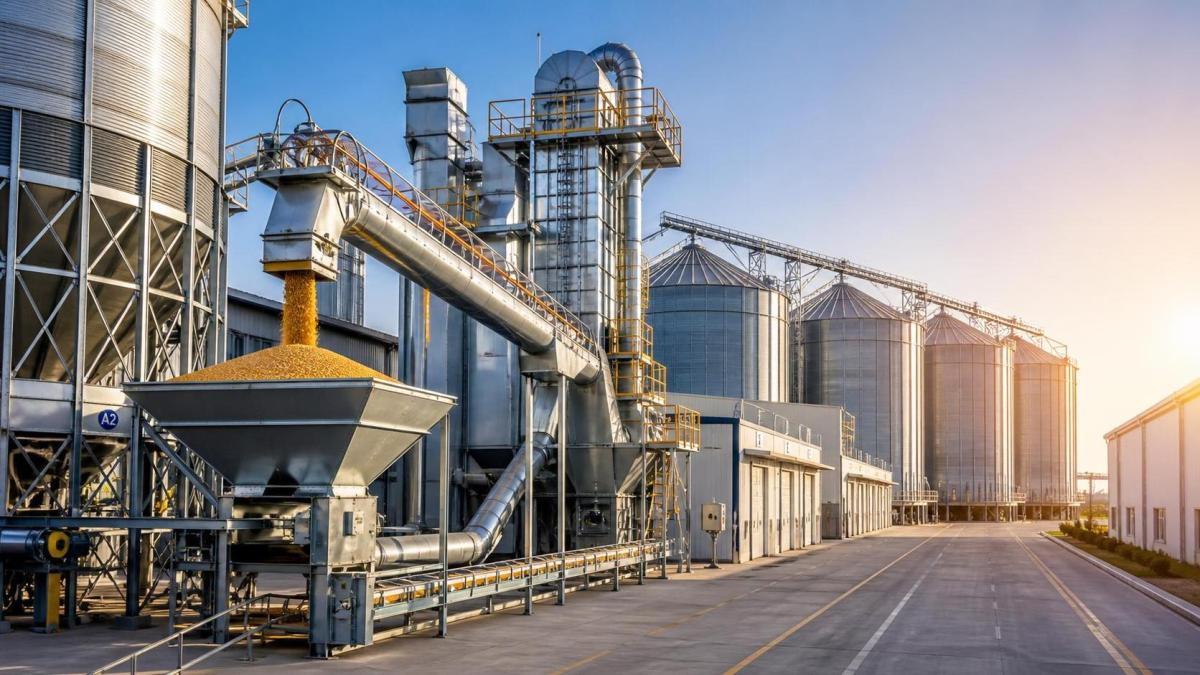
Storage volume does not solve a flow restriction. A facility can have large bins and still experience receiving delays if the intake pit, elevator, cleaner, dryer, or transfer conveyor cannot keep pace with arrival rates. Conversely, an oversized receiving leg may provide little benefit if the next destination is routinely full.
Map every route as a sequence of maximum usable rates, not just nameplate capacities. The usable rate is affected by grain condition, moisture, dust loading, elevator fill, conveyor incline, cleaning intensity, changeover time, and the need to avoid mixing. Equipment also cannot always operate at its rated capacity while maintaining gentle handling and reliable aspiration.
Then compare three rates for each critical period:
- Arrival rate: how quickly grain can reach the site and be presented for unloading.
- Receiving-to-storage rate: the slowest effective rate from pit to approved destination.
- Production withdrawal rate: the rate at which the process can consume material from available bins.
If arrival exceeds receiving-to-storage capacity, a truck queue or temporary holding requirement will develop. If receiving exceeds the ability to dry or condition grain, wet inventory accumulates. If production withdrawal depends on a single transfer path that is also needed for receiving, the plant may be forced to choose between accepting deliveries and feeding production. These are flow conflicts, not merely equipment sizing issues.
Pay close attention to shared equipment. One bucket elevator, one drag conveyor, or one distributor may serve several functions on a layout drawing, yet it can only move one material stream at a time. Allow for the minutes spent emptying a line, switching valves, confirming destination, and documenting lot movement. Those interruptions are often overlooked because they do not appear as a rated throughput value.
Use a time-based mass balance before choosing bin sizes
A practical way to test the design is to create a shift-by-shift mass balance. For each grain category, record opening inventory, receipts, material sent to cleaning or drying, transfers into storage, withdrawals to production, and closing inventory. Repeat the exercise across the difficult scenarios identified earlier.
The basic relationship is straightforward:
Closing inventory = Opening inventory + Receipts − Process withdrawals − Losses or approved removals
What matters is where that closing inventory sits. Grain in a truck, intake pit, wet holding bin, drying queue, finished storage bin, or day bin is not equally useful. A model that shows positive total inventory can still conceal a blocked system because the available space is in the wrong location or assigned to the wrong grain class.
Do not assume every bin can be filled to its geometric maximum and counted as available capacity. Working capacity must account for safe operating levels, flow behavior, aeration requirements, roof-space limits, and the practical need to preserve a route for the next movement. It should also account for material that remains in hoppers, conveyors, legs, and transition chutes after a changeover.
Test the “one bin out” condition
One of the most useful stress tests is to remove a key bin from service in the model. It may be emptying for a grade change, undergoing cleaning, awaiting inspection, or unavailable because of a mechanical issue. If the whole receiving plan collapses when one bin is unavailable, the design has little operational resilience.
The response is not always to add the largest possible silo. Sometimes a smaller dedicated surge bin, an alternate conveyor route, an extra discharge point, or clearer segregation rules provides more usable flexibility than a single large vessel. The correct choice depends on where the imbalance occurs and whether the constraint is time, routing, moisture handling, or inventory separation.
Plan receiving and drying as one operating system
Wet grain is where many otherwise sound storage plans become fragile. A receiving pit sized for dry grain may be insufficient when unloading must pause for moisture testing, dryer availability, or wet-bin management. If wet grain cannot move promptly into a controlled path, quality risk increases and receiving staff may be pressured to make unsuitable routing decisions.
Define the wet-grain path in detail. Include sampling, acceptance criteria, temporary holding, cleaning if required before drying, dryer feed, discharge, cooling, post-drying verification, and final storage assignment. Each step needs a designated destination and a method for preventing untreated material from mixing with dry, released inventory.
Drying capacity should be evaluated in relation to the expected moisture removal task, not only the stated grain intake rate. Higher incoming moisture generally means more work per unit of grain and may reduce the amount that can be processed during a delivery window. Storage planning should therefore include enough buffering to keep wet grain moving safely when drying is the pacing operation.
Aeration and temperature management also deserve early attention. Long holding periods, uneven moisture, fines concentration, and limited airflow can create conditions that are difficult to correct after bins are filled. Access for inspection, temperature monitoring points, sampling, cleanout, and safe maintenance should be considered part of usable storage design rather than later add-ons.
Protect quality by designing for segregation and clean changeovers
Operational efficiency has little value if the system cannot maintain the grain distinctions required by the process. Segregation may be necessary for moisture class, protein or quality specification, supplier lot, crop variety, allergen-related controls, treated seed exclusion, or status pending release. The exact categories vary, but the design principle remains the same: the material route must match the control plan.
Ask where residual grain remains after every transfer. A conveyor can be empty enough to appear clear while still retaining material that matters for a sensitive changeover. Consider reclaim tunnels, boot pits, distributors, gravity spouts, filters, and dust collection interfaces. These locations influence both carryover risk and the time needed to switch products safely.
Where frequent changes are expected, reduce unnecessary shared paths or provide procedures that make route verification visible and repeatable. Bin identification, destination interlocks, documented sampling points, and clear status controls can be more valuable than adding nominal capacity. The goal is to prevent an operator from having to rely on memory during a congested shift.
Choose expansion flexibility deliberately
For a new build, it is tempting to optimize only for the current production forecast. That can make the first phase cheaper, but it may leave no practical way to add capacity without interrupting operations later. Reserve space and structural allowances where future bins, elevators, reclaim equipment, or truck lanes could be added. Confirm that electrical distribution, dust-control arrangements, foundations, and controls architecture can accommodate a future phase.
Expansion does not always mean more storage. If future production will consume a different grain mix, require tighter segregation, or operate additional shifts, the more valuable investment may be parallel receiving, extra day-bin capacity, or a separate route for conditioned grain. Grain storage planning for processing plants should therefore identify the expected source of future strain instead of assuming it will be solved by more bulk volume.
Turn the layout into an operating plan
Before approving equipment selections, run a tabletop operating review with the people who will receive, maintain, sample, and run the process. Walk through a peak delivery period, a wet-grain event, a production formulation change, and a mechanical outage. Note every decision that depends on a person noticing a condition at exactly the right moment. Those are the areas where bin status indication, routing controls, physical access, or operating procedures may need improvement.
A sound design leaves room for ordinary disruptions: delayed trucks, variable grain condition, maintenance windows, and the occasional rejected or held load. It does not require perfect timing to function. When capacity and flow are planned together, storage becomes a controlled buffer that protects production, grain quality, and receiving efficiency rather than a collection of bins that only looks adequate on paper.
Related Intelligence
- Grain Silos & StorageHow Modular Feed and Grain Systems Support Scalable Storage and Processing ExpansionModular feed and grain systems enable smarter, scalable expansion across storage, conveying, processing, and loadout. Discover how to eliminate bottlenecks, protect future capacity, and keep operations moving.
- Grain Silos & StorageHow to Size a Grain Pre-Cleaner for Capacity, Crop Type, and Impurity LoadGrain pre cleaner machine sizing guide: match capacity, crop type, moisture, and impurity load to improve flow, separation quality, and downstream performance.
- Grain Silos & StorageHow Can You Verify That a Grain Handling System Meets Export Standards?How do I know if a grain handling system meets export standards? Explore practical checks for traceability, sanitation, quality control, and export-ready compliance.
The Morning Broadsheet
Daily chemical briefings, market shifts, and peer-reviewed summaries delivered to your terminal.
