

The Authority in Global Agricultural Chemistry & Bio-Resources
Is quaculture & Fishery entering a smarter growth phase?
Is quaculture & Fishery entering a smarter growth phase? The stronger signal is not hype, but operational pressure. Energy costs, feed volatility, traceability rules, and water risk are reshaping daily decisions.
For quaculture & Fishery, smarter growth means using data, automation, and compliance planning to protect margins while meeting environmental expectations. The opportunity now depends on where digital tools solve real bottlenecks.
Across the broader industrial landscape, quaculture & Fishery also connects with chemicals, processing equipment, ingredients, cold chain systems, and export documentation. That makes scenario-based evaluation more useful than broad trend statements.
When quaculture & Fishery becomes a high-priority modernization case
Not every operation enters a smarter growth phase at the same speed. The urgency rises when biological uncertainty, regulatory scrutiny, and scale expansion begin to collide.
In quaculture & Fishery, that collision appears in three common settings: intensive farming systems, export-linked processing networks, and mixed sourcing models exposed to climate disruption.
Scenario 1: Intensive farms need tighter biological control
High-density farming raises output potential, but also concentrates risk. Oxygen drops, disease spread, feeding errors, and waste accumulation can damage economics in a matter of hours.
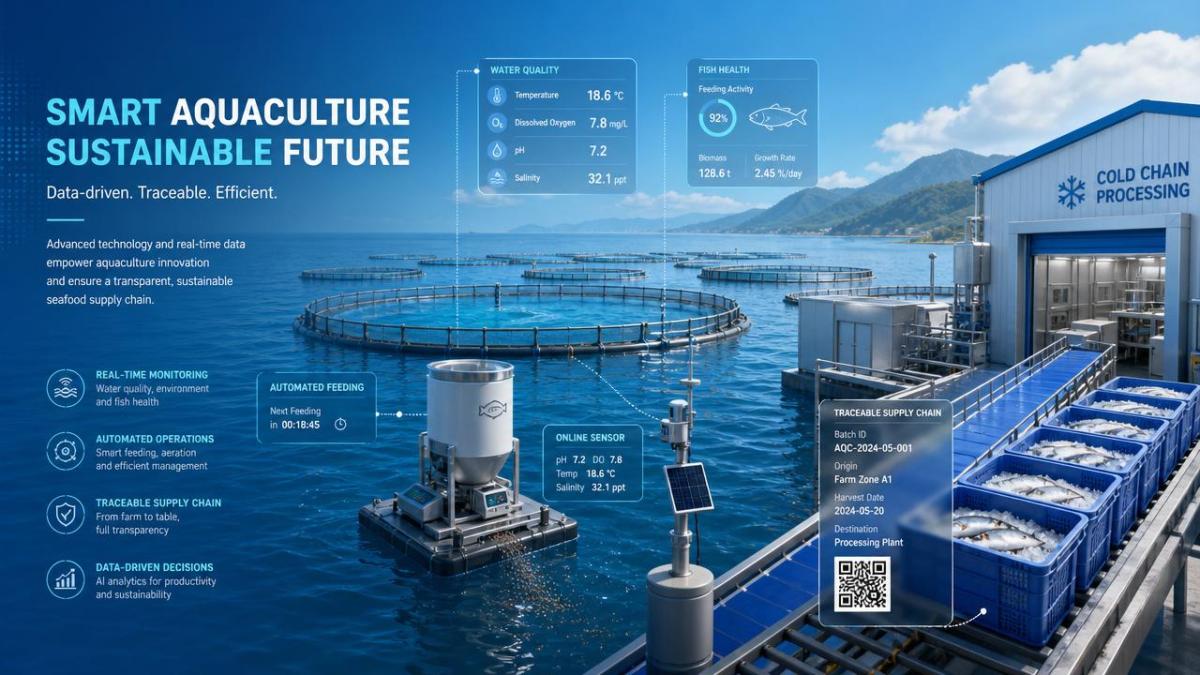
Here, quaculture & Fishery benefits most from real-time sensing. Water quality dashboards, automated feeders, and biomass estimation tools help convert biological variation into manageable operating data.
The key judgment point is simple. If manual checks no longer catch problems early enough, then digitized monitoring becomes a growth requirement, not a technology upgrade.
Scenario 2: Export-oriented processors face traceability pressure
Processing businesses linked to premium retail or regulated overseas markets face a different challenge. Their problem is not only yield, but document integrity across every lot.
In quaculture & Fishery, smarter growth in this setting depends on batch traceability, residue control, sanitation records, and supplier verification. Data gaps can quickly become market access barriers.
This scenario often overlaps with fine chemicals, feed additives, and cleaning formulations. That is why cross-functional compliance systems matter as much as production efficiency.
Scenario 3: Wild catch and hybrid sourcing need resilience tools
Wild catch operations and hybrid supply networks face unstable availability. Weather shifts, quota changes, vessel costs, and landing delays can make planning highly uncertain.
For quaculture & Fishery in this setting, smarter growth comes from predictive planning. Route visibility, cold storage optimization, and demand-linked inventory models reduce waste and revenue leakage.
The main judgment point is whether sourcing variability already affects fulfillment quality. If yes, digital coordination tools create strategic value beyond simple cost savings.
Which quaculture & Fishery applications show the clearest return
The smartest investments are rarely the broadest ones. In quaculture & Fishery, value appears where one intervention improves survival, compliance, throughput, or saleable quality within a measurable timeframe.
Water quality automation and alert systems
These systems fit sites where dissolved oxygen, pH, salinity, or ammonia change quickly. They reduce response lag and support more stable stocking densities.
Precision feeding and feed conversion management
Feed remains a major cost center. In quaculture & Fishery, machine vision and feeding algorithms can reduce overfeeding while improving growth consistency and water conditions.
Traceability software linked to quality records
Where documentation determines customer confidence, digital lot mapping becomes essential. It connects feed source, treatment history, harvest timing, processing records, and shipment status.
Energy and aeration optimization
Rising power costs have changed the investment logic. Aeration control, pump scheduling, and backup energy planning now shape the competitiveness of quaculture & Fishery operations.
How scenario demands differ across quaculture & Fishery operations
Different operating models need different technology priorities. A practical comparison helps avoid overinvestment in tools that do not match site-level constraints.
This comparison shows why quaculture & Fishery should not adopt digital tools as a package trend. The highest return usually starts with one operational pain point and one measurable correction.
Practical adaptation steps for smarter quaculture & Fishery growth
A useful modernization plan should be selective, staged, and evidence-based. The following actions help align investment with biological realities and compliance needs.
- Map the highest-loss stage first, such as feeding, water quality, storage, or batch documentation.
- Set three core metrics before deployment, including survival, FCR, downtime, rejection rate, or energy per output unit.
- Check compatibility between sensors, feeding equipment, ERP tools, and compliance record systems.
- Review standards exposure early, especially if quaculture & Fishery output enters regulated food, ingredient, or pharmaceutical-linked chains.
- Prioritize supplier transparency for feed inputs, treatment products, water management chemicals, and maintenance components.
These steps reflect a broader industrial truth. Smart systems work best when they connect biology, machinery, data governance, and procurement discipline into one operating model.
Common misreads that slow quaculture & Fishery decision quality
Several judgment errors still appear when organizations assess quaculture & Fishery modernization. Most are not technical failures. They are framing failures.
Mistaking equipment purchase for digital transformation
Buying hardware without alert logic, staff response rules, or record integration often creates data noise. Systems must support decisions, not just collect readings.
Ignoring compliance until scale has already increased
In quaculture & Fishery, documentation pressure usually intensifies after growth. Late compliance design can force rework, delay certification, and weaken buyer confidence.
Underestimating upstream input risk
Feed composition, additives, sanitation chemicals, and spare parts all affect consistency. Smarter growth requires visibility across these linked inputs, not only within the pond or vessel.
Using generic ROI assumptions across all sites
A recirculating system, a coastal cage site, and a wild catch fleet do not share the same economics. Quaculture & Fishery investments should be scenario-calculated, not copied.
What the next move looks like for quaculture & Fishery
The smarter growth phase in quaculture & Fishery is already visible where operators connect operational data with compliance readiness and sourcing resilience. The winners are not simply more digital. They are more selective.
A practical next step is to audit one production or supply scenario, define one avoidable loss pattern, and match it with one verifiable technology response. That approach turns complexity into manageable progress.
For industries tracked by AgriChem Chronicle, quaculture & Fishery stands out because it sits at the intersection of food systems, environmental governance, industrial equipment, and fine input chemistry. That intersection is exactly where smarter growth becomes measurable.
If the goal is scalable, investment-ready performance, quaculture & Fishery should be judged through real operating scenarios, not broad optimism. Smarter adoption begins where biological control, data discipline, and traceable supply lines meet.
Related Intelligence
- RAS SystemsSustainable Aquaculture Practices That Cut Feed Waste and Protect Fish Farm Water QualitySustainable aquaculture for fish farms: reduce feed waste, protect water quality, and build resilient, efficient systems with practical strategies.
- RAS SystemsDrum Filter System Price: How Flow Rate, Micron Rating, and Automation Affect CostDrum filter system price depends on flow rate, micron rating, automation, materials, and lifecycle costs. Compare quotes confidently and choose the right system.
- RAS SystemsHow to Specify Large-Scale Fish Farming Equipment for High-Output RAS ProjectsLarge scale fish farming equipment guide for high-output RAS projects—specify tanks, filtration, oxygen, automation, and redundancy for reliable growth.
The Morning Broadsheet
Daily chemical briefings, market shifts, and peer-reviewed summaries delivered to your terminal.
