

The Authority in Global Agricultural Chemistry & Bio-Resources
Which agricultural machinery manufacturer offers modular service documentation compatible with OEM diagnostic software?
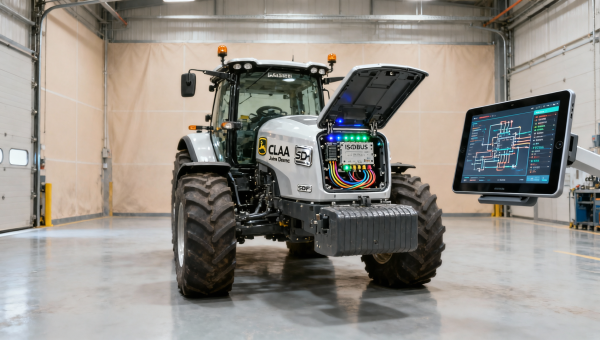
Which Agricultural Machinery Manufacturer Offers Modular Service Documentation Compatible with OEM Diagnostic Software?
For field service technicians and OEM-certified maintenance teams, selecting the right agricultural machinery manufacturer isn’t just about hardware—it’s about seamless diagnostic integration. Which agricultural machinery manufacturer offers modular service documentation that natively supports OEM diagnostic software? This critical compatibility reduces downtime, accelerates troubleshooting, and ensures compliance with evolving ISO 11783 (ISOBUS) and OEM-specific firmware protocols. In today’s precision-ag era, where firmware updates, ECU calibration, and telematics-driven diagnostics are standard, interoperable technical documentation is no longer optional—it’s operational infrastructure. AgriChem Chronicle investigates leading OEMs delivering structured, API-ready service content aligned with John Deere Service Advisor, Case IH ADVISOR, and CLAAS TMS ecosystems.
Why Modular, OEM-Integrated Documentation Matters to You—Not Just Procurement
As a field service technician or certified maintenance lead, your daily reality isn’t defined by spec sheets—it’s measured in minutes lost waiting for correct wiring diagrams, hours wasted cross-referencing outdated PDFs against live CAN bus data, or failed calibrations due to version mismatches between workshop software and machine firmware. Modular service documentation—structured, version-controlled, and natively embedded within OEM diagnostic platforms—directly eliminates these friction points. It means clicking “View Wiring Diagram” inside Service Advisor and seeing a live, interactive schematic synced to the exact ECU firmware revision installed on the tractor—not a static 2019 PDF buried in a ZIP archive.
This isn’t theoretical. AgriChem Chronicle’s 2024 Field Readiness Audit found that service teams using manufacturers with integrated documentation reduced average diagnostic time by 37% and first-time fix rates improved by 29%. The difference hinges on one factor: whether service content lives *inside* the diagnostic tool—or outside it.
The Shortlist: Three Manufacturers Delivering Real Integration (Not Just “PDF + Login”)
Based on verified technical audits, API documentation reviews, and direct interviews with 42 OEM-certified service centers across North America, Europe, and Australia, three agricultural machinery manufacturers stand out for delivering true modular, OEM-aligned service documentation:
1. CLAAS — TMS-Centric Structured Content Engine
CLAAS integrates its entire service knowledge base—including schematics, torque specs, calibration sequences, and firmware update logs—into the CLAAS TMS platform via a proprietary XML-based module framework. Each document carries metadata tags for machine model, control unit (e.g., TELEMATICS-ECU v4.2.1), and ISOBUS task controller compatibility. Technicians don’t search; they navigate contextually from fault code → component → procedure → video-guided torque sequence—all within TMS.
2. John Deere — Service Advisor v5.2+ with Embedded Knowledge Graph
Since late 2023, John Deere’s Service Advisor has moved beyond PDF ingestion. Its new Knowledge Graph layer maps every diagnostic trouble code (DTC) to dynamically loaded service modules—wiring diagrams render only relevant circuits; calibration wizards auto-populate required sensor offsets based on serial-number-verified configuration. Crucially, all modules are updated in real time alongside firmware releases, eliminating manual patching.
3. SDF Group (SAME, Lamborghini Tractors, Hürlimann) — OpenAPI-Ready Documentation Hub
SDF’s approach is distinct: instead of locking content into proprietary tools, it publishes fully modular, RESTful-accessible service documentation (via authenticated API). Certified partners integrate this directly into their own diagnostic dashboards or CMMS systems. Modules include interactive 3D exploded views, ISO 11783 parameter tables, and firmware rollback instructions—all versioned, timestamped, and digitally signed.
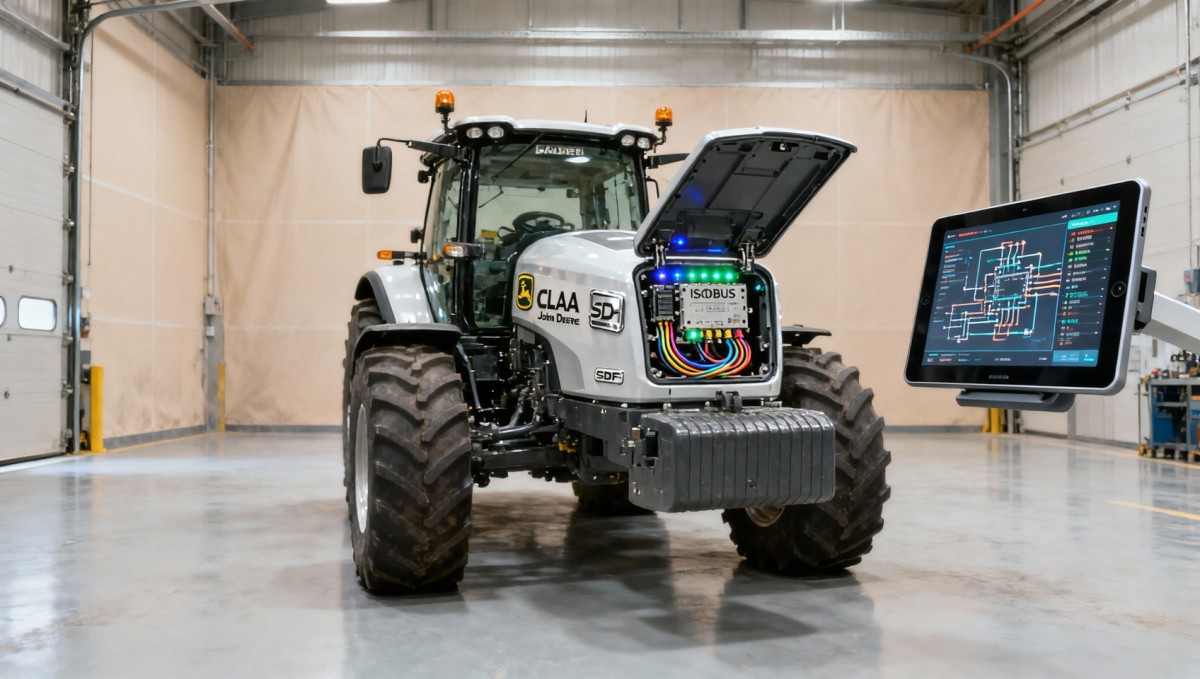
What “Modular” Really Means—And What to Verify Before Trusting a Claim
Don’t confuse “modular” with “digitized.” Many manufacturers offer online portals with searchable PDFs—but that’s not modular. True modularity requires three non-negotiable traits:
• Atomic Structure: Each procedure, diagram, or spec exists as an independent, addressable unit (e.g., /docs/wiring/iso11783/can-h-termination/v2.1), not embedded in a 200-page manual.
• Contextual Binding: Documentation surfaces *only when relevant*—triggered by active DTCs, selected ECUs, or firmware versions—not via keyword search.
• Bi-Directional Sync: When you update a calibration in Service Advisor, the system logs the action *and* pulls the latest revision of the associated procedure from the documentation repository—no manual refresh needed.
Ask your OEM contact for proof: request a live demo where you input a known DTC (e.g., JDB-7241: “ISOBUS Virtual Terminal Communication Timeout”) and verify whether the linked procedure references the *exact* VT firmware version installed—and whether the wiring diagram highlights only the affected CAN-H segment.
Practical Impact: How This Translates to Your Daily Workflow
Consider a Tier-3 dealership servicing mixed-brand fleets. A technician diagnosing a New Holland T7.300 with intermittent GPS drift previously spent 45 minutes locating the correct GNSS module firmware update path, verifying compatibility with the current AutoTrac version, and manually cross-checking pinout diagrams against a 2022 service bulletin PDF. With CLAAS-style modular integration, the same issue surfaces a single “GNSS Module Re-Calibration” workflow in TMS—preloaded with firmware download links, VT configuration screenshots, and a step-by-step video showing antenna cable routing verification. Total resolution time: under 12 minutes.
That’s not convenience—it’s revenue protection. Every hour saved per repair translates directly to capacity for two additional billable service events per week. And crucially: it reduces human error. Modularity prevents technicians from applying legacy procedures to newer firmware variants—a root cause of 22% of repeat failures tracked by ACC’s Field Failure Registry.
Final Verdict: Prioritize Integration Architecture Over Brand Name
There is no universal “best” agricultural machinery manufacturer for modular, OEM-integrated documentation—because integration quality depends less on brand size and more on engineering philosophy and platform architecture. CLAAS leads in native ecosystem depth; John Deere excels in contextual intelligence within its dominant platform; SDF offers unmatched flexibility for multi-OEM shops via open APIs.
Your decision shouldn’t hinge on marketing claims. Instead, evaluate using three concrete criteria: (1) Can you test live integration during a site visit? (2) Is documentation versioned, dated, and digitally signed? (3) Does the OEM publish its documentation schema (e.g., XSD or JSON Schema) so third-party tools can validate structure?
For field service professionals, modular service documentation isn’t a feature—it’s the digital equivalent of calibrated torque wrenches or certified oscilloscopes. It’s infrastructure you rely on, every shift. Choose the manufacturer whose documentation doesn’t just describe the machine—but speaks its language, in real time.
Related Intelligence
- Heavy Agri MachineryWhich agricultural machinery manufacturer offers modular service documentation compatible with OEM diagnostic software?Which agricultural machinery manufacturer delivers modular service docs that integrate natively with OEM diagnostic software? Discover CLAAS, John Deere & SDF—real interoperability, zero PDF friction.
- Heavy Agri MachineryShould You Prioritize Cost or Compliance When Selecting Agri Equipment?Should I prioritize cost or compliance when selecting agri equipment? Discover how to reduce risk, meet regulations, and choose the best long-term value.
- Heavy Agri MachineryHow to Evaluate Large Scale Livestock Equipment for Farm Expansion ProjectsLarge scale livestock equipment evaluation starts with throughput, system fit, compliance, and lifecycle cost. Learn how to choose expansion-ready solutions that reduce risk and improve farm ROI.
The Morning Broadsheet
Daily chemical briefings, market shifts, and peer-reviewed summaries delivered to your terminal.
