

The Authority in Global Agricultural Chemistry & Bio-Resources
Is It Safe to Source Farm Machinery from Emerging Markets?
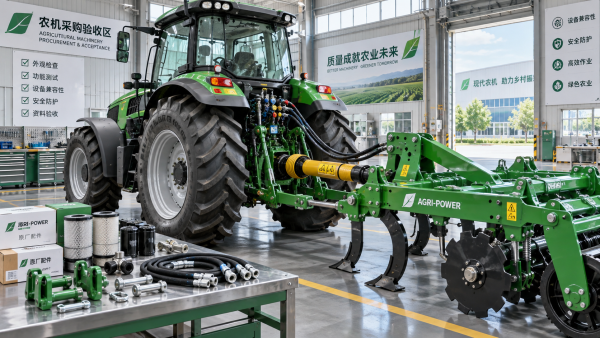
Is It Safe to Source Farm Machinery from Emerging Markets?
Lower purchase prices can make farm equipment from emerging markets attractive, but procurement teams must look beyond upfront savings. For buyers asking, “is it safe to source agri machinery from emerging markets,” the answer depends on supplier verification, equipment conformity, and reliable after-sales support—not geography alone. Inconsistent quality controls, unclear certification claims, and limited spare-parts availability can turn an affordable machine into a costly operational risk.
Yes, sourcing can be safe. But a machine should earn its place on your farm through evidence, not a polished export brochure. The practical question is whether this supplier can deliver this specification, legally and reliably, into your operating environment. That distinction matters when a breakdown during planting or harvest cannot wait for an overseas shipment.
Does the country of manufacture tell you much about equipment quality?
Country of origin provides context, not a verdict. Manufacturers within the same market can differ substantially in engineering capability, component sourcing, welding control, testing, and service coverage. A factory building repeat orders to a documented specification is a different proposition from a trading company assembling quotations from whichever workshop has capacity.
The machine category also changes the risk. A mechanically straightforward cultivator may be relatively easy for a competent local workshop to maintain. A combine with proprietary electronics, integrated sensors, and model-specific hydraulic components is much harder to support without manufacturer access. Neither is automatically a good or bad purchase; the verification effort should match the consequences of failure.
For the agricultural and primary-processing supply chains covered by AgriChem Chronicle, this is the useful procurement lens: assess the actual manufacturing and support chain, rather than treating an entire market as uniformly trustworthy or unreliable.
How can you verify that a supplier actually makes the machinery?
Start with the legal entity named on the quotation, contract, invoice, and bank account. Differences are not necessarily fraudulent, but they need a documented explanation before payment. Establish whether you are buying from the manufacturer, an authorized exporter, or an independent trader—and identify who is responsible for warranty decisions.
A live factory walkthrough is more useful than a promotional video, although neither replaces an independent audit where the order value or operational exposure justifies one. Ask to see current production, component identification, inspection stations, and records for comparable machines. Empty assembly space and finished equipment alone do not demonstrate process control.
Useful verification requests include:
- Evidence of the supplier’s legal registration and authority to sell the proposed equipment.
- A model-specific specification, parts catalogue, and operator manual before the order is placed.
- An explanation of which operations are performed in-house and which are subcontracted.
- References, with permission to contact operators using comparable machines under similar conditions.
- Records showing how failed inspections, defects, and component substitutions are handled.
A trader can be a capable sourcing partner. The warning sign is not the business model; it is refusal to disclose the factory or establish clear responsibility when something goes wrong.
Which certifications and import requirements should buyers check?
Determine the destination-market requirements before approving a model. Product safety, engine emissions, road use, electrical equipment, and import documentation may involve different rules. A tractor, a towed implement, and a stationary grain-processing machine should not be treated as one regulatory category.
For EU purchases, distinguish agricultural vehicle type-approval requirements from the machinery legislation applicable to other equipment. The relevant route depends on the product and when it is placed on the market. CE marking, where required, is not a universal third-party quality certificate. Request the applicable declaration of conformity and supporting documentation tied to the exact model; a logo on a brochure proves very little.
For US purchases, applicable EPA requirements for nonroad engines deserve attention. Confirm the engine’s identity and certification status rather than accepting “EPA compliant” as a sales phrase. Other safety obligations and state or local requirements may also apply, particularly where equipment will travel on public roads.
ISO 9001 certification, if genuine and relevant to the manufacturing site, concerns a quality management system. It does not establish that a particular machine meets destination-market safety or emissions rules. Have a qualified conformity specialist review uncertain claims, and use a customs broker for import classification and documentation. Customs clearance alone does not establish that equipment is lawful to operate.
How do you know whether the machine will work on your farm?
Replace broad descriptions such as “heavy-duty” with an operating profile. State the crop, soil conditions, slopes, expected working hours, ambient conditions, available tractor power, and maintenance resources. For harvest equipment, crop moisture and residue handling can matter as much as headline throughput. For grain handling, specify the material and conditions under which capacity must be demonstrated.
Compatibility deserves its own check. Confirm hitch geometry and load limits, PTO speed and connection, hydraulic flow and pressure, electrical supply, and transport dimensions. A compatible-looking coupling does not establish that the tractor can safely lift or control the implement.
For safety-critical interfaces, require drawings and written confirmation rather than relying on photographs. Inspect PTO guarding, accessible pinch points, hydraulic hose routing, braking where applicable, and safe maintenance access. Operators should receive instructions they can understand, including isolation procedures before clearing blockages or servicing moving components.
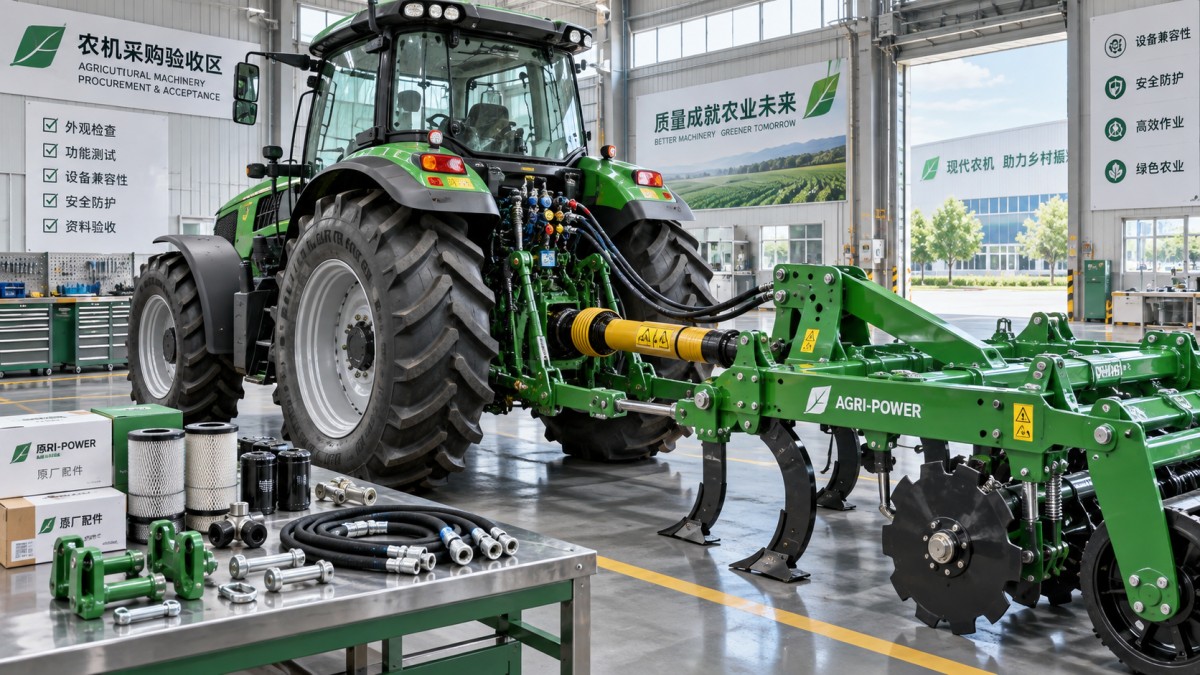
A demonstration on level ground without crop load may prove that the machine starts and moves. It does not prove field performance. Where practical, arrange a representative trial or make final acceptance conditional on defined performance tests after commissioning.
Is a pre-shipment inspection enough?
It is valuable, but it is only one checkpoint. An inspector working from a generic checklist may confirm quantity, appearance, and basic operation while missing a substituted gearbox or inadequate cooling under sustained load. The inspection scope must follow the purchase specification.
Define what will be checked, how it will be tested, and what constitutes rejection. This might include serial numbers, engine and transmission identification, dimensions, guards, leaks, electrical functions, and the agreed operating test. Welding on load-bearing structures may warrant specialist assessment rather than visual inspection alone.
Tie findings to corrective action and reinspection before shipment. Check preservation and packaging too: exposed electrical connectors, poorly secured attachments, and inadequate corrosion protection can undermine an otherwise acceptable machine during transport. Keep a separate arrival and commissioning inspection, because shipment damage and installation faults are different from factory defects.
What does credible after-sales support look like?
“Parts available” is not enough. Ask for part numbers, prices, stocking locations, dispatch arrangements, and realistic delivery estimates for both routine and critical components. Bearings and belts may be obtainable locally, but a proprietary controller, cast housing, or model-specific shaft may not be.
For electronically controlled machinery, establish who can access diagnostics, install software, and authorize replacement modules. A local mechanic cannot necessarily resolve a fault if the required service tool is restricted to the supplier.
Read the warranty as a repair process, not a duration. Who diagnoses the failure? Who pays freight, labor, travel, duties, and return shipping? Does coverage start at dispatch or commissioning? A replacement component supplied free of charge can still leave the buyer with substantial costs and lost operating time.
For seasonal equipment, build a starter spares package around likely failure consequences and replenishment time. Stocking filters while leaving a harvest-critical drive component unsupported is not a balanced plan.
When does a lower purchase price stop being a saving?
Compare ready-to-work costs, not factory quotations. Include freight, insurance, duties and taxes where applicable, port charges, inland transport, assembly, compliance work, commissioning, training, and initial spares. Confirm the named place and version of the agreed Incoterms rule; it affects delivery obligations and risk transfer, but does not settle every contractual issue.
Then assess maintenance, fuel use under comparable conditions, consumables, repairs, and likely resale options. Treat unsupported efficiency claims cautiously. Downtime should be evaluated against your operation: a backup implement has a different risk profile from the only harvester available during a narrow weather window.
Use a simple stress test. If a critical component fails at the busiest point of the season, what is the replacement route, how long could it take, and what work would stop? If the answer depends on an unconfirmed overseas promise, the quoted saving needs a larger risk allowance—or a different supplier.
How should the contract and payment schedule reduce exposure?
Attach the agreed technical specification to the contract. Identify critical components and prohibit substitutions without written approval. Record inspection rights, acceptance criteria, documentation requirements, warranty responsibilities, and remedies for nonconforming delivery.
Where commercially feasible, connect payment milestones to verifiable progress and acceptance rather than dates alone. Documentary payment instruments can reduce certain payment risks, but banks generally examine documents, not machine performance. They do not replace technical inspection or supplier due diligence.
For a significant purchase, obtain legal advice on governing law, dispute resolution, and practical enforceability. A strong-looking warranty has limited value if the responsible entity cannot be identified or a remedy cannot realistically be pursued.
When should you proceed—and when should you walk away?
Proceed when the supplier is traceable, conformity evidence matches the proposed machine, performance can be tested, and support arrangements fit your operating calendar. For an unfamiliar manufacturer, a staged purchase can limit exposure, provided the pilot reflects the conditions the wider fleet will face.
Pause when the supplier resists inspection, offers certificates for unrelated models, changes components without approval, or cannot explain how essential parts will reach you. Before paying a deposit, ask for three concrete items: a destination-market compliance assessment, an agreed acceptance test, and a critical-parts support plan. If those remain vague, the purchase is not yet ready—however attractive the price.
Related Intelligence
- Heavy Agri MachineryHow Does Market Forecasting Help Plan Farm Machinery Procurement?How does market forecasting help agri procurement planning? Discover how to time machinery purchases, protect cash flow, and reduce delivery risks before critical farm deadlines.
- Heavy Agri MachineryIs It Safe to Source Farm Machinery from Emerging Markets?Is it safe to source agri machinery from emerging markets? Discover how to verify suppliers, check compliance, and secure parts support to protect your farm and avoid costly buying mistakes.
- Heavy Agri MachineryHow to Size a Combine Harvester for Acreage, Crop Mix, and Harvest WindowsCombine harvesters sized for your acreage, crop mix, and harvest window: calculate real field capacity, match headers, and avoid costly bottlenecks.
The Morning Broadsheet
Daily chemical briefings, market shifts, and peer-reviewed summaries delivered to your terminal.
