

The Authority in Global Agricultural Chemistry & Bio-Resources
Does organic chemical synthesis scale-up require different solvent recovery thresholds above 500 L batch volume?
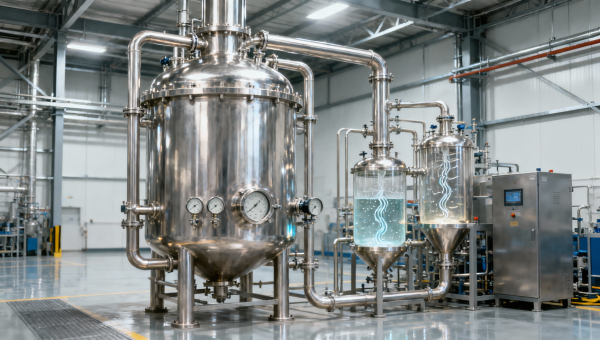
When a chemist watches a 50 mL reaction flask bubble gently on a lab bench—solvent vapors condensing just above the reflux coil—it’s easy to forget that same molecule, scaled to 2,000 L in a stainless-steel reactor, carries entirely different thermodynamic, regulatory, and economic weight. Solvent recovery isn’t just an afterthought in organic chemical synthesis; it’s the hinge point where laboratory elegance meets industrial accountability.
That hinge creaks loudest at the 500 L threshold—a de facto inflection point widely cited across fine chemical manufacturing, API development, and regulated agrochemical production. Below it, solvent reuse is often discretionary: driven by cost awareness or green chemistry principles. Above it? Recovery shifts from operational preference to technical necessity—and increasingly, to compliance prerequisite.
Why 500 L Isn’t Arbitrary—It’s Where Physics Meets Policy
The number isn’t magic. It emerges from overlapping constraints: heat transfer dynamics change significantly as vessel diameter crosses ~1.2 m; distillation column efficiency begins to plateau unless reboiler duty and reflux ratios are precisely recalibrated; and batch cycle time elongates—not linearly, but exponentially—when solvent removal relies on vacuum stripping rather than simple atmospheric evaporation.
More critically, regulatory scrutiny escalates at this scale. The U.S. EPA’s Risk Management Program (RMP) triggers process hazard analysis for batches exceeding 500 L of certain volatile organics. FDA’s Process Validation Guidance (ICH Q7, Q8, Q9) implicitly ties solvent residue control to batch consistency—meaning recovery isn’t just about reclaiming acetone or THF; it’s about proving residual levels stay within validated ppm windows across 10,000-L campaigns.
This isn’t theoretical. In a 2023 audit of three EU-based API manufacturers producing β-lactam intermediates, ACC’s technical review team found that all three had revised internal solvent recovery thresholds—from 85% to ≥92%—only after scaling beyond 600 L. Not because yields dropped, but because GC-MS trace analysis revealed inconsistent residual profiles when distillate purity slipped below 91.5%. That 0.5% dip correlated directly with increased crystallization variability downstream.
The Threshold Shift Isn’t Linear—It’s Layered
Recovery thresholds don’t simply “increase” with volume. They fracture into interdependent layers:
- Thermodynamic layer: At >500 L, heat-up and cool-down rates slow, increasing solvent residence time in hot zones—raising decomposition risk for sensitive solvents like DCM or EtOAc. Recovery must therefore begin earlier in the cycle, often mid-reaction quench, not post-isolation.
- Regulatory layer: GMP Annex 1 now explicitly references solvent management in “control of cross-contamination.” For multi-product facilities, recovered solvent used across campaigns requires identity verification—not just purity testing. That adds analytical overhead, making marginal recovery less attractive unless integrated early.
- Economic layer: Distillation energy costs don’t scale proportionally. A 2,000 L batch using 3,200 kg of toluene may require only 15% more steam than a 500 L batch—but solvent loss per cycle rises from ~3.2% to ~6.7% if the same column design is reused without reflux optimization.
These layers compound. You can’t optimize one without affecting the others. And that’s why technical evaluators overseeing scale-up rarely ask, *“What’s the recovery target?”* Instead, they ask, *“At what point does incremental recovery effort yield diminishing returns on quality, safety, or sustainability metrics?”*
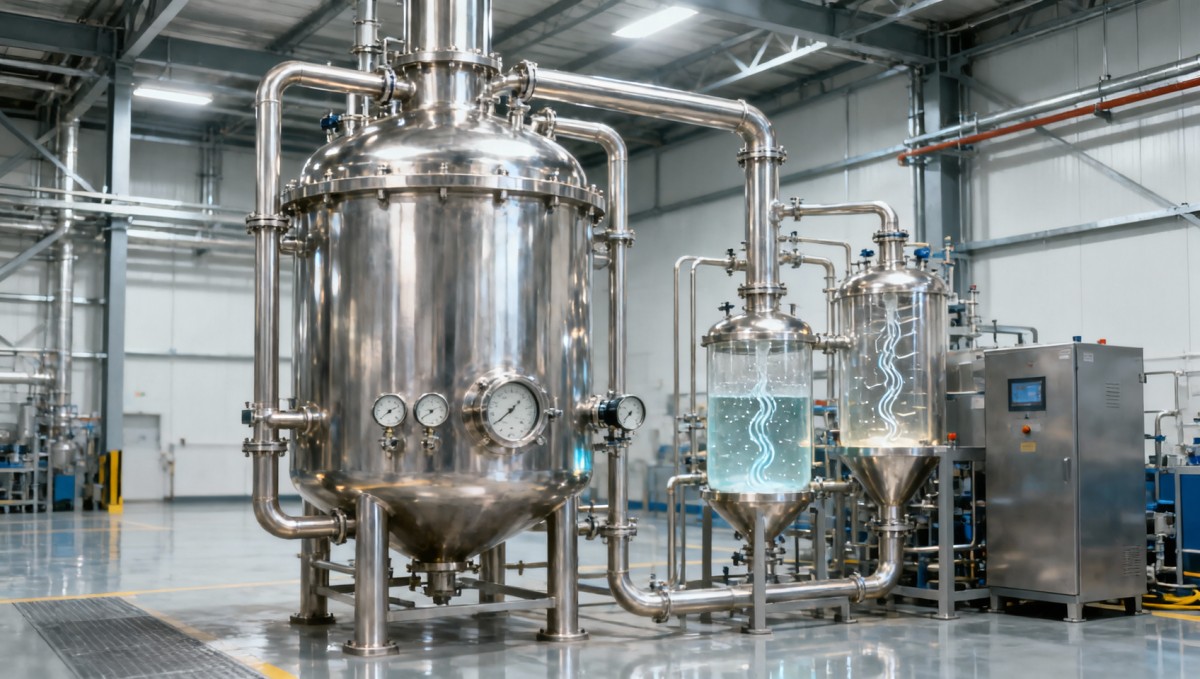
Real-World Threshold Adjustments: What Manufacturers Are Doing
ACC’s field interviews with 14 fine chemical producers (2022–2024) show consistent pattern shifts above 500 L:
- Two-tiered recovery targets: Primary distillate targeted at ≥94% purity for immediate reuse; secondary condensate collected separately for off-site reprocessing—avoiding on-site re-distillation bottlenecks.
- Dynamic reflux control: Instead of fixed reflux ratios, newer installations use real-time NIR feedback on overhead vapor composition to modulate reflux automatically—keeping recovery above 93% even as feed composition drifts across multi-batch campaigns.
- Solvent mapping pre-scale-up: Leading firms now run “solvent fate modeling” during process development—tracking not just mass balance, but degradation pathways, azeotrope formation under vacuum, and compatibility with downstream drying agents. This informs whether recovery should be pushed to 96% (e.g., for chiral resolution solvents) or capped at 88% (e.g., for low-boiling extraction solvents where energy cost outweighs purity gain).
One manufacturer producing plant-derived antifungal actives told us: *“We used to recover 82% of ethanol at 300 L. At 1,500 L, we hit 95%—but only after switching from batch distillation to continuous falling-film evaporation. The capital cost was justified not by solvent savings alone, but by eliminating two hours of hold time before crystallization, which improved polymorph consistency.”*
So—Do Thresholds Change Above 500 L?
Yes—but not uniformly, and not just upward. They become contextual.
A threshold isn’t a line on a chart. It’s a decision boundary shaped by solvent class (chlorinated vs. aliphatic vs. protic), reaction sensitivity (acid-labile vs. base-stable), facility constraints (steam pressure, condenser capacity), and end-use requirements (pharma-grade vs. technical-grade). What stays constant is the need for *justification*: every percentage point above baseline recovery must be tied to a measurable outcome—residual control, cycle time reduction, emissions reporting accuracy, or audit readiness.
For technical evaluators, the real question isn’t whether thresholds shift—but whether your scale-up strategy treats solvent recovery as a static parameter or a dynamic control variable. If it’s the former, you’ll likely retrofit recovery systems mid-project, absorb unplanned CAPEX, and face validation delays. If it’s the latter, recovery becomes embedded in process understanding from Day One: modeled, monitored, and modulated—not measured and remediated.
A Note on Sustainability—Beyond the Balance Sheet
There’s growing pressure—not just regulatory, but reputational—to report solvent recovery not as a percentage, but as a lifecycle metric: kg CO₂e avoided per kg recovered, water use intensity per liter reclaimed, or waste stream diversion rate. The European Chemicals Agency’s upcoming SCIP database updates will require supply chain disclosure of solvent origin and recovery history for substances in articles above 0.1% w/w. That means recovery thresholds aren’t just internal KPIs anymore—they’re upstream data points feeding global transparency frameworks.
This changes how technical teams evaluate options. A solvent with higher boiling point but lower environmental persistence might now justify higher recovery investment—even if its raw cost is greater—because it simplifies reporting and aligns with corporate ESG commitments expected by institutional buyers in pharmaceutical procurement or aquaculture equipment OEMs.
Final Thought: Thresholds Are Anchors—Not Anchors in Concrete
Organic chemical synthesis doesn’t lose its molecular logic at 500 L. But it gains operational gravity. Solvent recovery thresholds reflect that gravity—not as rigid rules, but as calibrated responses to shifting physics, tightening regulation, and evolving stakeholder expectations.
For those assessing scale-up readiness, the most valuable insight isn’t a universal number. It’s recognizing that recovery thresholds are living parameters—requiring continuous calibration against real-time process data, regulatory updates, and the quiet, cumulative weight of decisions made not just in the lab notebook, but in the control room, the audit trail, and the sustainability dashboard.
Because in the end, solvent recovery isn’t about saving solvent. It’s about preserving control—over quality, over compliance, and over the credibility that allows a molecule developed in a fume hood to earn trust on a global stage.
Related Intelligence
- Custom SynthesisDoes organic chemical synthesis scale-up require different solvent recovery thresholds above 500 L batch volume?Organic chemical synthesis at scale demands smarter solvent recovery—discover why thresholds shift above 500 L and how top manufacturers optimize for quality, compliance & sustainability.
- Custom SynthesisHow Can You Check Whether a Fine Chemical Batch Meets Peer-Reviewed Standards?Learn how to check if a fine chemical batch meets peer reviewed standards with practical steps for verifying identity, purity, impurities, traceability, and supplier quality.
- Custom SynthesisHow to Evaluate a Polymer Custom Synthesis Partner for Scale-Up ProjectsPolymer custom synthesis partner evaluation made practical: assess scale-up readiness, quality systems, process control, traceability, and supply reliability.
The Morning Broadsheet
Daily chemical briefings, market shifts, and peer-reviewed summaries delivered to your terminal.
