

The Authority in Global Agricultural Chemistry & Bio-Resources
Evaluating Farm Equipment Distributors: Parts Availability and Service Coverage
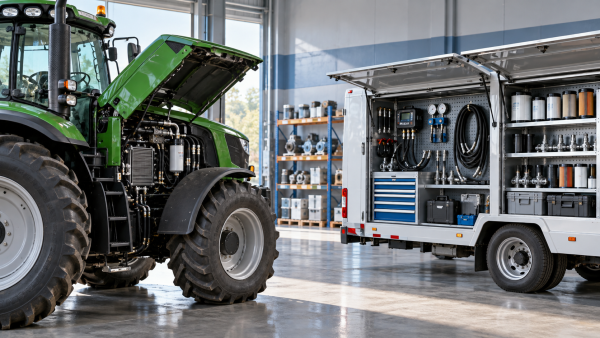
A competitive purchase price offers little protection when a critical machine sits idle during planting or harvest. When evaluating farm equipment distributors, the decisive question is not how many branches or parts numbers they advertise, but whether they can restore a specific machine to operation within an acceptable working window.
Parts availability and service coverage must therefore be assessed together. A component sitting in a regional warehouse has limited value if delivery takes several days; a nearby technician cannot complete a repair without the correct diagnostic access, tools, and replacement parts. The strongest comparison measures the complete path from reporting a fault to returning equipment to work.
Define the downtime exposure before comparing distributors
Support requirements depend on the operation, not simply the equipment’s purchase value. A tractor with a compatible backup presents a different risk from the only combine available during harvest. A failed planter metering component can interrupt a time-sensitive operation even when the replacement part itself is inexpensive.
For each proposed machine, establish the seasonal operating window, expected workload, backup capacity, and maximum tolerable interruption. Separate faults that reduce productivity from those that stop work entirely. These distinctions determine which parts need local stock and which service commitments justify additional cost.
Describe support requirements in operational terms. “Emergency service available” is difficult to evaluate. “A qualified technician must be able to attend this farm during the defined harvest period, including weekends, within an agreed dispatch window” creates a requirement that can be checked and priced.
Use the same operating assumptions for every quotation. Otherwise, one distributor may price a basic warranty arrangement while another includes seasonal field support, making the equipment prices appear more comparable than they are.
Test parts availability against the machines being purchased
A large inventory does not necessarily provide strong coverage for a particular model. Stock may be concentrated in filters, lubricants, and common wear items while model-specific controllers, hydraulic components, or driveline assemblies remain dependent on remote supply.
Request a model- and serial-number-specific critical-parts list, developed with maintenance staff and checked against the manufacturer’s documentation. Distinguish scheduled-maintenance items, predictable wear parts, and failure-critical components. The stocking logic should reflect the consequence of failure as well as replacement frequency.
Ask the distributor to demonstrate availability for a sample from this list. Distinguish inventory held at the servicing branch from stock at another branch, a national depot, or the manufacturer. Confirm whether the quantity shown is physically available, already allocated, awaiting inspection, or dependent on an inbound shipment.
Parts availability metrics also need a definition. A reported fill rate could measure order lines supplied immediately, quantities delivered, or orders completed over a reporting period. Those measures answer different questions. An aggregate figure dominated by fast-moving consumables says little about urgent repairs. Request the calculation method and, where records permit, results for relevant equipment families and emergency orders.
Measure lead time to usable repair, not warehouse dispatch
“Next-day delivery” may begin only after order confirmation, apply only to stocked items, and exclude weekends or remote locations. For imported equipment, a part can be available overseas yet still require export processing, international transport, customs clearance, and domestic delivery.
Trace the full sequence: fault identification, correct part-number confirmation, stock allocation, dispatch cutoff, transport, receipt, installation, and testing. Ask which stages the distributor controls and which depend on another organization. This exposes delays hidden inside a single quoted lead time.
For repairable assemblies, check exchange-unit arrangements as well. A remanufactured transmission or hydraulic pump may offer an alternative to waiting for a new assembly, but availability, warranty terms, core acceptance, and core-return charges must be clear. An exchange program is not a dependable fallback unless the proposed model is covered.
Compatibility matters as much as speed. A superseded part may require an adapter, revised wiring, or software changes. Non-OEM alternatives can be appropriate for some applications, but fit, material specification, warranty implications, and safety requirements need verification. “Equivalent available locally” is not sufficient evidence for a critical component.
Map service capability rather than branch locations
A service territory on a map establishes where a distributor accepts business, not how quickly it can complete a repair. Field-service capacity depends on technician location, travel time, concurrent jobs, equipment specialization, and access to mobile tooling.
Request a coverage map showing the actual servicing base for each operating site. Identify travel charges, access restrictions, after-hours arrangements, and whether the stated response time means telephone acknowledgment, remote diagnosis, technician dispatch, or arrival on site.
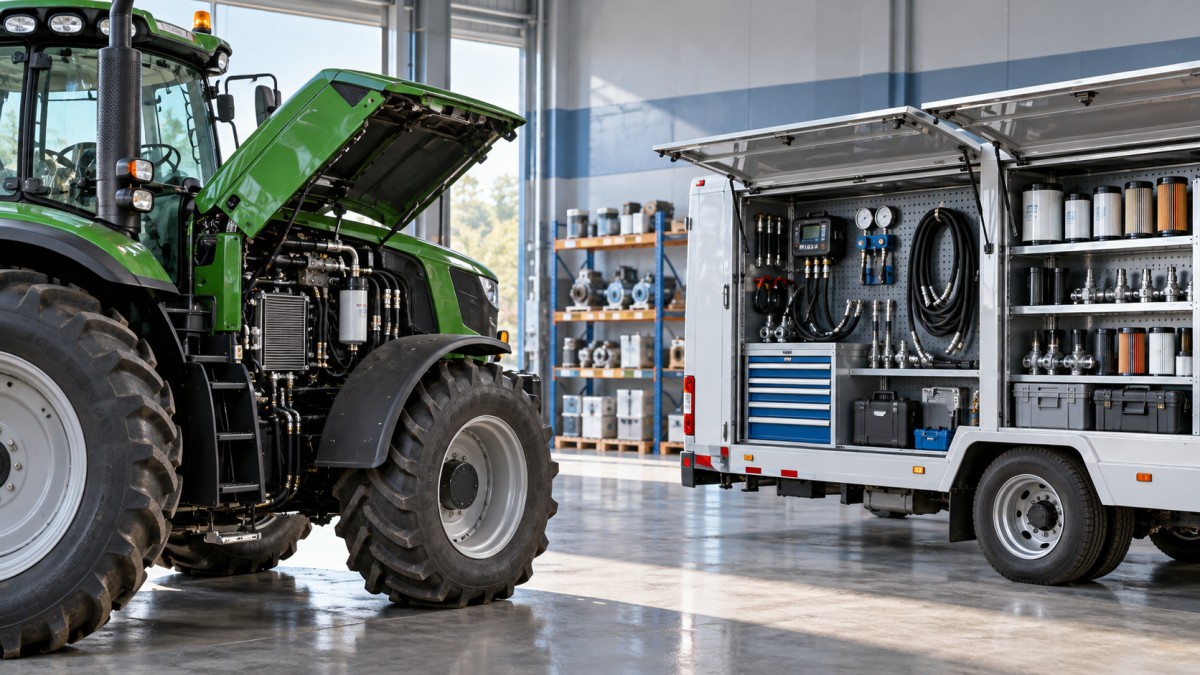
Technician headcount needs similar scrutiny. A workshop may employ several technicians but have limited capacity for a particular machine’s transmission, precision guidance system, or electronic architecture. Ask who is qualified for the proposed models, whether that capability is available on each relevant shift, and what happens when the principal specialist is unavailable.
Verify that field vehicles carry the tools needed for the expected work. Diagnostic interfaces, suitable lifting equipment, hydraulic test instruments, and calibration tools can determine whether a visit resolves the problem or merely identifies a second visit. Some repairs require workshop facilities; clarify transport responsibility and recovery arrangements before treating mobile service as complete coverage.
Remote diagnostics can shorten fault identification where the machine, connection, and permissions support it. They do not replace physical repair capacity. Confirm subscription costs, connectivity requirements, data permissions, and whether a remote diagnosis can lead directly to parts allocation and technician dispatch.
Check authorization, warranty execution, and seasonal capacity
Authorization should be verified for the relevant product line and service territory, rather than inferred from branding. A business may sell equipment without having equivalent authority to perform warranty repairs, access protected diagnostic functions, or support machines imported through another channel.
Where equipment crosses borders, obtain written confirmation that the machine’s serial number qualifies for local warranty support. Clarify responsibility for warranty registration, commissioning, software activation, and campaigns affecting the unit. A manufacturer’s warranty and a distributor’s ability to execute that warranty are separate issues.
Peak-season capacity deserves a direct test. Ask how emergency jobs are prioritized when several customers need support simultaneously. Are technicians shared across branches? Can another authorized provider attend? Does the distributor reserve capacity under a paid support agreement? A general promise of priority has little value without an escalation process and a defined service scope.
Request anonymized service records where available, including fault-report time, initial diagnosis, technician arrival, parts receipt, and return to operation. Compare similar machines, distances, and operating periods. Annual average response time can conceal delays during the very weeks when downtime matters most.
Turn support claims into a practical verification exercise
A structured failure scenario can expose gaps that brochures leave unanswered. Select a plausible machine-stopping fault on the proposed equipment and place it at a real operating site during the busiest relevant period. This is a verification exercise, not evidence of an actual failure or a prediction that the component will fail.
Ask each distributor to explain who receives the call, how the fault is diagnosed, where the replacement component is held, who authorizes release, and which technician can complete the work. Include an after-hours reporting time and a part that requires installation or calibration, rather than testing only a straightforward consumable order.
The useful output is a documented recovery route with dependencies and costs. If the answer relies on another branch, confirm transfer arrangements. If it relies on a manufacturer, confirm escalation access. If the proposed solution is a loan machine, establish whether it is compatible with existing implements, guidance systems, transport arrangements, and operating requirements.
Where practical, visit the servicing location and review the proposed critical stock against inventory records. A site visit cannot prove future performance, but it can establish whether the workshop, mobile equipment, and inventory described in the proposal exist and are relevant to the machines under consideration.
Contract for measurable support without confusing response with restoration
Support commitments should distinguish acknowledgment, diagnosis, attendance, parts supply, and repair completion. A distributor may reasonably commit to technician attendance while being unable to guarantee restoration before an unknown fault is assessed. Those limits should be explicit rather than hidden inside “rapid response” language.
The agreement should identify covered sites and machines, service hours, seasonal extensions, escalation contacts, travel charges, emergency freight responsibility, and subcontracting arrangements. For reserved parts, specify ownership, storage location, replenishment triggers, access rights, and treatment of obsolete stock.
Clarify warranty-related expenses separately. Labor and components may be covered while travel, equipment recovery, consumables, or expedited freight are excluded. Define any loan-equipment entitlement and its conditions; availability on request is not the same as a guaranteed substitute.
Where service credits or other remedies are negotiated, assess their practical value. A credit can compensate for a missed commitment, but it does not harvest a field. Critical operations still need an executable contingency, such as an agreed alternative service provider, compatible replacement equipment, or a carefully selected on-farm spares package.
Make the award on recoverability, not the strongest headline promise
Set minimum support requirements before applying weighted scores. If a distributor cannot provide essential diagnostic access or credible field coverage, a low purchase price should not offset that failure. Among suppliers that meet the minimum, weighting can reflect the operation’s actual exposure: seasonal single-machine dependence warrants a different balance from a fleet with interchangeable backup capacity.
Compare total support cost, including planned maintenance, subscriptions, travel, emergency freight, reserved inventory, and backup arrangements. Evaluate downtime through scenarios rather than unsupported precision. Test how the purchase decision changes under a short interruption, a multi-day repair, and a critical-season failure, using the operation’s own capacity and cost assumptions.
The preferred distributor should be able to show where critical parts are held, how they reach the farm, who can install them, and what happens when the first recovery plan fails. Those capabilities, supported by records and enforceable commitments, provide a firmer basis for an equipment purchase than warehouse size, branch count, or an unqualified promise of service.
Related Intelligence
- Heavy Agri MachineryEvaluating Farm Equipment Distributors: Parts Availability and Service CoverageCompare farm equipment distributors on critical parts availability, service coverage, and repair response. Learn what to verify before buying to reduce costly downtime.
- Heavy Agri MachineryHow Does Market Forecasting Help Plan Farm Machinery Procurement?How does market forecasting help agri procurement planning? Discover how to time machinery purchases, protect cash flow, and reduce delivery risks before critical farm deadlines.
- Heavy Agri MachineryIs It Safe to Source Farm Machinery from Emerging Markets?Is it safe to source agri machinery from emerging markets? Discover how to verify suppliers, check compliance, and secure parts support to protect your farm and avoid costly buying mistakes.
The Morning Broadsheet
Daily chemical briefings, market shifts, and peer-reviewed summaries delivered to your terminal.