

The Authority in Global Agricultural Chemistry & Bio-Resources
Selecting Greenhouse Propagation Equipment for Hot, Humid Southeast Asian Nurseries
Selecting Greenhouse Propagation Equipment for Hot, Humid Southeast Asian Nurseries
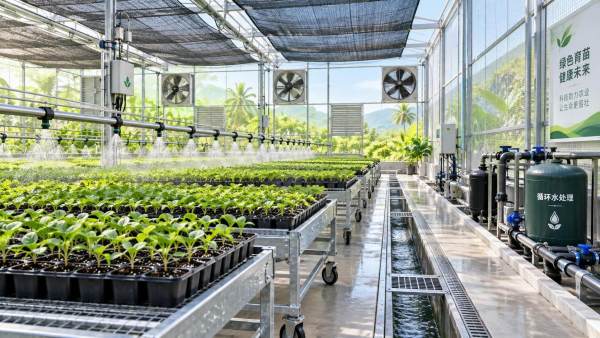
Selecting greenhouse propagation equipment Southeast Asia project teams can rely on requires more than comparing trays, benches, and irrigation systems. In hot, humid nursery environments, equipment decisions directly affect seedling uniformity, disease pressure, labor efficiency, energy demand, and long-term project viability. This guide outlines the technical factors project managers should evaluate to build resilient, scalable propagation operations suited to tropical conditions.
The central mistake is to treat propagation as a small, isolated stage before “real” crop production begins. For commercial vegetables, ornamentals, forestry seedlings, tissue-culture hardening, and young perennial crops, propagation is where plant quality becomes either repeatable or unpredictable. A greenhouse may look well equipped on commissioning day yet perform poorly once afternoon heat, monsoon rainfall, power interruptions, contaminated water, and seasonal labor constraints begin to overlap.
A sound equipment decision starts with the crop and production rhythm, not a catalogue. A nursery producing short-cycle vegetable plugs faces different risks from one hardening fruit tree liners or acclimatizing plantlets. The required root-zone moisture profile, target plug size, handling frequency, sanitation regime, and dispatch schedule should shape the equipment specification. In Southeast Asia, the climate makes that discipline especially important: a system designed around temperate greenhouse assumptions can introduce costly weaknesses before the first tray is filled.
Begin with the climate load, not the equipment list
Hot and humid conditions create a difficult propagation balance. Young plants need a stable, moderately protected environment, but excessive enclosure can trap heat and moisture. That combination slows drying after irrigation, encourages condensation, and can create conditions favorable to damping-off and foliar disease. The answer is not automatically more cooling equipment. It is a coordinated approach to solar gain, air exchange, crop spacing, irrigation timing, drainage, and control logic.
For many projects, the first engineering question should be whether the greenhouse structure can release heat and humid air quickly enough under local peak conditions. Roof vents, side ventilation, insect screens, circulation fans, and shading are interdependent. Fine insect mesh may be essential for pest exclusion, but it also increases airflow resistance. A ventilation design that appears adequate without screens may underperform once screens accumulate dust, algae, or residue. Project teams should ask suppliers to explain the expected airflow path with the actual proposed screen specification installed, rather than accepting a generic ventilation claim.
Shade management deserves the same scrutiny. External shading usually reduces solar load before radiation enters the structure, while internal screens can offer flexibility and crop protection. Neither is universally preferable. The practical choice depends on crop light requirements, wind exposure, roof geometry, maintenance access, and the operator’s ability to manage screen deployment consistently. In a humid nursery, a shading strategy that reduces leaf temperature but leaves air stagnant may solve only half the problem.
Evaporative cooling can be useful in some conditions, but it should not be assumed to be a default tropical solution. Its cooling potential depends on the relationship between air temperature and humidity. During periods of very high ambient humidity, adding moisture may deliver limited cooling while raising disease-management challenges. Equipment selection therefore needs local weather records, site orientation, and a realistic operating scenario—not just equipment capacity quoted under more favorable conditions.
Design the propagation line around uniformity
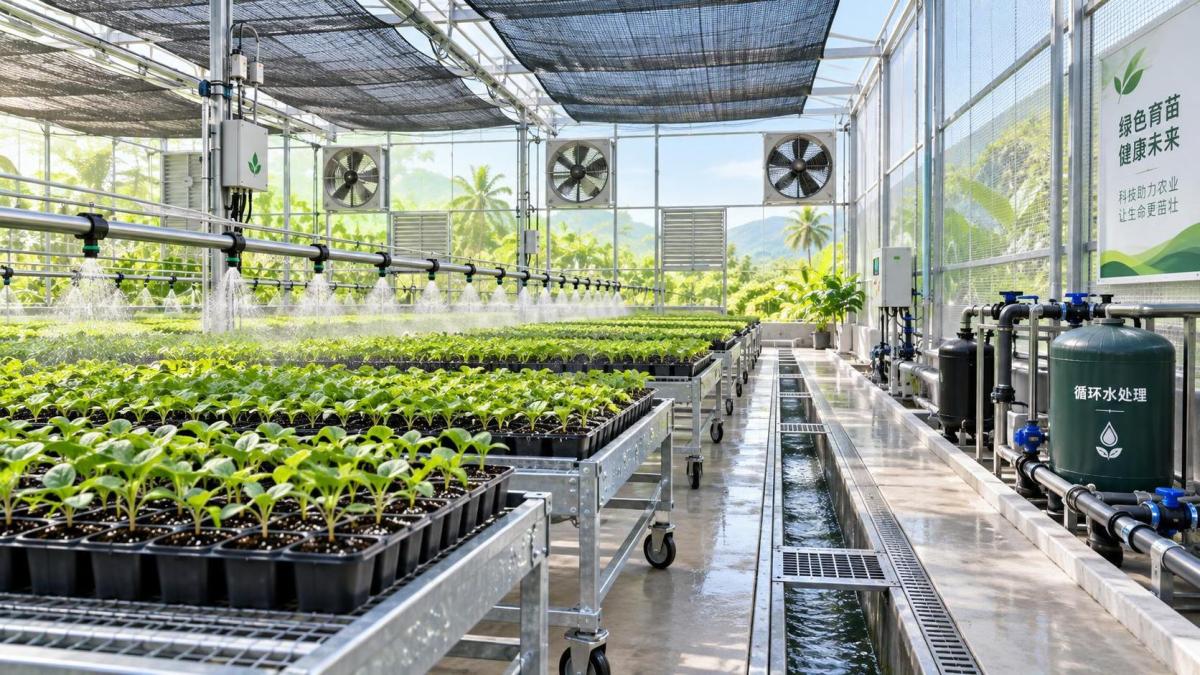
Uniformity is the commercial outcome that links nearly every propagation equipment decision. Uneven emergence, inconsistent rooting, or variable plant height creates downstream sorting work, irregular transplanting, and uneven field establishment. Project managers should assess how each part of the line contributes to repeatability: substrate filling, seeding, germination, irrigation, climate control, bench layout, and movement between zones.
Tray choice is more consequential than it often appears. Cell volume, cell depth, drainage-hole geometry, rigidity, and material durability all influence root development and handling. Deep cells may support longer holding periods for certain crops, but they also retain more media and can dry differently from shallow cells. In humid conditions, drainage performance is not merely a convenience. Water retained beneath trays or on benches can maintain a disease reservoir and complicate sanitation. Trialing a small number of tray formats with the intended substrate and irrigation method is usually more informative than selecting by cell count alone.
Benches should be evaluated as part of the crop-environment system. Fixed benches can provide simplicity and robust support. Rolling benches may improve floor-area utilization but require reliable tracks, disciplined aisle management, and consideration of how tightly packed crops affect airflow and access. For nurseries needing frequent movement between germination, early growth, hardening, and dispatch, mobile racks or transport carts may reduce handling damage. Their value depends on whether the site layout actually avoids bottlenecks at doors, wash areas, and loading points.
The equipment brief should specify acceptable variation, even if the final threshold must be agreed with the crop team. For example, a project may need to define how it will measure fill consistency, sowing accuracy, irrigation coverage, and seedling readiness. Without those acceptance criteria, commissioning can become subjective: the line runs, but no one has established whether it produces the desired crop outcome.
Irrigation and water hygiene are a single decision
In humid climates, irrigation equipment must do more than deliver water. It must deliver the right volume, at the right interval, with predictable coverage, while allowing foliage and surfaces to dry when required. Overhead booms can provide broad coverage and support automation, but nozzle selection, travel speed, pressure stability, and tray spacing all affect distribution. Fine droplets may be suitable for delicate early-stage crops, whereas frequent leaf wetness later in the cycle can become undesirable.
Ebb-and-flow benches, subirrigation systems, misting lines, drip arrangements, and mobile booms each have viable applications. The important question is not which system is most advanced. It is how the system responds to the nursery’s crop mix, water quality, sanitation capability, and operating skill. Recirculating systems can reduce water and nutrient discharge, but they require an explicit plan for filtration, treatment, monitoring, and clean-out. A project should not select recirculation simply because it appears resource-efficient if it cannot reliably manage pathogen-transfer risk.
Water source assessment belongs early in design. Suspended solids can clog emitters and filters; dissolved minerals can affect nutrient management; biological contamination can undermine otherwise careful hygiene. The appropriate treatment train depends on test results and intended use. It may include storage, settling, filtration, disinfection, or blending, but the selection should be based on verified site water analysis and local compliance requirements. Rainwater harvesting can be valuable, yet stored water also needs protection from debris, light exposure, and unmanaged biological growth.
Automation should reduce variability, not add fragility
Automation can improve timing, traceability, and labor allocation, especially in larger propagation facilities. Yet a highly automated line is not necessarily the right line. In Southeast Asian nursery projects, teams need to consider voltage stability, network reliability, spare-parts access, local technical support, cleaning practices, and the availability of operators who can diagnose faults without waiting for an overseas technician.
Controls should be understandable at the point of use. A climate-control platform may collect temperature, relative humidity, solar radiation, substrate moisture, and irrigation data, but the project must decide which readings will trigger action and who is authorized to adjust setpoints. More sensors do not automatically create better decisions. Poorly located sensors, uncalibrated probes, or dashboards that no one reviews can create false confidence.
A sensible approach is to identify the few processes where consistency matters most: sowing rate, irrigation cycle initiation, ventilation response, fertigation dosing, and crop-batch traceability. Then define a manual fallback procedure for each. Power backup requirements should be assessed according to the consequence of interruption. Ventilation, irrigation control, water pumps, and critical communications may have different priorities. The objective is not to automate every motion; it is to keep plants protected and the operation recoverable when conditions deviate from plan.
Procurement should test the supplier’s engineering discipline
For greenhouse propagation equipment Southeast Asia projects, a technically credible supplier should be able to discuss interfaces, not just individual products. Ask how benches relate to drainage falls, how irrigation pressure is maintained across zones, how screen cleaning affects airflow, how equipment materials tolerate fertilizer salts and humid air, and how the control system communicates with pumps or external weather inputs. Vague answers at this stage often become change orders, operational workarounds, or maintenance gaps later.
Material selection warrants attention in tropical environments. Corrosion resistance, UV durability, fastener quality, electrical enclosure suitability, and access for cleaning all influence lifecycle performance. The relevant requirement may vary by site, chemical exposure, coastal proximity, and local electrical rules, so project teams should request documented specifications rather than relying on broad claims that equipment is “tropicalized.” The same applies to sanitation: smooth, accessible surfaces and removable components can matter more in daily operation than an impressive equipment finish.
The contract scope should also make commissioning tangible. It should distinguish installation from functional testing, operator training, calibration, documentation, and handover of spare-parts recommendations. If a propagation facility handles export-oriented or highly regulated plant material, traceability expectations may need to be defined alongside the physical equipment. These requirements are separate from pharmaceutical GMP or food-processing standards, but the underlying procurement principle is similar: critical processes need documented controls, clear responsibilities, and auditable records where the business model requires them.
Build the decision around operating reality
The strongest equipment selection is usually not the most elaborate proposal. It is the one that connects crop requirements to site conditions and leaves the operator with a system they can clean, maintain, understand, and expand. Before approving a design, project leaders should walk through a wet-season day, a hot still afternoon, a pump failure, a delayed shipment, and a disease-suspect batch. Each scenario reveals whether the proposed layout and equipment create control or merely add components.
AgriChem Chronicle examines agricultural machinery procurement through this broader operational lens: equipment performance is inseparable from supply-chain transparency, technical documentation, and the disciplines required to manage biological and industrial processes responsibly. For project teams, that means asking for evidence that can be checked—drawings, material specifications, control narratives, water-quality assumptions, service arrangements, and training scope—before treating a quotation as a complete solution.
A practical next step is to turn the crop plan into a staged equipment brief: germination, early propagation, hardening, sanitation, dispatch, and contingency operation. Once each stage has defined environmental, irrigation, handling, and hygiene needs, it becomes much easier to compare suppliers on technical fit rather than on headline price or automation level alone.
Related Intelligence
- Smart GreenhouseSelecting Greenhouse Propagation Equipment for Hot, Humid Southeast Asian NurseriesGreenhouse propagation equipment Southeast Asia: discover how to select resilient irrigation, ventilation, benches, and automation for hot, humid nurseries.
- Smart GreenhouseWhat Are the Biggest Challenges in Agri-Tech Adoption in 2026?What are the biggest challenges in agri tech adoption for 2026? Explore cost, data, connectivity, skills, compliance, and ROI barriers.
- Smart GreenhouseHow Does Compact Greenhouse Technology Improve Yield in Space-Limited Growing Environments?Compact greenhouse technology improves yield in space-limited environments through better climate uniformity, vertical efficiency, precise irrigation, and repeatable crop performance.
The Morning Broadsheet
Daily chemical briefings, market shifts, and peer-reviewed summaries delivered to your terminal.
