

The Authority in Global Agricultural Chemistry & Bio-Resources
Greenhouse Equipment for Vertical Farming: Choosing Lighting and Ventilation
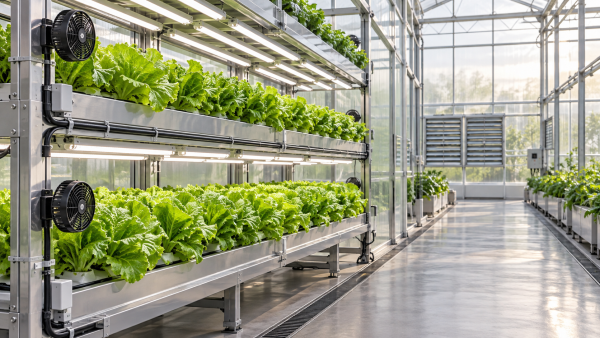
Select greenhouse equipment for vertical farming as a coordinated lighting and climate system. Fixtures must deliver usable light across every growing tier, while air movement and moisture removal must support the resulting crop growth. A lighting package that performs well on an open bench may create uneven growth or excessive cooling demand when installed inside closely spaced racks.
Begin with crop requirements, rack dimensions, and seasonal greenhouse conditions. These determine whether a proposed system can maintain consistent conditions at the leaves—and whether its operating costs remain acceptable as production expands.
Establish what each growing tier needs
A greenhouse receives sunlight, but stacked crops do not receive it equally. Upper shelves intercept light that would otherwise reach lower levels, and the distribution changes with sun angle, structural shading, screens, and crop maturity. Treating every tier as an identical supplemental-lighting zone can leave lower crops underlit while upper crops receive unnecessary electrical light.
Before requesting equipment proposals, define the following:
- Crop and growth stage: Include the intended harvest size, canopy density, and any quality requirements affected by light or temperature.
- Growing geometry: Record shelf width, tier spacing, fixture mounting height, and clearance above the mature canopy.
- Production schedule: Establish the daily lighting window, required dark period, and seasonal production expectations.
- Climate conditions: Account for outdoor temperature and moisture, solar heat gain, and periods when greenhouse ventilation is restricted.
- Operating constraints: Include electrical capacity, available heating and cooling, cleaning access, and maintenance space.
Use these inputs to set conditions at crop level. Room-average temperature and humidity are insufficient when a dense lower tier can remain humid while a sensor in the aisle reports acceptable conditions.
Compare lighting by delivered photons and distribution
Fixture wattage describes electrical demand. It does not establish how much useful light reaches the plants. A lighting comparison needs three related measures: fixture photon output, photon efficacy, and canopy-level light distribution.
Photosynthetic photon flux, or PPF, describes the amount of light a fixture emits within the specified photosynthetic waveband. Photosynthetic photon efficacy, commonly expressed in micromoles per joule, relates that output to electrical input. Higher efficacy can reduce electricity use for a given emitted photon output, but it does not guarantee efficient delivery to the crop. Light falling into aisles or onto rack supports still consumes electricity.
Request performance data for the complete fixture, including its driver, and check that suppliers use the same wavelength basis. Values that include additional far-red wavelengths cannot be compared directly with conventional photosynthetic efficacy figures without accounting for that difference.
Evaluate the light map at the actual mounting height
Photosynthetic photon flux density, or PPFD, describes the photon flux arriving at a surface. Request a canopy-level PPFD map based on the proposed shelf dimensions, fixture spacing, mounting height, and relevant reflective surfaces.
An average PPFD value can conceal bright strips beneath fixtures and weak areas between them. Examine minimum values, edge losses, and the definition used for any quoted uniformity figure. Maps should cover the planted footprint rather than a conveniently selected central area.
Low-clearance racks often benefit from distributed light bars because they can spread light across a broad, shallow canopy. A smaller number of powerful fixtures may require more distance to blend their output. However, adding bars also adds wiring, connectors, cleaning surfaces, and potential obstructions to airflow. Compare the complete installed arrangement.
Daily light integral, or DLI, accounts for light received over the day. Under constant electric lighting, it is calculated from PPFD multiplied by operating seconds and divided by one million. In a greenhouse, sunlight contributes a variable share, so controls should account for accumulated light by zone where practical. A sensor above the rack cannot reliably represent a heavily shaded lower shelf.
Choose spectrum and controls around the crop
Spectrum affects plant development, morphology, and visual inspection. Select it alongside light intensity and photoperiod, using crop-relevant evidence. A spectrum marketed for rapid growth may not suit the desired leaf shape, coloration, or production schedule.
Adjustable spectra have value when crop requirements change or trials are part of the operating plan. For a stable crop program, simpler fixtures may reduce cost and control complexity. In either case, assess dimming range, output consistency when dimmed, and compatibility with the environmental controller.
Also examine fixture dimensions, resistance to the intended cleaning conditions, driver access, and cable routing. Remote drivers can reduce heat released immediately around the canopy, but they only reduce the greenhouse cooling load if that heat is rejected outside the conditioned space.
Separate air circulation from heat and moisture removal
Fans inside a greenhouse perform different jobs. Circulation fans redistribute air around crops. Exhaust fans and vents exchange indoor and outdoor air. Mechanical cooling and dehumidification manage conditions when outdoor air cannot provide the required result.
These functions need separate evaluation. Increasing internal air movement can reduce stagnant pockets, but circulation alone does not remove water vapor from the greenhouse. Conversely, substantial exhaust capacity does not ensure that replacement air passes through every growing tier.
In tightly packed racks, air may bypass the plants through open aisles. A large fan can produce obvious room movement while leaving the center of a shelf poorly ventilated. Depending on rack depth and crop density, distributed fans, ducts, or tier-level air delivery may provide better coverage.
Assess this arrangement with a mature canopy represented. Empty-rack airflow measurements can be misleading because foliage changes resistance and creates sheltered areas. Excessive local air speed can also increase water demand or damage sensitive foliage, so the objective is suitable distribution throughout the crop.
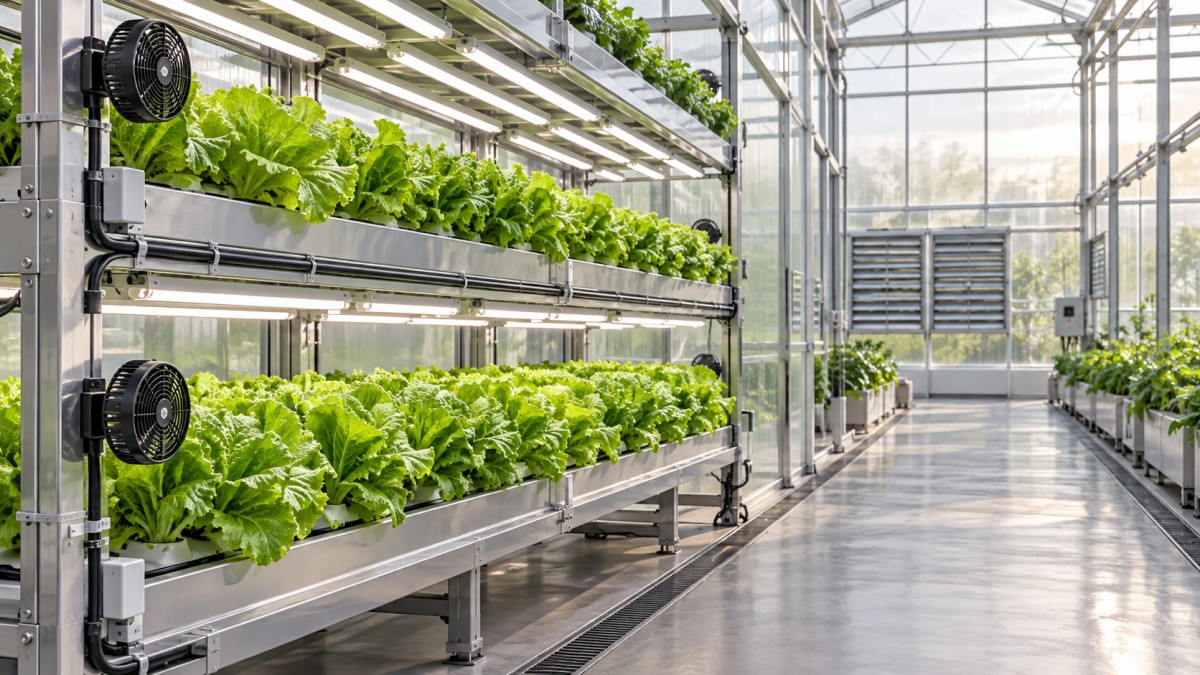
Size moisture removal for the crop and the weather
Water released by plants becomes a climate-control load. As leaf area expands, moisture production changes, and irrigation practices or exposed wet surfaces can add to it. A system sized around young plants may struggle near harvest.
Ventilation removes moisture when incoming air has a lower moisture content than outgoing air. Outdoor relative humidity alone does not establish this: cold air at high relative humidity may contain less water than warmer greenhouse air. Compare humidity ratio or dew point alongside temperature when evaluating ventilation-based drying.
In cool conditions, ventilation may remove moisture effectively but increase heating demand. During warm, humid weather, outdoor air may provide limited drying, making mechanical dehumidification or cooling with moisture removal more relevant. Evaporative cooling also becomes less effective as incoming air approaches saturation and introduces additional moisture.
Request dehumidifier capacity at the intended greenhouse conditions. A headline rating measured in warmer, more humid air may overstate removal at the operating setpoint. Examine energy consumption, drainage, service access, and where the equipment releases heat. A standalone dehumidifier rejecting heat indoors adds sensible heat that the climate system must accommodate.
Night operation deserves its own load assessment. When lights switch off, leaf and air temperatures can fall while moisture remains elevated, increasing condensation risk. Specify a transition strategy that coordinates circulation, heating, ventilation, and dehumidification through this period.
Check how lighting and climate controls interact
Lighting changes the greenhouse energy balance. Electrical input ultimately becomes largely heat within the growing environment, although where that heat appears depends on fixture design, radiation, plant absorption, and driver placement. Greater light availability can also increase transpiration when other conditions support it.
This means a fixture upgrade cannot be evaluated solely through its electricity savings. A changed light schedule or higher delivered intensity can alter cooling, heating, and moisture-removal requirements. In cooler periods, reduced fixture heat may increase heating demand; during hot periods, it may reduce cooling demand.
Compare proposed packages under several operating conditions: strong summer sunlight, humid weather with limited ventilation, cool nights, and mature crops near harvest. Include partial occupancy if racks will be commissioned in stages.
Controls should coordinate responses. For example, dehumidifying while vents remain unnecessarily open can waste energy. Aggressive lighting adjustments can also disrupt a crop-specific photoperiod strategy. Define priorities, allowable operating ranges, and responses to sensor or communication failures.
Sensor placement is part of this design. Locate representative measurements near crops without exposing sensors to direct fixture heating, spray, or supply-air jets. Where tiers behave differently, a single central sensor offers limited control.
Make supplier proposals comparable before purchase
A useful quotation identifies the conditions under which the equipment will deliver the proposed result. Give each supplier the same crop schedule, rack layout, climate assumptions, and operating targets, then request a coordinated response.
The comparison package should include:
- Lighting layout: Canopy maps, mounting clearances, electrical input, dimming behavior, and assumptions about sunlight.
- Air distribution design: Supply and return paths, expected canopy coverage, and fan performance at installed resistance.
- Climate calculations: Heat and moisture loads, outdoor design conditions, and equipment capacity at operating setpoints.
- Controls documentation: Sensor locations, operating sequences, alarms, data access, and integration responsibilities.
- Maintenance provisions: Cleaning methods, component replacement access, spare-part availability, and service requirements.
Compare operating costs across the whole package: lighting electricity, fans, cooling, dehumidification, heating, maintenance, and replacement components. Use the same production schedule and local energy tariffs for every proposal. Where electricity pricing includes demand charges, simultaneous equipment operation also matters.
A lower fixture price can be offset by poor light distribution or difficult maintenance. Similarly, a more efficient fan may deliver little benefit if the air path bypasses the crop. Assess energy use against the growing area maintained within specification and the intended production output.
Set acceptance criteria at canopy level
Before ordering, agree on how installed performance will be demonstrated. Measure light across representative tiers and shelf edges, check air distribution with crop obstruction represented, and log temperature and humidity through lighting transitions.
Commissioning should include drainage, alarms, dimming, sensor calibration, and recovery after a power interruption. If installation occurs in mild weather, retain a seasonal verification step for conditions that cannot be reproduced during initial handover.
Where rack geometry or crop requirements remain uncertain, a representative production bay can resolve questions before a full rollout. Equip it with the proposed fixtures, airflow arrangement, and controls, then assess crop uniformity and climate stability through a complete growing cycle. The purchase decision should rest on whether the combined system maintains the required conditions across the planted canopy within an acceptable operating budget.
Related Intelligence
- Smart GreenhouseGreenhouse Equipment for Vertical Farming: Choosing Lighting and VentilationChoose greenhouse equipment for vertical farming with confidence. Compare lighting, airflow, and moisture control to improve crop uniformity and manage costs. Explore the guide.
- Smart GreenhouseSelecting Greenhouse Propagation Equipment for Hot, Humid Southeast Asian NurseriesGreenhouse propagation equipment Southeast Asia: discover how to select resilient irrigation, ventilation, benches, and automation for hot, humid nurseries.
- Smart GreenhouseWhat Are the Biggest Challenges in Agri-Tech Adoption in 2026?What are the biggest challenges in agri tech adoption for 2026? Explore cost, data, connectivity, skills, compliance, and ROI barriers.
The Morning Broadsheet
Daily chemical briefings, market shifts, and peer-reviewed summaries delivered to your terminal.
