

The Authority in Global Agricultural Chemistry & Bio-Resources
Choosing Compact Forestry Machinery for Small Woodlots and Narrow Access
Choosing Compact Forestry Machinery for Small Woodlots and Narrow Access
On small woodlots, a machine that fits through the gate may still struggle to turn, maintain traction, or handle timber safely. Selecting compact forestry machinery therefore requires more than comparing overall width and engine power. Operating weight, ground pressure, turning geometry, hydraulic capacity, and load stability must be assessed against the access route and the work itself.
The decision is rarely about finding the smallest machine available. It is about choosing a system that can move timber from stump to landing without creating unacceptable safety risks, soil damage, or handling costs. A narrow carrier with insufficient payload can become expensive through repeated trips; a capable forwarder can be equally unsuitable if it cannot negotiate the route.
Define the extraction job before comparing machines
Begin with the timber and its destination. Selective thinning, firewood recovery, storm cleanup, and small-scale commercial harvesting impose different demands. Record the expected log lengths, typical and maximum piece weights, extraction distance, and available landing space. Include occasional difficult pieces, not just the average load.
Piece weight affects more than payload. A crane must lift the timber at the actual working reach, while a winch must pull it through terrain where roots, stumps, and changes in direction increase resistance. Green timber weight varies with species, moisture, and dimensions, so volume alone is not a reliable loading limit.
Also decide which operations belong on the machine. Felling, processing, extraction, and loading need not use the same platform. On a lightly managed woodlot, buying a complex harvesting system may leave expensive capability idle. Conversely, separating every operation can create excessive manual handling and coordination costs.
Survey the whole route, not just the entrance
Measure the narrowest usable passage along the complete extraction route. Include gateways, standing trees, culverts, overhead branches, and the approach to the landing. Published machine width is only a starting point: tires, tracks, protective structures, attachments, and loads can change the operating envelope.
Turning clearance deserves a separate check. An articulated machine, skid-steer carrier, and tractor-trailer combination follow different paths. A trailer may cut inside a corner, while a long log can sweep outside it. Ask for turning information for the proposed configuration, including the loaded trailer or attachment, rather than relying on a base-machine turning radius.
A route sketch should mark tight bends, cross-slopes, drainage crossings, soft patches, and places where reversing would be unavoidable. Check bridge and culvert capacity against the fully loaded combination and axle loads where relevant. An uncertain crossing requires competent assessment, not a successful empty-machine test.
Clearance is also needed for safe operation and maintenance. A machine that passes between two trees may leave no safe space to dismount, inspect a hose, or recover a stalled unit. Identify recovery access before work begins; narrow access can turn an ordinary mechanical fault into a prolonged stoppage.
Match the equipment type to the handling method
Compact forwarders: carrying timber off the ground
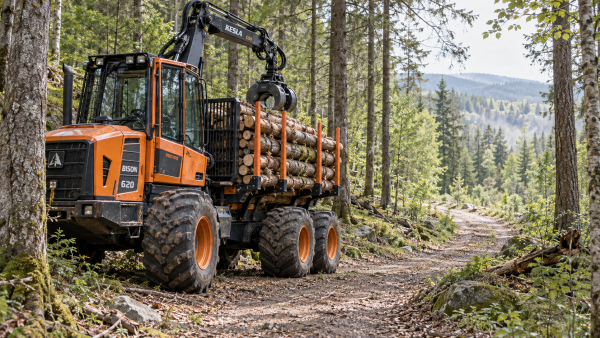
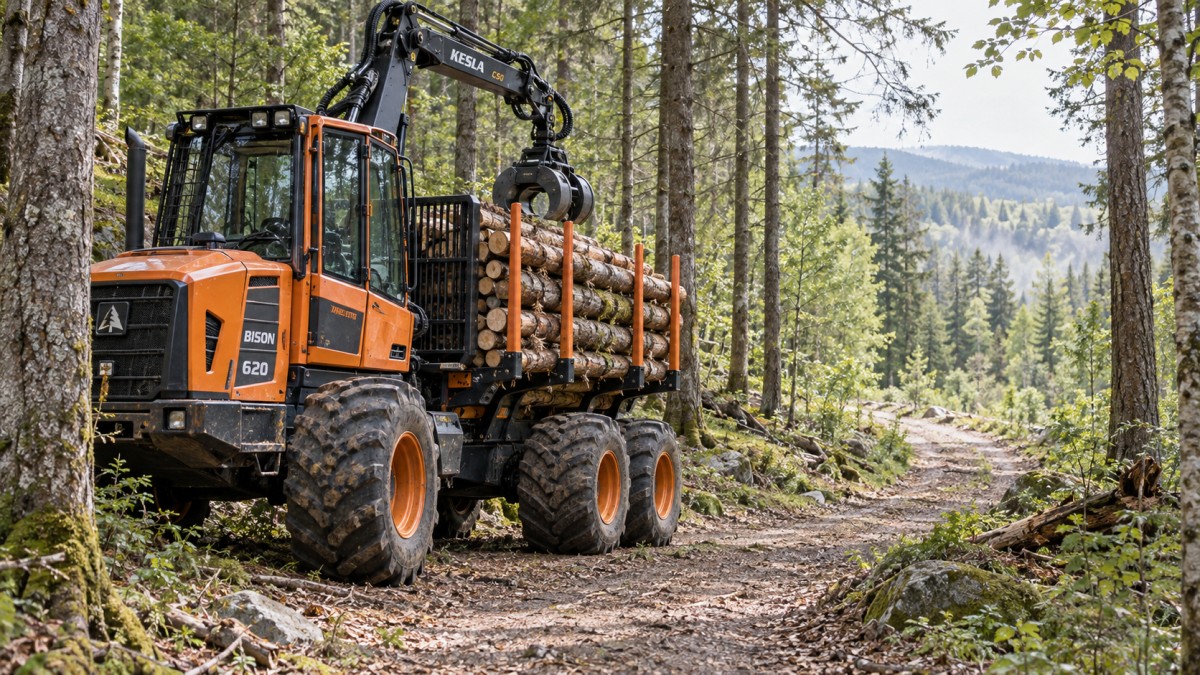
A compact forwarder can suit repeated extraction where carrying timber clear of the soil is valuable. Its integrated crane and load space reduce dependence on separate loading equipment. The trade-off is the mass and maneuvering space of a loaded machine, plus the need for enough landing area to unload efficiently.
Compare usable payload, bunk dimensions, crane capacity at working reach, and loaded axle distribution. Rated payload is not permission to fill the bunk under every terrain condition. Long or unevenly distributed timber can alter balance even when total load weight remains within the nominal rating.
Tractors with forestry winches or trailers: flexible, but configuration-sensitive
A suitably equipped tractor may be practical when the same power unit serves other seasonal work. A winch can bring timber to an extraction corridor without driving to every stem. A forestry trailer adds carrying capacity but also length, hitch forces, and braking requirements.
An agricultural tractor is not automatically suitable for forestry. Confirm guarding, operator protection, tire suitability, permitted attachment loads, and braking compatibility. Winching requires an appropriate anchor position, rated rigging, controlled exclusion zones, and trained operators. Remote control does not remove the hazards of a tensioned line or moving timber.
Tracked carriers and compact loaders: useful where the task is defined
Small tracked carriers and compact loaders can provide access and attachment flexibility, especially for short-distance handling or site maintenance. However, a grapple-compatible platform is not necessarily an efficient timber extraction machine. Check visibility, log retention, attachment weight, lifting geometry, and suitability for repeated travel over uneven ground.
Skid steering can disturb soil during tight turns. Tracks may improve flotation in some conditions, but they do not eliminate rutting, loss of traction, or slope instability. Judge the complete machine and operating method, not the undercarriage label.
Read specifications as a connected system
Engine power is easy to compare and easy to overvalue. For compact forestry machinery, performance often depends on how power reaches the wheels, tracks, winch, and hydraulic functions during a working cycle.
Hydraulic comparisons need both flow and pressure, measured at the relevant operating conditions. Confirm the flow available to the attachment, continuous-duty capability, return-line requirements, and whether travel and crane operation compete for the same supply. A demanding attachment can expose cooling limitations that are invisible during a short demonstration.
Lift capacity must be checked at the required outreach and configuration. A maximum lifting figure close to the machine tells little about collecting a log beyond a ditch. Use the manufacturer's load chart and account for grapple or attachment mass as specified. Do not substitute tipping load for rated operating capacity.
Ground-pressure figures also need interpretation. They may describe an unloaded machine using a simplified contact area. Actual soil loading changes with payload, tire inflation, track configuration, terrain, and dynamic movement. Request the calculation basis and assess rutting risk against soil strength and moisture conditions. A low catalog figure does not establish that a wet route is trafficable.
Treat stability and soil protection as operating limits
There is no universal safe slope for all compact machines. Manufacturer limits, load position, travel direction, surface grip, hidden obstacles, and attachment movement all matter. A machine may retain traction while approaching an unsafe stability condition; traction and rollover resistance are different questions.
Ask how the operator is protected from rollover, falling objects, and penetrating branches, and obtain documentation applicable to the intended configuration and market. Do not assume that a canopy, cab, or aftermarket guard provides every required form of protection. Visibility, emergency exit access, restraints, and safe servicing provisions also deserve inspection.
Soil protection starts with route planning. Concentrating traffic on suitable extraction corridors, avoiding unnecessary turns, and suspending travel when conditions deteriorate can matter more than a small difference in nominal machine weight. Slash mats may help where appropriate, but they are not a substitute for assessing bearing capacity or protecting watercourses under local requirements.
Reducing payload can limit individual axle loads, but it also increases trips. Evaluate both effects. Where access is seasonally weak, postponing extraction or using a different handling method may be more sensible than specifying a lighter machine that still cannot operate acceptably.
Use a site demonstration to test the shortlist
A useful demonstration reproduces the difficult parts of the job under a planned, supervised procedure. It should not involve deliberately approaching rollover limits or improvising recovery operations. Agree on the load, route, operator, and acceptance criteria before the machine arrives.
- Time complete cycles, including loading, travel, unloading, and repositioning—not just the fastest movement.
- Verify passage and turning with representative timber, including load overhang and operator visibility.
- Run long enough to assess hydraulic temperature behavior and simultaneous-function performance within manufacturer limits.
- Inspect ground disturbance and practical access to filters, grease points, hoses, and debris-prone cooling surfaces.
- Record configuration details so the delivered machine matches the tested tires, tracks, ballast, guarding, and attachments.
If a representative trial is unavailable, record the unresolved risks explicitly. A supplier's written application review is useful, but it should not be treated as proof of performance on ground neither party has assessed.
Buy productive availability, not just capacity
For small woodlots, annual utilization can determine whether ownership makes sense. Compare purchase and financing costs with transport, insurance, scheduled service, wear parts, fuel, training, and downtime. Include the cost of bringing in another machine for tasks the selected unit cannot perform.
Local support can outweigh a modest specification advantage. Check parts availability, diagnostic access, service travel charges, and warranty responsibility for the machine-attachment combination. Confirm delivery configuration and commissioning arrangements in writing. A nominally versatile platform is less attractive if every attachment fault becomes a dispute between suppliers.
For AgriChem Chronicle's agricultural and forestry machinery coverage, the useful distinction is between advertised capability and documented application fit. Technical comparisons become stronger when they connect supplier specifications with route surveys, working-cycle observations, and support commitments rather than treating each specification as an isolated benefit.
Before committing, assemble a short acceptance file: the surveyed route, representative timber dimensions and weights, required load charts, protection documentation, trial findings, and service terms. If one candidate still depends on uncertain clearance, unsupported lifting assumptions, or favorable weather throughout the season, resolve that constraint before discussing optional equipment.
Related Intelligence
- Forestry EquipmentChoosing Compact Forestry Machinery for Small Woodlots and Narrow AccessChoose compact forestry machinery that fits small woodlots and narrow access. Compare payload, turning clearance, safety, and running costs to find the right machine for your site.
- Forestry EquipmentAre PTO driven wood chipper vibration levels within ISO 5349-1 hand-arm exposure limits for forestry crews?PTO driven wood chipper vibration often exceeds ISO 5349-1 limits—discover real-world data, actionable mitigation strategies, and how to protect forestry crews now.
- Forestry EquipmentSelecting Timber Processing Equipment for Middle East Heat, Dust, and Wood SpeciesTimber processing equipment for Middle East operations: discover how to select heat-resistant, dust-protected, species-matched systems for reliable output and lower downtime.
The Morning Broadsheet
Daily chemical briefings, market shifts, and peer-reviewed summaries delivered to your terminal.
