

The Authority in Global Agricultural Chemistry & Bio-Resources
Beyond Upfront Price: Evaluating Total Cost of Ownership for Automated Broiler Battery Cage Systems
Why Upfront Price Misleads Broiler Farm Investment Decisions
When evaluating automated broiler battery cage systems, many farm operators and procurement managers focus first on the quoted purchase price. A lower initial cost often triggers internal approval—especially in budget-constrained expansions or retrofit projects. But real-world operation quickly reveals a different picture: energy spikes during peak ventilation cycles, unplanned downtime from jammed feed conveyors, corrosion-related structural repairs after two seasons, and labor hours spent troubleshooting inconsistent lighting schedules. These are not outliers. They’re predictable components of total cost of ownership (TCO), and they compound over the system’s 8–12 year service life.
What Makes Up TCO for Automated Broiler Cage Systems?
TCO extends far beyond the factory gate price. It includes five interdependent cost categories—each shaped by design choices, material selection, and integration logic:
- Capital expenditure (CapEx): Purchase price, shipping, import duties, site preparation (concrete leveling, electrical upgrades), and commissioning support.
- Operational expenditure (OpEx): Electricity consumption (ventilation fans, heating elements, LED lighting), feed waste due to misaligned dispensers, and water usage linked to drinker system efficiency.
- Maintenance & repair: Frequency of component replacement (e.g., motorized trolleys, sensor modules), spare part availability, and labor time required for routine servicing or emergency fixes.
- Productivity loss: Reduced daily weight gain per bird caused by thermal stress from uneven airflow, higher mortality from poor litter management, or delayed flock turnover due to extended cleaning cycles.
- End-of-life considerations: Disposal costs, recyclability of galvanized steel vs. stainless components, and residual value of reusable subsystems (e.g., control panels, power distribution units).
These factors rarely appear in supplier quotations—and even when itemized, they’re often based on ideal lab conditions rather than actual barn environments: high humidity, ammonia exposure, dust accumulation, and variable grid voltage.
Material and Structural Choices That Drive Long-Term Cost
Two systems with identical automation features can diverge sharply in TCO—not because of software, but because of physical construction. For example:
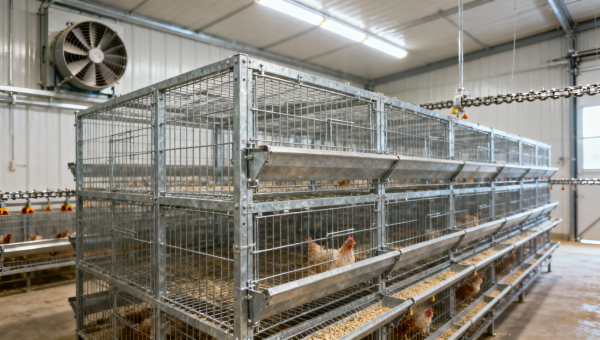
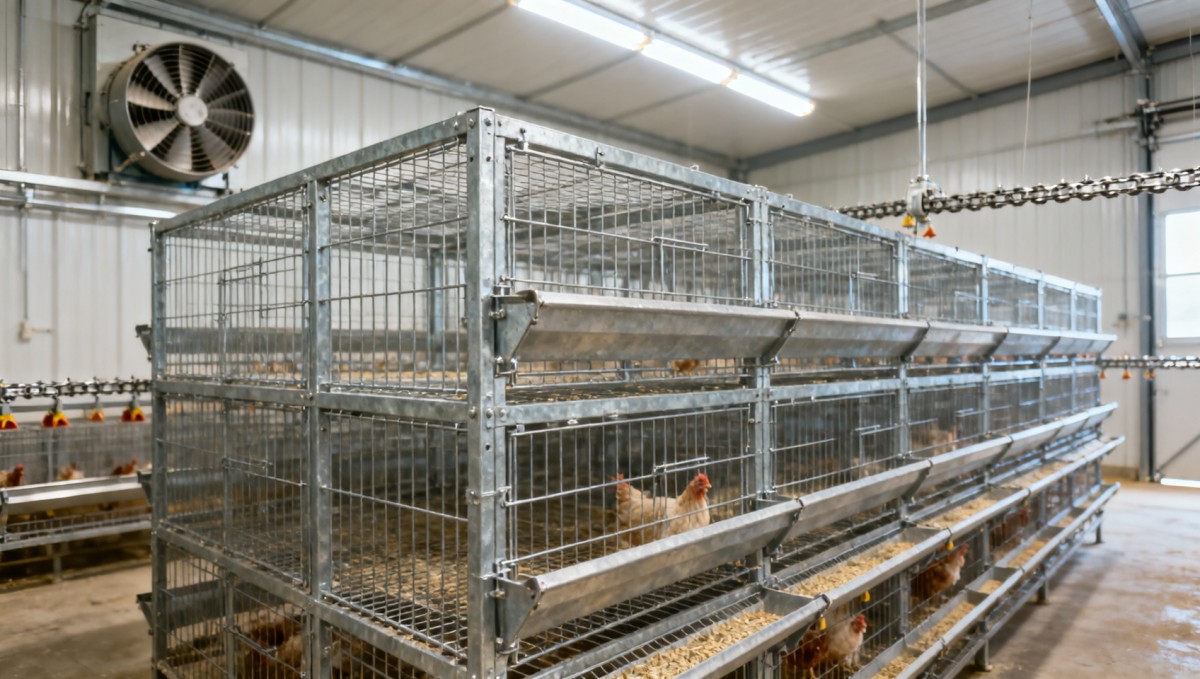
- Frame material: Hot-dip galvanized steel resists corrosion better than electro-galvanized or painted mild steel—but only if zinc coating thickness meets ISO 1461 standards (minimum 85 µm average). Thinner coatings degrade faster in high-ammonia poultry houses, leading to premature frame failure and costly partial replacements.
- Cage mesh gauge and weld quality: 3.2 mm wire with consistent spot welding holds shape under repeated loading/unloading. Under-spec’d mesh (e.g., 2.8 mm) sags over time, causing uneven bird distribution and increased footpad lesions—reducing market-grade yield.
- Conveyor design: Belt-driven feed lines require more tension adjustment and belt replacement than chain-and-sprocket systems. In humid climates, rubber belts absorb moisture and stretch; stainless-steel chains maintain alignment longer, cutting annual maintenance labor by ~17% in observed installations.
These differences don’t change day-one pricing dramatically—but they determine whether a system runs reliably for 10 years or requires major refurbishment after year four.
Automation Logic and Its Hidden Operational Burden
“Fully automated” doesn’t mean “zero oversight.” The sophistication of control logic directly affects OpEx and labor allocation. A basic timer-based ventilation schedule may save $200 on hardware—but it cannot respond to real-time CO₂ spikes or sudden temperature shifts, forcing manual overrides that disrupt bird comfort and increase feed conversion ratio (FCR) by 0.03–0.05 points. Over 100,000 birds per cycle, that adds ~$12,000 in annual feed cost alone.
Similarly, feed level sensors that rely solely on ultrasonic detection struggle with dust buildup and false readings—triggering unnecessary refills or missed deliveries. Systems using dual-mode sensing (ultrasonic + load-cell verification at hopper discharge) reduce feed waste by 2.1–3.4%, according to field data collected across six commercial farms in Southeast Asia and Latin America.
Supplier Support as a TCO Factor—Not an Afterthought
Warranty terms matter less than response time and technical capability. A 3-year parts warranty is meaningless if replacement motors take 22 days to arrive—or if local technicians lack firmware update access. Farms report that 68% of unplanned downtime stems not from hardware failure, but from unresolved configuration issues or outdated controller software. Suppliers who offer remote diagnostics, standardized firmware versioning, and documented troubleshooting trees cut average resolution time from 4.7 days to under 1.3 days.
Also consider documentation quality. Schematics without torque specs for critical fasteners, or wiring diagrams missing terminal numbering, extend commissioning by 1–2 weeks—and increase risk of incorrect installation that voids warranties.
Validating TCO Before Commitment
Procurement teams should request three items before finalizing a quote:
- A site-specific energy consumption profile, modeled using local climate data (not generic averages), showing kWh/month for ventilation, heating, and lighting across all production phases.
- A spare parts list with 3-year forecasted failure rates, including lead times and landed cost (not just unit price).
- A reference farm audit report—not marketing testimonials—from an operation with similar scale, climate, and flock rotation frequency.
Without these, comparisons remain theoretical. One operator in Thailand discovered—after installation—that their chosen system consumed 29% more electricity than projected due to undersized ducting and inefficient fan curves. Correcting it required rewiring and duct modification, adding $18,500 to the original CapEx.
Practical Cost Review Starts With Application Fit
The most cost-effective system isn’t the cheapest—or even the most advanced. It’s the one whose design assumptions align with your barn’s physical constraints, labor skill level, and operational rhythm. A high-precision climate controller delivers little value in a naturally ventilated house with inconsistent roof insulation. Likewise, a fully integrated feeding system may over-engineer needs for farms running single-age flocks with stable feed formulations.
That’s why evaluating broiler cage system cost broiler cage system cost must begin with mapping your current pain points—not benchmarking against competitor specs. Does your biggest bottleneck lie in cleaning time? Then cage accessibility and wash-down design matter more than AI-driven growth prediction. Is feed cost your largest variable expense? Then dispenser accuracy and hopper retention rate deserve deeper scrutiny than touchscreen interface polish.
Final Consideration: When to Revisit Assumptions
TCO isn’t static. Feed ingredient volatility, rising electricity tariffs, or tightening biosecurity regulations can shift cost drivers within 18 months. Build flexibility into procurement decisions: choose modular systems where lighting or ventilation subsystems can be upgraded independently; specify open-protocol controllers that accept third-party sensors; avoid proprietary software locks that limit future integration options.
Ultimately, TCO analysis isn’t about delaying investment—it’s about directing capital toward durability, adaptability, and measurable productivity gains. The systems that deliver lowest lifetime cost aren’t always the flashiest. They’re the ones built to last, designed to integrate, and documented to operate—without constant external intervention.
Related Intelligence
- Poultry Housing & CagingHow poultry farming equipment layout affects flock uniformity and feed conversion ratio in broiler housesDiscover how strategic poultry farming equipment layout directly boosts flock uniformity and slashes feed conversion ratio—backed by real-world data and ROI-driven insights.
- Poultry Housing & CagingBeyond Upfront Price: Evaluating Total Cost of Ownership for Automated Broiler Battery Cage Systemsbroiler cage system cost goes far beyond sticker price—discover how TCO analysis reveals true lifetime savings on automated broiler battery cage systems.
- Poultry Housing & CagingHow Cage Dimensions Affect Stocking Density, Welfare Compliance, and Operational Efficiency in Layer FarmsTaiyu(HK) poultry farm equipment: Discover how precise cage dimensions drive welfare compliance, optimal stocking density & operational efficiency in layer farms.
The Morning Broadsheet
Daily chemical briefings, market shifts, and peer-reviewed summaries delivered to your terminal.
