

The Authority in Global Agricultural Chemistry & Bio-Resources
Choosing Stainless Steel Smart Greenhouse Systems: Corrosion and Controls
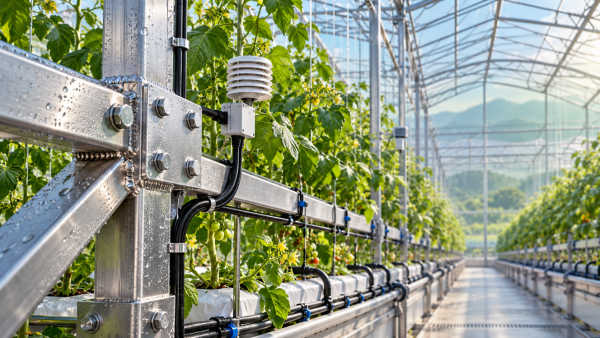
Stainless steel smart greenhouse systems are most valuable when the material specification matches the actual exposure and the controls remain dependable under greenhouse conditions. A system with a corrosion-resistant frame can still suffer from failing fasteners, moisture-damaged sensors, or software that cannot communicate with existing equipment. The right choice depends on where corrosion is likely to occur, what the automation must control, and how the installation will be maintained over its working life.
Start by separating the greenhouse into exposure zones and control functions. A dry structural member under cover does not face the same conditions as a dosing pump bracket exposed to concentrated fertilizer. Similarly, a temperature sensor used for monitoring has a different operational role from one that triggers ventilation or heating. Those distinctions make it easier to compare proposals on their merits rather than on a general claim of being “stainless” or “smart.”
Match the steel to the exposure, not just the greenhouse
Stainless steel resists corrosion because a thin protective oxide layer forms on its surface. That layer is effective in many environments, but it is not immune to damage. Chlorides, deposits, prolonged wetness, poor drainage, and certain cleaning chemicals can create localized conditions that overwhelm the material’s resistance.
In greenhouse applications, exposure varies substantially across a single installation. Condensation may collect on overhead members and drip onto connections. Fertilizer mist or irrigation leaks can leave deposits on rails and brackets. Coastal air can introduce salt, while cleaning and disinfection may expose equipment to chemicals that were not considered when the structure was specified.
Common stainless grades such as 304 and 316 offer different levels of resistance to chloride-related attack. Grade 316 generally provides better resistance in chloride-bearing environments, but it is not a universal solution: concentration, temperature, contact time, surface condition, and design all affect performance. Where exposure is mild and surfaces can dry and be cleaned, 304 may be a reasonable choice. Where salt, aggressive cleaning agents, or persistent deposits are expected, 316 may justify its higher cost for selected components.
The decision need not be uniform across the entire facility. Using a more corrosion-resistant grade around fertigation equipment and wet connections, while using another suitable material for less exposed structural elements, can be a practical approach. Conversely, specifying an expensive alloy for a frame while leaving vulnerable hardware or joints unaddressed may provide little benefit.
Inspect connections, welds, and mixed materials
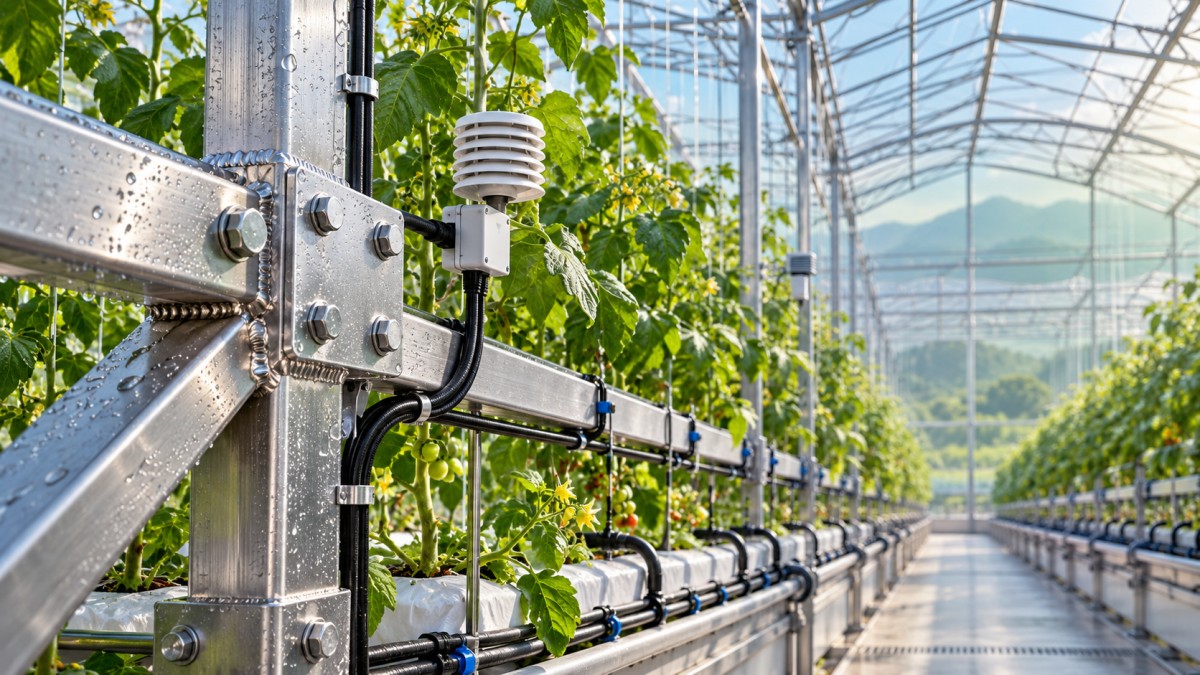
Corrosion often starts at details rather than on a broad, clean surface. Overlapping plates, tight gaps beneath washers, poorly drained tube ends, and joints that trap debris can retain concentrated solutions long after surrounding surfaces have dried. A proposal should therefore identify not only the grade of the main members, but also the materials and construction of fasteners, hinges, brackets, supports, and enclosures.
Weld quality matters as well. Heat from welding can alter the surface, and discoloration or contamination left around a weld can reduce local corrosion resistance. Ask how welds will be finished and cleaned, especially in wet zones. The aim is not a cosmetic finish alone; it is a surface that can maintain its protective behavior and be inspected without concealed deposits.
Mixed-metal connections deserve attention. When dissimilar metals are electrically connected in the presence of moisture, galvanic corrosion may accelerate attack on the less resistant metal. The risk depends on the materials, their relative exposed areas, and how long the joint stays wet. Suitable isolation, drainage, compatible fasteners, and protective coatings can reduce that risk, but each adds installation and maintenance requirements.
Also consider contact with galvanized steel, aluminum, or carbon-steel tools and fittings. Contamination from ordinary steel can leave rust staining on stainless surfaces. Staining does not automatically mean the stainless component has failed, but it warrants inspection and removal of the contamination before the affected area becomes harder to assess.
Define what the controls must do before comparing features
A smart greenhouse may monitor temperature, humidity, light, carbon dioxide, irrigation, and nutrient delivery. The distinction is whether each measurement is merely displayed, used to generate an alert, or used to operate equipment automatically. A dashboard with extensive charts is not equivalent to a control strategy that coordinates vents, fans, heating, and irrigation.
For each growing zone, describe the desired response to changing conditions. For example, humidity control may involve ventilation, heating, circulation, or a combination. Those actions can conflict: opening vents may lower humidity while increasing heating demand or changing carbon dioxide concentration. The system should allow control priorities and operating limits to be configured around the crop and facility, rather than treating every device as an independent switch.
Ask how the controller handles competing commands. If a temperature sensor requests ventilation while wind or rain protection requires vents to close, the safety condition should take precedence. Similarly, irrigation automation should account for the consequences of a failed valve, unavailable water, or an implausible sensor reading. These behaviors belong in the functional specification, not only in the commissioning discussion.
Sensor placement can matter as much as sensor selection
A reliable sensor in the wrong location can produce misleading control decisions. Air temperature measured close to a heater, humidity measured in stagnant air, or light measured in an unrepresentative shaded position may not reflect the crop environment. Position sensors where their readings represent the conditions being controlled, while keeping them accessible for cleaning, calibration, and replacement.
Greenhouses also contain gradients. A large or compartmentalized facility may need separate measurements and control zones rather than a single sensor governing the whole structure. The number and location of sensors should follow the physical layout, airflow, crop arrangement, and consequences of uneven conditions.
Check the suitability of sensor housings and cable connections for condensation, spray, cleaning, and sunlight where relevant. A housing’s stated protection rating is useful, but it does not by itself establish that a complete installation will tolerate the intended cleaning chemicals or repeated wetting. Cable entries, connectors, mounting orientation, and maintenance practices matter too.
Integration and failure behavior are purchasing criteria
Controls should be evaluated as part of the existing operation. Identify the equipment already installed or planned: irrigation valves, pumps, climate equipment, weather stations, electrical panels, and farm-management software. Then establish which devices the proposed controller can read, command, and alarm on, including any gateways or interface modules needed.
For each interface, distinguish between a documented, usable connection and a general claim of compatibility. An equipment interface may expose readings but not operating commands, or it may require additional configuration or licensing. Request an interface list that identifies data points, control permissions, and responsibility for integration. Where data will move between systems, agree on ownership, export format, access permissions, and any recurring service charges.
Connectivity should not be the only route to basic operation. Determine what happens if the internet connection, cloud service, local network, controller, or power supply is unavailable. The appropriate response differs by function: some equipment may need to stop, while ventilation or other protective functions may require a separate fallback arrangement. Manual operation should be practical for trained staff and should not create an unsafe conflict with automatic commands.
Alarm design also deserves scrutiny. An alert that arrives too late, reaches the wrong person, or provides no indication of the affected zone is difficult to act on. Specify which conditions require immediate notification, how alerts are delivered, and what happens when an alarm is not acknowledged. Include sensor faults and communication loss, not just readings outside the desired range.
Compare proposals using the same operating conditions
Supplier quotations are easier to evaluate when they respond to a common set of assumptions. Provide the intended location, water characteristics where relevant, expected fertilizers and cleaning agents, crop zones, exposure to salt or spray, and the equipment to be controlled. Describe both normal operation and maintenance procedures: a component that performs well during irrigation may still be unsuitable for the cleaning routine.
Request enough detail to distinguish material and automation choices:
- Material schedule: grades and finishes for exposed structural members, fasteners, brackets, piping, and equipment enclosures, with any non-stainless components identified.
- Fabrication details: weld treatment, drainage, isolation at mixed-metal joints, and access for inspection and cleaning.
- Control narrative: operating sequences, setpoint authority, sensor locations, alarm conditions, interlocks, and fallback behavior.
- Integration scope: supported interfaces, included hardware and software, third-party responsibilities, and any access or licensing limitations.
- Service provisions: calibration needs, replacement parts, software support, remote access arrangements, and expected maintenance tasks.
Compare total ownership costs rather than the initial equipment price alone. A stainless component can reduce some corrosion-related maintenance, but it still requires cleaning and inspection. Automation may reduce routine manual adjustments, yet sensors, actuators, networking equipment, and software still need attention. Include commissioning, staff training, spare parts, subscriptions, and planned downtime in the comparison.
A fully stainless structure is not automatically the most economical choice. Galvanized or coated alternatives may suit less aggressive areas when their exposure, coating integrity, and maintenance needs are acceptable. Stainless becomes more compelling where sustained moisture, frequent cleaning, or fertilizer exposure makes corrosion consequences more severe, particularly when replacement would disrupt production. The comparison should account for access and downtime as well as material cost.
Make acceptance testing reflect real operation
Before handover, establish what evidence will show that the installed system performs its intended functions. Review the delivered material schedule against the specification and inspect representative welds, connections, drainage points, and areas where deposits could accumulate. Confirm that sensors are positioned as agreed and that their readings can be checked against suitable reference instruments.
Control testing should go beyond demonstrating a dashboard. Exercise representative sequences: change a setpoint, observe the intended actuator response, trigger an alarm, and test the agreed behavior for a lost sensor or communication link. Where safe and practical, demonstrate manual override and recovery to automatic operation. Record outstanding issues and the party responsible for resolving them.
The strongest selection is the one whose material choices, control logic, and maintenance obligations are visible before purchase and demonstrable after installation. Begin with the wettest and most chemically exposed parts of the greenhouse, then trace each critical measurement through to the equipment response. That process exposes gaps that a grade label or feature list alone cannot resolve.
Related Intelligence
- Smart GreenhouseChoosing Stainless Steel Smart Greenhouse Systems: Corrosion and ControlsStainless steel smart greenhouse systems need more than a corrosion-resistant frame. Discover how to compare steel grades, controls, integration, and maintenance before you buy.
- Smart GreenhouseGreenhouse Equipment for Vertical Farming: Choosing Lighting and VentilationChoose greenhouse equipment for vertical farming with confidence. Compare lighting, airflow, and moisture control to improve crop uniformity and manage costs. Explore the guide.
- Smart GreenhouseSelecting Greenhouse Propagation Equipment for Hot, Humid Southeast Asian NurseriesGreenhouse propagation equipment Southeast Asia: discover how to select resilient irrigation, ventilation, benches, and automation for hot, humid nurseries.
The Morning Broadsheet
Daily chemical briefings, market shifts, and peer-reviewed summaries delivered to your terminal.