

The Authority in Global Agricultural Chemistry & Bio-Resources
Vietnam Enforces New Pesticide Disclosure and Ban Rules
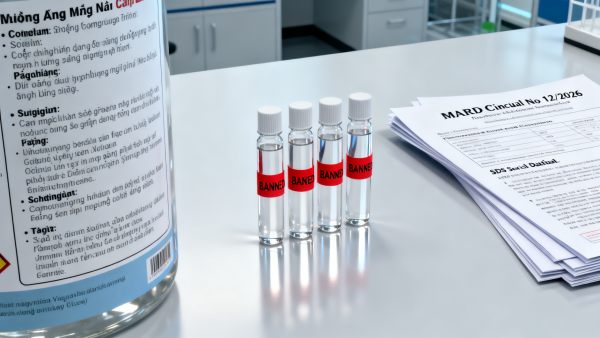
Vietnam’s Ministry of Agriculture and Rural Development (MARD) issued Circular No. 12/2026/TT-BNNPTNT on May 29, 2026, mandating full disclosure of all co-formulants in insecticides and fungicides — including solvents, stabilizers, and synergists — on labels and technical documentation, while simultaneously banning four newly listed organophosphate derivatives. The regulation took effect immediately and directly impacts exporters of botanical extracts, agrochemicals, and natural ingredients serving the Vietnamese market.
Event Overview
On May 29, 2026, MARD signed and published Circular No. 12/2026/TT-BNNPTNT. The circular requires complete ingredient disclosure for all insecticides and fungicides — whether imported or domestically registered — covering all co-formulants. It also adds four organophosphate derivatives to Vietnam’s prohibited substances list. The rule applies to products containing botanical extracts, synthetic agrochemicals, and natural active ingredients. Non-compliant products will be denied customs clearance.
Which Subsectors Are Affected
Direct Exporters and Importers
These entities face immediate regulatory gatekeeping at Vietnamese ports. Since compliance is assessed at customs clearance, failure to provide full co-formulant documentation — or inclusion of any of the four banned organophosphate derivatives — results in shipment rejection. Impact manifests as delayed market access, rework of labeling and dossier submissions, and potential loss of contracted deliveries.
Formulation Manufacturers and Contract Developers
Manufacturers supplying finished products or custom formulations to Vietnamese registrants must now disclose every co-formulant used — not just active ingredients. This affects internal documentation systems, quality assurance protocols, and supplier vetting for raw materials. Any undocumented solvent or stabilizer previously considered proprietary or commercially sensitive now requires formal declaration.
Active Ingredient and Co-formulant Suppliers
Suppliers of solvents, emulsifiers, or synergists may see increased demand for certified composition statements and regulatory-grade specifications. Buyers may request updated safety data sheets (SDS) and full chemical identity documentation — especially for substances with ambiguous naming conventions or multi-component blends.
What Stakeholders Should Monitor and Do Now
Track official guidance on co-formulant disclosure scope
MARD has not yet published a detailed annex specifying acceptable nomenclature, threshold limits (if any), or exemptions for trace impurities. Stakeholders should monitor MARD’s official portal and authorized notification channels for supplementary technical guidance — particularly regarding mixtures where full disclosure conflicts with trade secret protections.
Review current product portfolios for the four banned organophosphate derivatives
The circular names four specific organophosphate derivatives but does not list their CAS numbers or structural identifiers in publicly available summaries. Exporters and registrants should cross-check existing formulations against Vietnam’s latest prohibited substance list (as updated in Annex 1 of Circular 12/2026) and verify with local regulatory agents before submission or shipment.
Update labeling and registration dossiers ahead of customs verification
Customs officers are instructed to verify label compliance upon entry. Labels must now include full co-formulant lists — not only in Vietnamese but also aligned with the technical dossier submitted during product registration. Companies should audit existing labels and revise bilingual versions to reflect complete composition, ensuring consistency across packaging, SDS, and registration files.
Engage qualified local regulatory representatives early
Given the immediate effective date and absence of a grace period, companies without an in-country representative authorized to submit amendments or respond to customs queries risk shipment delays. Engaging a licensed Vietnamese regulatory agent now allows for rapid dossier updates, translation validation, and real-time coordination with MARD’s Plant Protection Department.
Editorial Perspective / Industry Observation
Observably, this circular signals Vietnam’s accelerating alignment with ASEAN and OECD transparency standards for pesticide regulation — shifting from active-ingredient-only oversight to full formulation accountability. Analysis shows it is less a one-off enforcement action and more a structural pivot: the dual focus on disclosure *and* prohibition suggests MARD is building capacity for risk-based evaluation of co-formulants, not merely administrative control. From an industry standpoint, this is best understood not as a temporary compliance hurdle, but as the beginning of a broader trend toward full-formulation traceability in Southeast Asian agrochemical markets. Continued monitoring is warranted — especially for future extensions to herbicides or biopesticides, and for potential harmonization with EU CLP or US EPA reporting expectations.
Conclusion
This regulation marks a definitive step toward greater compositional transparency in Vietnam’s pesticide market. Its immediate enforcement underscores that regulatory readiness — not just product efficacy or registration status — now determines market access. For stakeholders, the change is operational rather than strategic: it requires concrete updates to documentation, labeling, and supply chain communication — not a reassessment of market viability. Currently, it is more accurately understood as a procedural tightening with enforceable consequences, rather than a signal of broader policy reversal or market restriction.
Information Sources
Main source: Vietnam Ministry of Agriculture and Rural Development (MARD), Circular No. 12/2026/TT-BNNPTNT, effective May 29, 2026.
Note: The exact chemical identities of the four banned organophosphate derivatives, and any forthcoming technical annexes clarifying co-formulant disclosure requirements, remain pending official publication and are subject to ongoing observation.
Related Intelligence
- Smart GreenhouseGreenhouse Equipment for Vertical Farming: Choosing Lighting and VentilationChoose greenhouse equipment for vertical farming with confidence. Compare lighting, airflow, and moisture control to improve crop uniformity and manage costs. Explore the guide.
- Forestry EquipmentChoosing Compact Forestry Machinery for Small Woodlots and Narrow AccessChoose compact forestry machinery that fits small woodlots and narrow access. Compare payload, turning clearance, safety, and running costs to find the right machine for your site.
- APIs & IntermediatesProcurement Planning: Which Resource Reports Help Prevent Material Shortages?Discover how procurement planning resource reports reveal usable stock, shortage dates, and supplier risks so you can prevent material shortages and keep production on track.
The Morning Broadsheet
Daily chemical briefings, market shifts, and peer-reviewed summaries delivered to your terminal.
