

The Authority in Global Agricultural Chemistry & Bio-Resources
How Should Buyers Compare Poultry Farm Equipment Prices Globally?
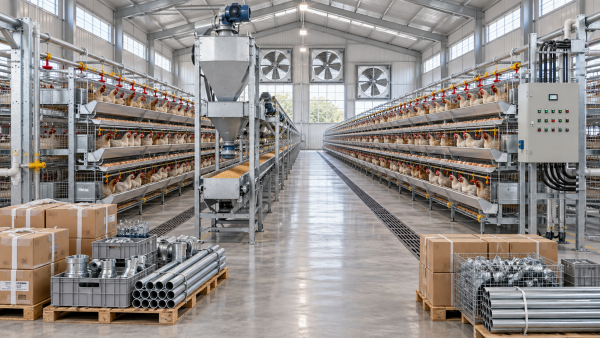
How Should Buyers Compare Poultry Farm Equipment Prices Globally?
A poultry-house quotation can look straightforward: cages, feeders, drinker lines, ventilation fans, controllers, manure removal, installation. Yet two offers carrying a similar headline price may represent very different operating models. One may cover only factory-gate equipment; another may include engineering drawings, electrical panels, commissioning support, and a defined spare-parts package. A cheaper imported fan may also have a motor, airflow curve, corrosion treatment, or control interface that does not suit the farm’s climate or electrical supply.
So, what is the best way to compare poultry farm equipment prices globally? Build a like-for-like comparison around total landed cost, verified technical performance, local compliance, supplier delivery capability, and the cost of operating the system over its useful life. The purchase price matters, but it is only one line in a much larger investment decision.
This matters whether a buyer is evaluating a broiler house retrofit, a breeder installation, a layer-cage project, or an integrated feed-and-poultry expansion. The equipment package affects bird environment, labour routines, biosecurity practices, energy use, repair exposure, and the ability to scale a farm without redesigning its core infrastructure.
Start with a comparable technical scope, not a supplier’s bundle
The most common pricing error occurs before negotiations begin: buyers compare package totals without standardising what each package contains. “Automatic poultry equipment” can mean a basic feeding and drinking arrangement in one quotation and a fully integrated environmental-control system in another. Even cage dimensions may be presented differently, with one vendor pricing by unit, another by bird capacity, and another by house.
Create a buyer-controlled bill of requirements before requesting final quotations. It should state the production type, target bird capacity, building dimensions, regional climate conditions, power supply, water quality considerations, preferred level of automation, and responsibility boundaries for civil works and electrical installation. Where the project is phased, specify what must be installed now and what must remain compatible with later expansion.
For climate-control equipment, request the stated operating conditions behind each performance claim. Airflow and static pressure are more useful than a fan diameter alone. For feeding systems, ask for hopper capacity, conveying arrangement, drive configuration, and the equipment’s intended feed characteristics. For drinker systems, compare line length, nipple type, pressure regulation, flushing provisions, and filtration requirements. Material thickness and coating type should be identified where corrosion resistance is relevant, particularly in humid houses or sites with aggressive cleaning regimes.
A quotation that cannot be mapped line by line to an agreed scope is not ready for a price comparison.
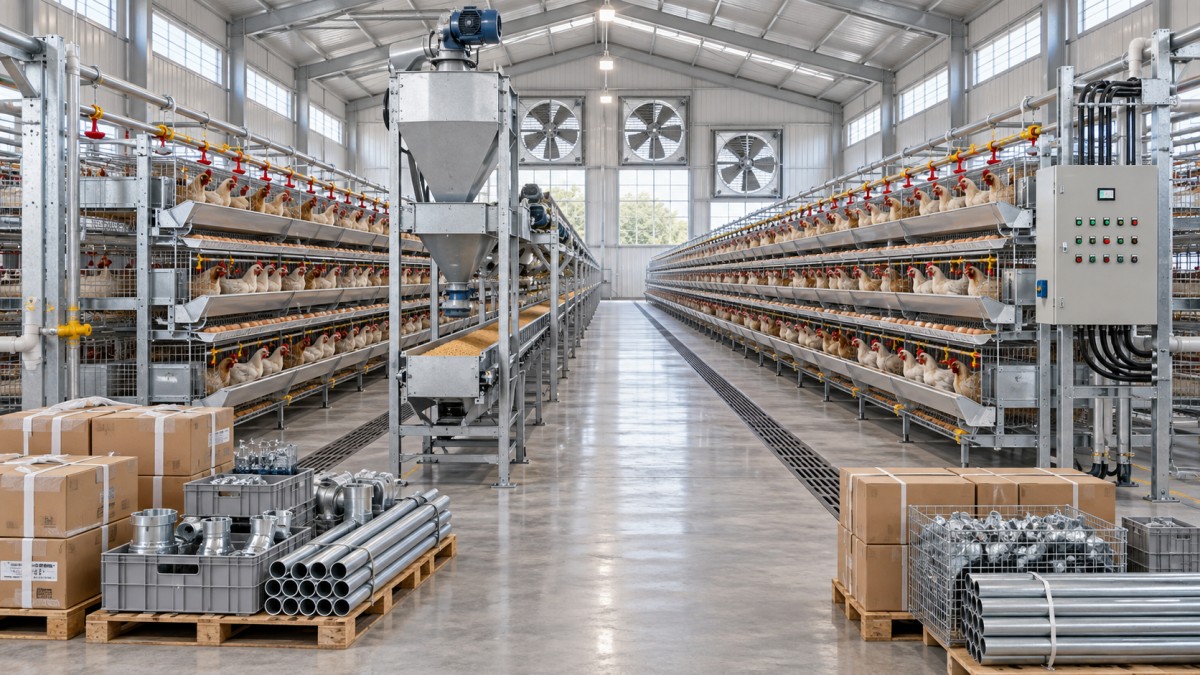
Convert quoted prices into total landed and installed cost
International poultry equipment prices are often quoted under different Incoterms. An EXW price may exclude everything after factory release. FOB generally shifts responsibility at the port of shipment. CIF may include ocean freight and insurance to a named destination port, but it does not automatically include inland delivery, unloading, customs clearance, duty, taxes, or installation. Buyers should not treat these as interchangeable commercial labels.
The practical comparison figure is the estimated total landed and installed cost in the project currency. That calculation should include equipment price, export packing, inland transport in the origin country where applicable, freight, insurance, port and clearance charges, import duties and taxes, inland haulage, local unloading equipment, installation labour, electrical integration, commissioning, and an initial spares allowance. Currency volatility and payment timing also deserve attention when deposits and final balances are paid months apart.
The intention is not to predict every downstream charge with false precision. It is to make exclusions visible early enough that procurement, finance, logistics, and farm operations are working from the same investment range.
Price performance through the operating cycle
A poultry system should be evaluated as an operating asset, not a shipment of metal and motors. The central question is whether its design supports stable daily management under the conditions of the intended farm. In hot regions, tunnel ventilation, cooling-pad design, controller logic, and backup power arrangements may carry more commercial weight than a small reduction in initial equipment cost. In cold climates, insulation interfaces, minimum-ventilation control, and condensation management can materially affect suitability.
Automation deserves the same discipline. A controller with remote visibility can be useful, but only if its alarms, sensor calibration, connectivity requirements, user permissions, and local service arrangements are understood. A system with sophisticated software but no accessible technician or replacement sensor may create a different kind of operational risk. Conversely, a simpler control system can be commercially sensible where farm staff need straightforward manual override and locally available components.
Ask suppliers to describe electricity consumption assumptions, recommended preventive-maintenance intervals, parts that normally wear, and the practical steps required when a feeder drive, water regulator, fan motor, belt, or control sensor fails. These answers should not be taken as universal performance guarantees. They are inputs for comparing maintainability, expected downtime exposure, and the local capability needed to keep the house running.
Treat compliance and biosecurity as design inputs
Global sourcing adds a layer of regulatory and technical compatibility that cannot be resolved by price alone. Import requirements, electrical rules, welfare expectations, environmental permits, construction approvals, and food-chain assurance requirements vary by country and sometimes by region. The buyer should determine which requirements apply locally and then ask the supplier for evidence relevant to the supplied equipment—not broad claims of international compliance.
Useful documentation may include equipment drawings, electrical diagrams, material specifications, operating manuals, warranty conditions, and certificates where a particular local authority or customer standard requires them. If a vendor refers to CE marking, electrical conformity, or other declarations, verify whether the documentation applies to the exact equipment configuration and destination market. A generic brochure is not a substitute for project documentation.
Biosecurity also shapes the equipment decision. Smooth cleanable surfaces, controlled water-line flushing, protected feed storage, practical manure handling, rodent-proofing interfaces, and the ability to isolate or clean house sections may be more valuable than cosmetic features. Equipment must fit the farm’s cleaning and downtime routines. Design decisions that complicate sanitation can create costs long after purchase orders are closed.
Evaluate the supplier’s ability to deliver, not just to quote
A polished quotation says little about manufacturing control, export readiness, or after-sales capacity. Buyers should examine whether the supplier can provide a consistent technical submittal, clear packing information, realistic lead-time assumptions, and a named point of responsibility for engineering questions. Ambiguity is especially risky where equipment from several sources must connect: ventilation to controls, feeding to feed bins, drinking lines to water treatment, and house equipment to local electrical work.
Due diligence does not need to become theatrical. Request photographs or documentation of relevant manufacturing processes where appropriate, review sample manuals and spare-parts lists, check the granularity of drawings, and ask how warranty claims are handled across borders. Find out whether troubleshooting can be conducted remotely and whether recommended critical parts can be stocked at the farm or through a regional partner. The goal is to identify practical support pathways before a breakdown occurs.
Payment structure should match evidence and project milestones. Large equipment projects commonly benefit from clearly defined technical approval, production, inspection, shipping-document, delivery, and commissioning checkpoints. The exact arrangement depends on the contract and trade route, but vague acceptance language is a warning sign for both buyer and supplier.
Use a weighted decision sheet—but leave room for judgement
A weighted comparison matrix is helpful once the technical scope is fixed. Typical categories include total landed cost, production suitability, energy and water considerations, installation complexity, documentation quality, spare-parts access, warranty clarity, supplier responsiveness, and expansion compatibility. Weighting should reflect the farm’s actual constraints. A remote site with unreliable grid power may reasonably give greater weight to resilient controls and serviceability than a facility near a strong distributor network.
The matrix should guide judgement rather than conceal it. A score cannot compensate for an unresolved incompatibility, such as equipment designed for a different voltage and frequency, a cage arrangement that does not fit the approved building layout, or a controller unsupported in the local language and service environment. Flag these as pass/fail conditions before scoring price and features.
Common shortcuts that weaken international comparisons
- Comparing cost per bird place without confirming bird type, stocking assumptions, house layout, and included systems.
- Accepting a broad “turnkey” label without a boundary schedule for construction, wiring, controls, testing, and training.
- Focusing on equipment warranty duration while overlooking who pays for diagnosis, freight, replacement parts, and on-site labour.
- Choosing a technically advanced package before confirming operator training, connectivity, backup systems, and local repair support.
- Requesting final pricing before the farm’s production objectives and climate strategy have been translated into engineering requirements.
These shortcuts often appear efficient because they reduce early procurement work. In practice, they shift unanswered questions into installation, commissioning, or the first difficult production cycle—when changes are slower and more expensive.
A more defensible global buying decision
The strongest poultry equipment comparison is not the one that produces the lowest spreadsheet total. It is the one that makes assumptions, exclusions, interfaces, and operating risks visible. Once specifications are normalised and landed cost is understood, buyers can judge whether a higher initial offer is justified by stronger automation, more durable materials, clearer documentation, better service access, or lower operational exposure.
For AgriChem Chronicle, this type of disciplined evaluation sits naturally within the wider primary-industries supply chain: technical procurement is inseparable from compliance, logistics, maintenance, and production economics. Reliable market intelligence does not replace engineering or local regulatory advice, but it helps procurement teams ask sharper questions of both suppliers and internal stakeholders.
Before selecting a supplier, reconcile the final offer against the site layout, local requirements, logistics plan, installation responsibilities, and a critical-spares strategy. If those elements remain unclear, the quoted price is not yet a decision-ready price.
Related Intelligence
- Poultry Housing & CagingHow Should Buyers Compare Poultry Farm Equipment Prices Globally?What is the best way to compare poultry farm equipment prices globally? Evaluate landed cost, performance, compliance, supplier support, and lifetime value.
- Poultry Housing & CagingWhen a Lower Layer Cage Price Can Increase Long-Term Farm Operating CostsLayer cages price is more than an upfront quote. Discover how cheaper systems can raise labor, repair, egg-loss, and automation costs over time.
- Poultry Housing & CagingHow Poultry Equipment Layout Affects Cleaning, Biosecurity, and MaintenancePoultry equipment and their uses shape cleaning access, biosecurity, and maintenance. Discover layout strategies that reduce risks and improve farm efficiency.
The Morning Broadsheet
Daily chemical briefings, market shifts, and peer-reviewed summaries delivered to your terminal.
