

The Authority in Global Agricultural Chemistry & Bio-Resources
Selecting Solids Filtration for Aquaculture: Flow Rates, Loading, and Fish Welfare
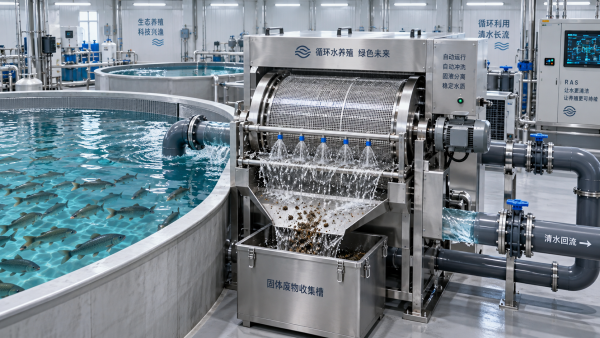
When suspended solids begin accumulating in an aquaculture system, the first visible symptom may be cloudy water, uneven tank cleanliness, or a rising need for manual flushing. The more serious effects often appear later: unstable dissolved oxygen, higher biofilter demand, gill irritation, stress during feeding, and greater difficulty maintaining predictable water conditions. A filtration unit can appear adequate during low biomass periods yet become a bottleneck as feed input and fish size increase.
The correct approach to solids filtration aquaculture selection is to size the system around the real hydraulic flow and expected solids load, then verify that its capture range, cleaning method, and failure behavior are compatible with fish welfare. The best filter is not simply the one with the finest nominal micron rating. It is the one that removes the problematic fraction of solids at the required flow without creating harmful head loss, excessive handling, or unstable operation.
Start with the water and waste conditions, not the filter catalog
Filtration selection often goes wrong when a design begins with a preferred equipment type. A drum filter, screen filter, settling device, bead filter, or microscreen may each be appropriate, but only after the operating conditions are defined. The essential question is not “Which technology is best?” but “What solids are entering this loop, how quickly do they arrive, and what water quality risk do they create before removal?”
In recirculating aquaculture systems, the incoming solids stream usually contains fecal particles, uneaten feed, biofilm fragments, fine organic matter, and occasionally treatment residues or debris. Their behavior differs. Some particles settle quickly in a clarifier. Others break apart under pumping and tank turbulence, becoming fine material that passes through coarse screens and remains suspended. Feed type, pellet durability, fish species, feeding intensity, tank hydraulics, and handling practices all influence this mix.
Before comparing equipment, establish the following operating basis:
- Design flow: the normal and maximum flow through each culture loop, including bypasses, redundancy arrangements, and expected pump operating range.
- Peak solids loading: waste production during high feeding periods, grading events, seasonal biomass changes, or short-term overfeeding conditions.
- Particle behavior: whether the dominant concern is settleable waste, visible suspended matter, fine colloidal material, or a combination.
- Water source and reuse configuration: flow-through, partial reuse, or high-rate recirculation systems place different demands on the filter.
- Operational limits: available footprint, drainage capacity, wash-water supply, operator access, automation capability, and allowable downtime.
A filter should be assessed at its expected dirty operating condition rather than only at clean-water performance. Clean screens, empty vessels, and laboratory-style flow values can conceal a substantial loss in throughput once solids accumulate.
Flow rate is a hydraulic requirement, not a nameplate number
Water exchange and circulation must support oxygen distribution, carbon dioxide stripping, temperature consistency, metabolite control, and fish movement through the culture unit. If the solids filter restricts this circulation, the system can create a welfare issue even while improving water clarity. Excessive head loss may reduce actual tank turnover, shift flows between parallel lines, or force pumps to operate inefficiently.
Assess flow in three layers. First, determine the required biological circulation through the tanks. Second, identify the flow that must pass through the mechanical filtration stage. Third, evaluate the actual flow delivered after pipe friction, elevation changes, valves, fouled screens, and pump performance are considered. These values are often treated as identical, but they may not be.
For example, a gravity-fed microscreen can be highly effective where upstream water level and downstream channel geometry provide sufficient hydraulic head. In a site with little elevation difference, the same unit may require larger channel sections or a different arrangement to avoid upstream water backup. A pressurized filter may fit a compact layout, but its pressure drop and backwash demand must be included in pump selection.
Request performance information that shows the relationship between flow and differential pressure or water-level loss across the expected operating range. A supplier’s maximum flow rating should be interpreted carefully. It may represent a short-term hydraulic limit rather than a sustainable solids-removal condition. The relevant question is: at the target mesh size and projected solids load, what flow can the unit maintain before cleaning is required?
Match capture performance to the particle problem
Nominal mesh size is useful, but it does not fully describe separation performance. A screen opening may retain large particles effectively while allowing deformable, fibrous, or fragmented material to pass. Screen loading can also form a temporary cake layer that improves fine-particle capture but sharply increases resistance to flow. That effect may help water clarity briefly while creating unstable hydraulics and more frequent wash cycles.
For fish welfare, the goal is usually early removal of organic solids before they fragment or dissolve. Fine organic particles contribute to turbidity, oxygen demand, bacterial growth, and biofilter loading. Fish exposed to persistently elevated suspended solids may show irritation of gill tissue or reduced feeding response, particularly where density, temperature, or organic load is already challenging.
Selection should therefore distinguish between three practical duties:
A coarse stage may be preferable upstream of a finer polishing stage when the raw solids burden is high. This arrangement avoids forcing a fine screen to handle particles that could have been removed more easily earlier in the process. It can also reduce wash-water use and improve consistency in downstream equipment.
Choose the technology according to operating behavior
Settling and swirl-based separation
Settling units, radial-flow separators, and swirl separators rely on reduced velocity and particle settling characteristics. They can be effective for larger, denser, settleable solids and often offer straightforward operation. Their limitation is that very fine or low-density material may remain in suspension. Performance depends heavily on inlet energy, hydraulic residence, tank geometry, and whether solids are removed before being resuspended.
These devices work well when the tank discharge delivers relatively intact waste and the facility can accommodate the required hydraulic volume. They are less suitable as the only barrier where fine feed particles or fragmented feces are a persistent concern.
Rotary drum and microscreen filters
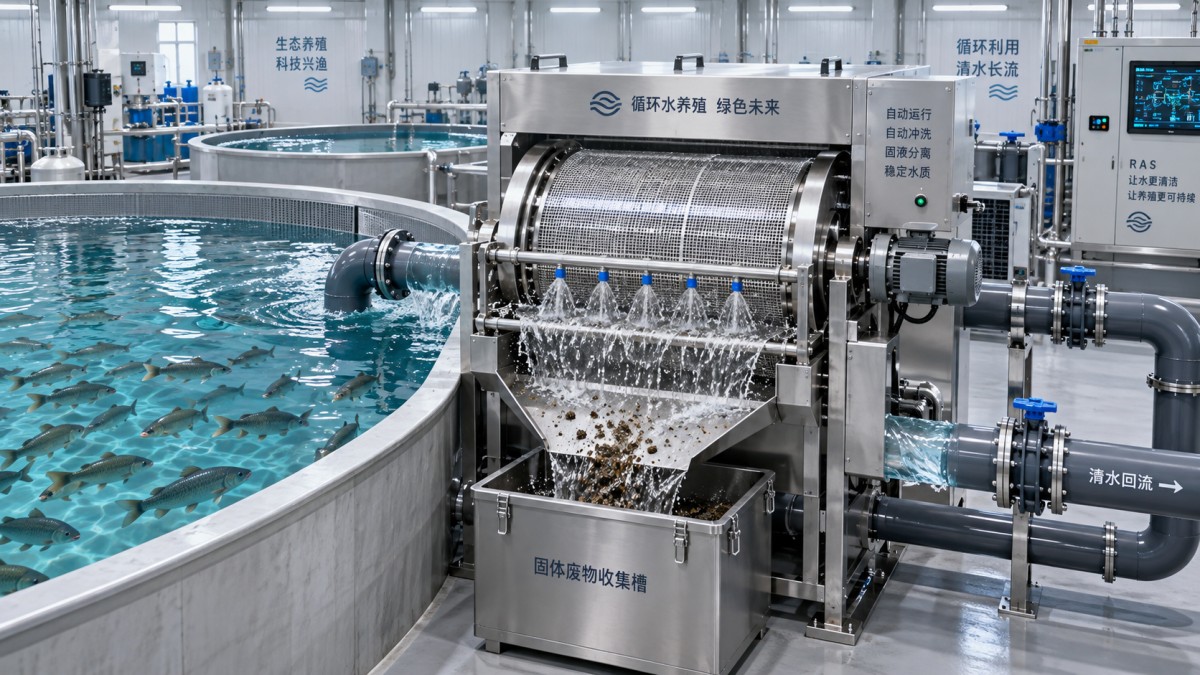
Rotary drum filters are frequently selected where continuous high-flow mechanical screening is needed. Their value lies in automated solids separation and regular screen cleaning, but success depends on screen area, mesh selection, spray effectiveness, sludge discharge handling, and the control logic that initiates wash cycles. A unit that washes too late may allow head loss to rise. One that washes too aggressively may consume unnecessary water and increase wastewater volume.
For these systems, verify the usable filtration area rather than relying only on overall drum dimensions. Also examine how easily the screen can be inspected, repaired, or replaced. A torn screen, blocked spray nozzle, faulty level sensor, or poor seal can compromise removal performance without immediately stopping flow.
Pressurized media, bead, and sand-based filters
Pressurized filters can combine solids retention with compact installation and may be useful where gravity flow is impractical. Their suitability depends on the nature of retained solids and the effectiveness of backwashing. Organic aquaculture waste can compact, channel, or degrade within media beds if backwash energy is insufficient. This may raise pressure drop and produce variable filtration results.
These systems require careful review of backwash water availability, waste discharge routing, air scour requirements where applicable, and the effect of backwashing on normal circulation. They should not be treated as maintenance-free devices simply because they are enclosed.
Cartridge and bag filters
Cartridge and bag filters are usually better suited to polishing or intermittent protective duties than to high-solids primary filtration. They can capture fine material, but consumable replacement and rapid fouling can make them impractical as the first treatment barrier in heavily loaded production water. Where used, they should be placed after effective bulk solids removal and monitored by differential pressure.
Solids loading changes across the production cycle
A filtration system that performs well at low stocking density may become undersized without any equipment failure. As fish grow, the relationship among biomass, feed ration, fecal output, and water circulation changes. Feeding peaks can create short bursts of solids that are much greater than the daily average. A design based only on average feed input may allow repeated overloads after feeding, when water quality is already under the greatest biological pressure.
Build the evaluation around peak loading events. Ask when the largest waste pulse occurs, how long it lasts, and whether the filter can clear it before the next pulse. This is especially important in systems with concentrated feeding windows, automatic feeders that distribute frequent small portions, or tank layouts where solids are not transported evenly to the outlet.
Tank hydraulics deserve the same attention as filter capacity. Dead zones, weak self-cleaning action, poor center-drain performance, and excessive turbulence can turn a filtration issue into a tank design issue. Waste retained in the tank breaks down before reaching the filter. Installing a finer screen downstream may improve appearance while leaving the root cause untouched.
Assess maintenance as part of welfare control
Mechanical filtration is often discussed as a water-treatment task, but its maintenance pattern affects fish directly. A blocked screen or delayed sludge purge can lead to rising water levels, altered flows, pump strain, and recirculation instability. A poorly planned backwash cycle may cause abrupt changes in system volume or draw contaminated water into an unintended path. These are operational risks, not merely housekeeping concerns.
During equipment evaluation, inspect the work required during normal production rather than assuming automation eliminates intervention. Important questions include:
- Can an operator safely inspect the screen, spray system, drain points, and sensors while the unit is running?
- What happens to flow when the cleaning cycle is active, when wash water is unavailable, or when solids discharge is restricted?
- Are alarms based on meaningful indicators such as differential level, pressure, motor status, or abnormal wash frequency?
- Can critical components be isolated and serviced without stopping all culture-water circulation?
- Where does collected sludge go, and can that route back up or create biosecurity concerns?
Waste handling is frequently underestimated. Collected solids remain biologically active. If sludge channels, sumps, or storage points are poorly drained, they can generate odor, attract pests, complicate cleaning, and create a reservoir for contamination. The filtration package should include a practical route from solids capture to removal from the production area.
Biosecurity and failure modes should influence the final specification
In facilities with separate age classes, quarantine zones, or health-management compartments, the filter arrangement must not create unwanted connections between water streams. Shared backwash lines, common dirty-water pits, and overflow paths can undermine otherwise sound separation practices. A unit that is easy to clean but difficult to isolate may be unsuitable for a compartmentalized facility.
Consider failure modes before purchasing. Loss of power, a blocked screen, a failed wash pump, sensor fouling, damaged mesh, valve malfunction, and sudden high solids loading should each have a defined response. Some systems fail by reducing filtration but maintaining flow; others can restrict flow or cause bypass. From a fish welfare perspective, preserving safe circulation and avoiding overflow may take priority over retaining maximum capture efficiency during a short equipment fault.
Redundancy does not always require duplicate full-capacity filters. It may involve parallel modules, a bypass with controlled protection, spare screen panels, standby wash components, or enough hydraulic buffer to allow safe intervention. The appropriate level depends on stocking density, reliance on recirculation, and how quickly water quality can deteriorate after mechanical removal is lost.
A practical basis for comparing proposals
When reviewing competing options, require each proposal to state the same operating assumptions: design and peak flow, target particle range, expected solids loading basis, clean and dirty head loss, cleaning trigger, wash-water demand, waste discharge arrangement, electrical loads, maintenance access, and response to component failure. Without a common basis, one proposal may appear less expensive simply because it has been rated at a lower flow, coarser screen, or cleaner water condition.
The final selection should preserve stable circulation first, remove solids early enough to protect water quality, and remain serviceable during the dirtiest periods of production. Where process conditions are uncertain, it is safer to identify the uncertainty explicitly—such as variable feed fines, limited hydraulic head, or an unproven sludge route—than to compensate by selecting an arbitrarily finer filter. Fine capture can be valuable, but only when the entire system can support the resulting cleaning frequency, pressure loss, and wastewater burden.
Related Intelligence
- Aeration & Water TechSelecting Solids Filtration for Aquaculture: Flow Rates, Loading, and Fish WelfareSolids filtration aquaculture guide: compare flow rates, peak loading, capture performance, maintenance, and fish welfare to choose a reliable system.
- Aeration & Water TechWhat RO water treatment systems deliver consistent 98% salt rejection at 25°C with feed TDS over 3,000 ppm?RO water treatment systems that deliver proven 98% salt rejection at 25°C with >3,000 ppm TDS—engineered for API synthesis, aquaculture & grain processing.
- Aeration & Water TechCan pond aeration systems maintain dissolved oxygen above 5 mg/L during summer stratification in catfish ponds?Pond aeration systems can sustain >5 mg/L DO during summer stratification—when engineered for mixing *and* oxygen transfer. See field-proven data & design essentials.
The Morning Broadsheet
Daily chemical briefings, market shifts, and peer-reviewed summaries delivered to your terminal.
