

The Authority in Global Agricultural Chemistry & Bio-Resources
How to Size Belt Drive Poultry Fans: Airflow, Static Pressure, and House Layout

Sizing belt drive poultry fans is not a matter of matching a fan diameter to a house drawing. The real task is to align airflow demand, expected static pressure, and building layout so ventilation performs under daily operating load.
That matters more today because poultry housing is being pushed harder on energy, stocking density, and climate consistency. In technical coverage across primary industries, AgriChem Chronicle often treats ventilation equipment as a system decision, not a catalog purchase.
For belt drive poultry fans, the difference is important. Their field performance depends on pulley ratio, motor selection, maintenance condition, inlet restriction, and how the house itself creates resistance.
What belt drive poultry fans are really being sized for
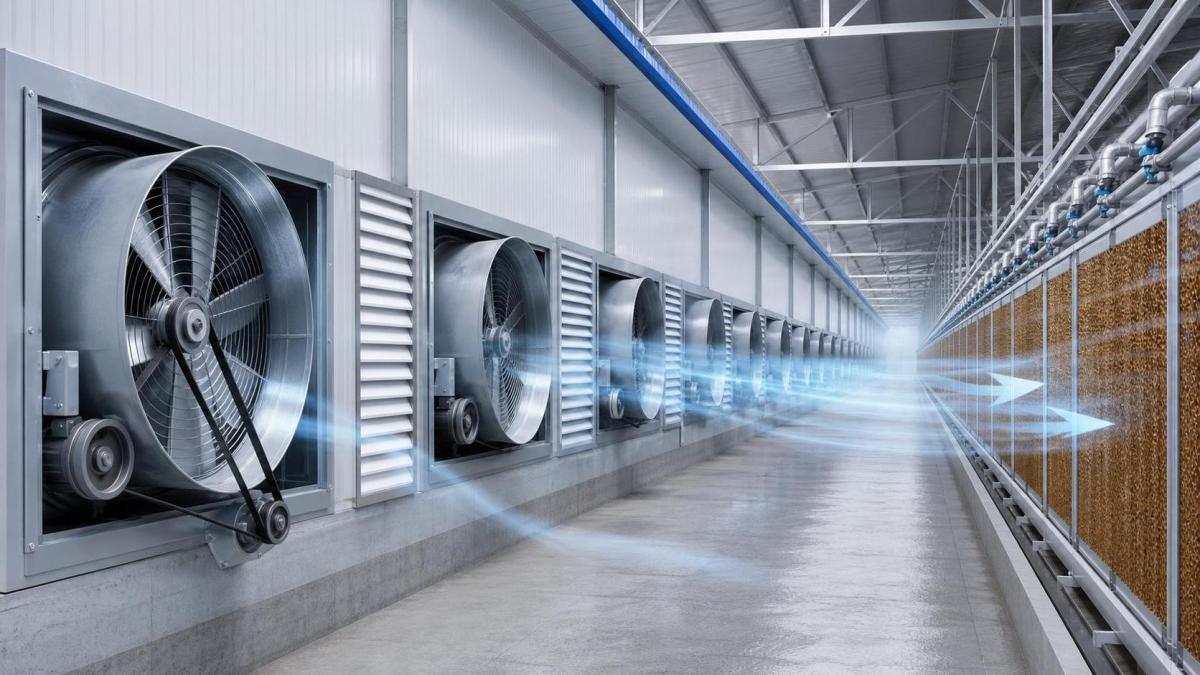 In most projects, the fan is expected to do three jobs at once. It must remove heat, control moisture, and maintain acceptable air quality without creating unstable pressure zones.
That is why belt drive poultry fans are usually evaluated by delivered airflow at a stated static pressure, not by free-air volume alone. Free-air numbers look attractive, but they rarely reflect house reality.
A practical sizing exercise starts with operating intent. Is the fan bank supporting minimum ventilation, transitional control, tunnel ventilation, or a mixed strategy across seasons?
Each mode changes the target. Minimum ventilation cares about consistency at low flow. Tunnel systems care about large-volume air exchange and airspeed through the bird zone.
Airflow is the output, not the whole answer
Airflow is commonly expressed as CFM or cubic meters per hour. Yet the useful question is how much airflow reaches the house when shutters, pads, inlets, guards, and dust loading are all present.
Manufacturers may publish strong nominal ratings, but belt drive poultry fans should be compared at the same test conditions. Otherwise one specification sheet can appear stronger simply because it was measured at lower resistance.
Why static pressure drives the sizing outcome
Static pressure is where many ventilation plans become inaccurate. It represents the resistance the fan must overcome as air moves through the building envelope and equipment path.
In poultry houses, resistance rarely comes from one source. It builds from inlet design, evaporative cooling pads, screens, shutters, duct transitions, and leakage patterns around doors or service openings.
Belt drive poultry fans that look similar at 0.05 inches water column may separate sharply at 0.10 or 0.15. That gap can decide whether the house reaches target airspeed on hot days.
This is also why oversimplified fan counts create risk. Ten fans selected from free-air assumptions may underperform more than eight higher-capacity fans chosen against realistic pressure.
Typical sources of pressure loss
- Evaporative pads with high face velocity or partial clogging
- Poorly proportioned air inlets
- Dirty shutters, guards, and fan cones
- Long houses with uneven inlet-to-fan flow paths
- Building leakage that disrupts pressure control
When these losses are ignored, the selected fan may still run, but the ventilation system no longer behaves as designed.
House layout changes fan performance more than many plans assume
House layout is not just a placement question. It sets the airflow path, the pressure profile, and the uniformity of climate conditions from one end of the building to the other.
A short broiler house with straightforward tunnel geometry can tolerate simple fan staging. A longer house, or one with service rooms and internal obstructions, usually needs more careful zoning.
Belt drive poultry fans mounted in a poor arrangement may create dead areas, uneven litter moisture, and temperature drift. Those issues often get blamed on controls, when the root cause is mechanical layout.
Layout factors that deserve attention
In practice, the house drawing should be read like a flow network. That approach produces better fan counts than relying on floor area alone.
A practical method for sizing belt drive poultry fans
A workable method begins with the ventilation objective for each season. Design for the hardest operating condition first, then check whether staging still supports mild-weather and minimum-ventilation needs.
Start by estimating required airflow from bird mass, heat load, target airspeed, and climate profile. Then define the expected static pressure range with pads, shutters, and inlets in service.
Next, compare belt drive poultry fans using tested performance curves. A curve is more useful than a single rating because it shows how airflow falls as pressure rises.
Finally, translate total airflow into staged fan groups. That avoids large control steps that overshoot pressure or create unnecessary power demand.
Specification checkpoints
- Delivered airflow at the project pressure point
- Motor horsepower and service factor
- Fan efficiency and power use per airflow unit
- Pulley setup and expected belt speed
- Shutter loss, cone design, and guard resistance
- Maintenance access and belt replacement intervals
This step matters because two belt drive poultry fans with similar airflow may produce very different operating costs and service stability.
Where selection mistakes usually appear
Most underperforming installations are not caused by a bad fan alone. They result from a mismatch between fan data, controls, and the actual resistance of the house.
One common mistake is treating belt drive poultry fans as interchangeable with direct-drive models. Belt drive systems can offer tuning flexibility, but performance depends on correct setup and ongoing belt condition.
Another mistake is assuming nameplate motor power guarantees airflow. If shutters drag, belts slip, or static pressure rises above design, the delivered volume drops before the issue becomes obvious.
It is also risky to size only for peak summer and ignore colder periods. Ventilation systems still need stable low-stage operation for moisture removal and air quality control.
Signs that the original sizing needs review
- Uneven bird distribution along the house
- Persistent wet litter near low-flow zones
- Excessive energy use during hot weather
- Pressure readings outside the intended control band
- Large performance drop after pad installation or seasonal dust loading
How to move from equipment choice to a reliable ventilation plan
The best next step is to build a short decision sheet before final selection. Include target airflow by mode, expected static pressure range, house geometry, inlet details, and maintenance assumptions.
Then compare belt drive poultry fans on equal test points, not headline claims. That keeps the review grounded in operating conditions rather than brochure language.
For new builds, it helps to review fan placement with controls and pad design at the same time. For existing houses, pressure readings and airflow audits often reveal whether the current fan bank is correctly matched.
In a sector where equipment performance, compliance expectations, and operating margins are tightening together, good ventilation planning has become a measurable project discipline. Belt drive poultry fans should be sized as part of that system logic, with airflow, pressure, and layout evaluated together before procurement or retrofit decisions move forward.
Related Intelligence
- Climate Control & VentilationHow to Specify Modular Control Panels for Poultry House Ventilation SystemsModular control panels for poultry ventilation: learn how to specify reliable I/O, sensors, alarms, variable-speed fans, and future-ready expansion.
- Climate Control & VentilationWhat Variable Speed Insights Matter Most When Optimizing Greenhouse Ventilation?Variable speed insights reveal how fan speed affects humidity, airflow, stability, and energy use in greenhouse ventilation. Learn what to adjust first for smarter, more reliable climate control.
- Climate Control & VentilationPoultry Ventilation for Broilers: How to Balance Airflow, Temperature, and Litter QualityPoultry ventilation for broilers made practical: learn how to balance airflow, temperature, humidity, and litter quality to improve flock health, growth, and house performance.
The Morning Broadsheet
Daily chemical briefings, market shifts, and peer-reviewed summaries delivered to your terminal.
