

The Authority in Global Agricultural Chemistry & Bio-Resources
How a Supply Intelligence Knowledge Base Improves Supplier Risk and Sourcing Decisions

Why the supply intelligence knowledge base matters when supply chains stop behaving predictably
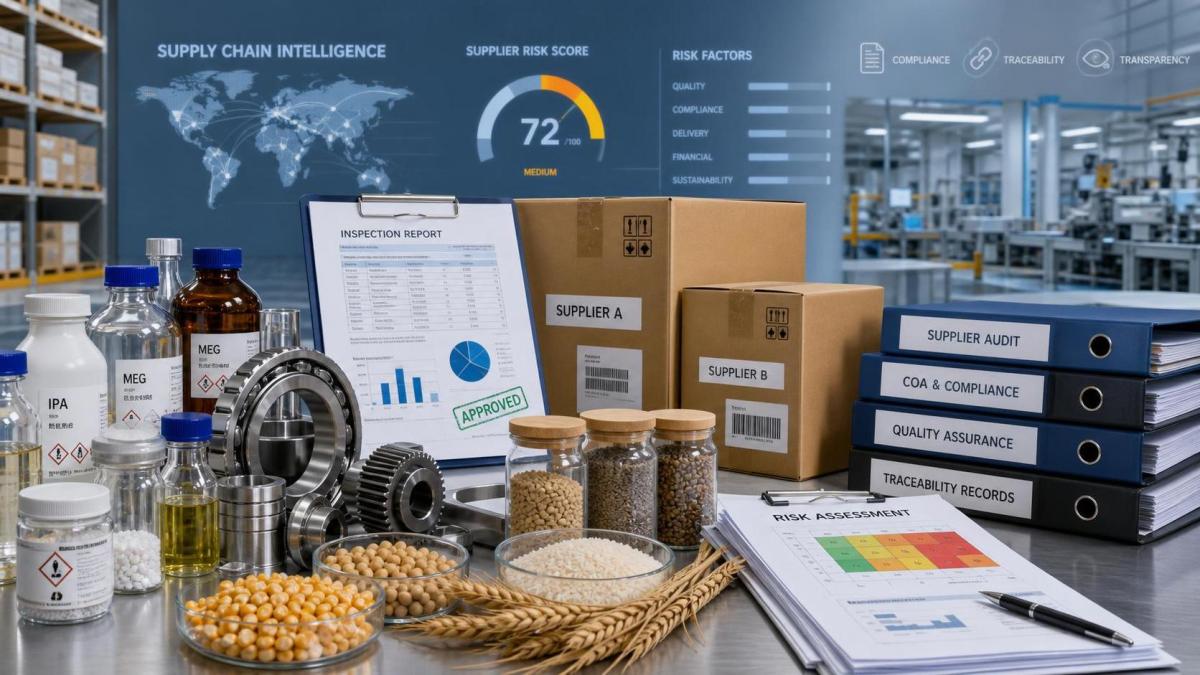 In regulated industrial markets, supplier data rarely fails because it is missing entirely. More often, it fails because it sits in disconnected systems, reports, audits, and trade records.
A supply intelligence knowledge base turns that fragmented picture into a working decision layer. It connects supplier history, compliance evidence, production capability, logistics exposure, and market movement.
That matters even more across fine chemicals, APIs, machinery, aquaculture systems, bio-extracts, and grain processing inputs, where one sourcing error can trigger regulatory, operational, and reputational damage.
AgriChem Chronicle has long covered these sectors from an intelligence-first perspective. That editorial context reflects a simple reality: sourcing decisions improve when technical detail and supply chain transparency are assessed together.
In practice, a supply intelligence knowledge base helps separate apparently similar suppliers that carry very different levels of execution risk. That distinction often decides whether a sourcing plan holds under pressure.
Different categories create different sourcing pressures
Not every purchase decision asks the same questions. A fermentation-derived ingredient, a solvent intermediate, and a commercial hatchery filtration system may all require supplier comparison, but the judgment criteria shift quickly.
For APIs and fine chemicals, traceability, batch consistency, and GMP alignment usually sit near the top. In aquaculture equipment, uptime, environmental durability, and service support can matter just as much as unit price.
Feed and grain processing brings another pattern. Here, procurement often has to weigh commodity volatility, storage limitations, port risk, and contamination controls at the same time.
That is why a supply intelligence knowledge base should not be treated as a static vendor directory. Its value comes from mapping category-specific risk signals to the actual sourcing decision in front of the business.
Where sourcing teams usually need deeper intelligence
Some scenarios repeatedly expose the limits of surface-level supplier screening. These are the points where a supply intelligence knowledge base tends to create the clearest advantage.
- Switching from an established supplier to a lower-cost alternative in regulated categories.
- Qualifying backup sources after geopolitical disruption, port congestion, or sanctions exposure.
- Comparing suppliers that claim similar certifications but show different audit histories.
- Evaluating whether capacity expansion is real, recent, and supported by technical documentation.
- Checking if a machinery or system provider can support long operating cycles in harsh field conditions.
When qualifying chemical and API suppliers, document quality is only the starting point
A common sourcing mistake is assuming that complete paperwork means low risk. In chemical and API categories, documentation matters, but it should be tested against manufacturing reality.
A useful supply intelligence knowledge base links certificates, inspection outcomes, shipment patterns, ownership structure, formulation specialization, and adverse event signals. That combination reveals whether compliance is routine or merely presented well.
In actual evaluation work, the key question is often consistency. Can the supplier maintain the same quality profile across lots, seasons, raw material swings, and demand spikes?
This is where editorial-grade market intelligence becomes valuable. ACC’s sector focus reflects how technical reports, laboratory findings, and trade compliance data can sharpen supplier risk analysis far beyond a checklist approach.
Another point is substitution risk. If a supplier depends on a narrow feedstock base or a single region for precursor inputs, even a compliant operation may still be strategically fragile.
Equipment and systems sourcing depends on performance after installation, not just before award
In agricultural machinery, forestry equipment, and aquaculture systems, supplier selection tends to look straightforward until operating conditions start diverging. Similar specifications can produce very different lifecycle outcomes.
A supply intelligence knowledge base helps by combining field reliability records, spare parts responsiveness, warranty behavior, environmental testing, and regional service capability into one comparable view.
The practical judgment here is not only whether the system works, but whether it keeps working under salinity exposure, variable power quality, heavy-duty usage, or seasonal labor constraints.
More refined sourcing teams also examine installability. A technically advanced system may still be a poor fit if commissioning support, operator training, or replacement components are weak in the destination market.
This is one reason a supply intelligence knowledge base is increasingly used beyond procurement. Engineering, compliance, and operations all benefit when supplier intelligence includes what happens after the purchase order is signed.
Bio-extracts and feed ingredients require a different balance of market and traceability signals
Bio-extracts, nutritional inputs, and feed ingredients often sit between commodity logic and specialty logic. Prices move with harvest conditions, but formulation performance and contamination exposure still demand technical scrutiny.
In these categories, a supply intelligence knowledge base is most useful when it tracks origin transparency, processing methods, residue testing, seasonality, and shipping stability in the same workflow.
The more common challenge is not finding suppliers. It is distinguishing between those offering short-term availability and those capable of stable, defensible supply over repeated buying cycles.
Where ingredient claims affect product positioning or regulatory acceptance, the sourcing review also needs publication-grade evidence. That makes validated technical content and verified market interpretation especially important.
Different scenarios shift the decision model
The same supply intelligence knowledge base can support very different sourcing decisions. The table below shows how the judgment focus changes by scenario.
Where companies misread supplier risk even with plenty of data
The biggest errors usually come from treating similar supply situations as interchangeable. A supplier that performs well in one geography, one season, or one product grade may fail under slightly different conditions.
Another frequent misread is overvaluing price visibility while underweighting implementation cost. For equipment, that means downtime, training gaps, and spare part delays. For chemicals, it often means qualification delays and rejection risk.
Some sourcing processes also freeze intelligence too early. A supply intelligence knowledge base should be updated continuously, because ownership changes, regulatory actions, freight bottlenecks, and capacity shifts can alter supplier risk quickly.
In regulated categories, one more blind spot appears often: standards are checked, but enforcement context is ignored. Passing certification is not the same as demonstrating reliable compliance behavior over time.
How to make the supply intelligence knowledge base useful in daily sourcing decisions
The most effective approach is to build the supply intelligence knowledge base around real sourcing triggers, not around generic vendor profiles. That keeps the system tied to decisions that actually carry financial and operational weight.
In practical terms, the knowledge base should group intelligence into a few decision layers: technical fit, regulatory fit, continuity risk, commercial resilience, and post-purchase support.
- Define category-specific risk indicators before supplier comparison begins.
- Separate mandatory evidence from useful but noncritical information.
- Track whether data comes from audits, trade records, lab reports, or supplier declarations.
- Review alternate-source readiness before disruption forces a rushed decision.
- Recheck high-risk suppliers when regulation, freight routes, or feedstock markets shift.
This is also where credible external intelligence adds value. A sector-focused source such as ACC helps connect validated manufacturing capability, market forecasting, and compliance interpretation into a more usable sourcing view.
The next step is not more data, but better scenario alignment
A supply intelligence knowledge base delivers its strongest results when it reflects how sourcing decisions are made across different industrial conditions, not when it simply stores more supplier information.
The practical move is to map core categories against their real decision pressures. For some, that means audit depth and formulation traceability. For others, it means uptime, service reach, or origin stability.
Before expanding supplier lists, clarify the scenario, compare the actual operating constraints, and define which risk signals must be verified. That is how a supply intelligence knowledge base becomes a sourcing tool rather than a reference archive.
In complex supply environments, better decisions rarely come from speed alone. They come from knowing which facts matter in each scenario, and testing suppliers against those facts consistently.
- Fine Chemicals
- Bio-Extracts
- APIs
- Agricultural Machinery
- Grain Processing
- Aquaculture Systems
- Feed Ingredients
- forestry equipment
- aquaculture equipment
- Trade Compliance
- Market Forecasting
- Supply Chain Transparency
- Aquaculture
- Feed and Grain
- Feed and Grain Processing
- Fine chemical sourcing
- supply intelligence knowledge base
- trade compliance data
Related Intelligence
- APIs & IntermediatesProcurement Planning: Which Resource Reports Help Prevent Material Shortages?Discover how procurement planning resource reports reveal usable stock, shortage dates, and supplier risks so you can prevent material shortages and keep production on track.
- APIs & IntermediatesBuyer-Focused Vendor Screening: How Procurement Teams Verify Supplier Fit and RiskBuyer-focused vendor screening helps procurement teams verify supplier fit, compliance, quality, and supply-chain resilience—reduce risk and make smarter sourcing decisions.
- APIs & IntermediatesHow API Sourcing Intelligence Reduces Supplier Risk and Protects Supply ContinuityChemical sourcing intelligence for APIs helps reduce supplier risk, validate capacity and GMP controls, and protect supply continuity. Explore practical sourcing insights.
The Morning Broadsheet
Daily chemical briefings, market shifts, and peer-reviewed summaries delivered to your terminal.
