

The Authority in Global Agricultural Chemistry & Bio-Resources
ANVISA Speeds Agrochemical GMP Reviews to 10 Days
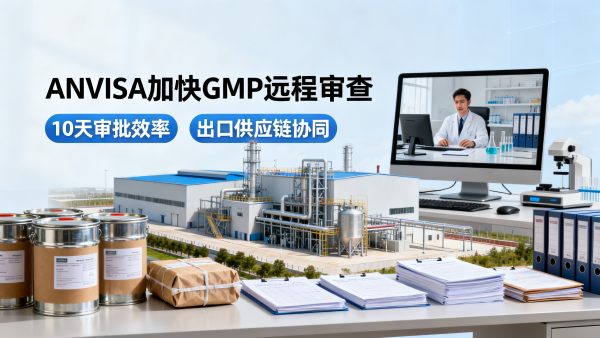
On June 26, 2026, Brazil’s health regulator ANVISA introduced a new access arrangement for agrochemical manufacturers that changes how qualified overseas producers can move through GMP review for the Brazilian market. Under the newly announced program, foreign active ingredient and formulation companies that already hold WHO-GMP or PIC/S-GMP certification may enter a fully remote GMP audit process, with the average review period reduced from 45 days to within 10 working days. For agrochemical exporters, procurement teams, compliance functions, and supply chain planners, this is worth attention because it points to a concrete shift in market-entry administration rather than a routine procedural update.

What ANVISA Confirmed on June 26
According to the information provided, ANVISA announced the launch of the “Agrochemicals Fast-Track Access Program 2.0” on June 26, 2026. The program opens a full-process online remote GMP audit route for overseas agrochemical active ingredient and formulation companies that have already completed WHO-GMP or PIC/S-GMP certification.
The stated review cycle under this route is shortened from the previous average of 45 days to within 10 working days. The first batch of eligible companies already includes 87 compliant agrochemical enterprises located in Shandong, Jiangsu, and Zhejiang in China.
Where the Change May Be Felt First
Export registration and market-entry teams
From an industry perspective, the most direct impact is likely on companies seeking to move products into Brazil under a tighter approval timeline. Where eligibility depends on existing WHO-GMP or PIC/S-GMP status, exporters will need to pay closer attention to whether their certification records, audit materials, and technical dossiers are ready for remote review rather than on-site inspection scheduling. The practical effect may appear first in submission planning, internal document control, and the sequencing of registration-related work.
Procurement and sourcing functions
For buyers and sourcing teams linked to agrochemical supply, a shorter GMP review cycle may affect how supplier readiness is assessed. Analysis shows that procurement decisions may increasingly hinge not only on production capability, but also on whether a supplier falls within the newly accessible review route and can present the required certification basis clearly. What deserves closer attention is the alignment between supplier qualification files, compliance documentation, and expected delivery windows.
Manufacturing and compliance coordination
For manufacturers and regulatory affairs teams, the shift to a full online audit process changes the operational focus of inspection preparation. Rather than treating audit readiness mainly as a site-visit exercise, companies may need to ensure that production records, quality documentation, and supporting materials can be presented consistently in a remote format. This does not change the confirmed facts of the program, but it does indicate where day-to-day compliance work may become more concentrated.
Supply chain and delivery planning
Supply chain service providers and delivery planners may also need to watch the change closely. If review timing becomes materially shorter for eligible companies, planning assumptions around shipment readiness, customer commitment timing, and handoff between regulatory clearance and delivery execution may need adjustment. Observably, the issue is less about volume assumptions and more about whether internal schedules still reflect the old 45-day review expectation.
What Companies Should Track Now
Eligibility tied to existing GMP credentials
Analysis shows that the first practical checkpoint is whether a company’s WHO-GMP or PIC/S-GMP status is current, clearly documented, and usable for the new route. Since the announced access path is limited to companies with those certifications, firms should review how their qualification materials are organized and whether the certification basis is reflected consistently across regulatory and commercial documents.
Remote-audit document readiness
Because the process is described as a full online GMP remote audit, companies should pay attention to the quality and completeness of the materials that may be used in remote review. The input does not provide detailed execution rules, so it would be premature to assume a settled document checklist. Even so, technical files, quality records, and submission materials are likely to become a more visible part of readiness management.
Impact on procurement and delivery timelines
What deserves closer attention is whether existing procurement plans and customer delivery discussions still use the previous review-cycle assumption. A reduction to within 10 working days may change how exporters and buyers discuss lead times, but companies should avoid treating the announced timeline as an automatic commercial outcome in every case until execution practice becomes clearer.
Follow-through in official wording and market practice
The announcement establishes a clear direction, but the input does not include further detail on operating guidance, review interpretation, or downstream tender wording. Companies should therefore keep tracking how the new route is described in later official communication and how market participants begin to reference it in qualification, sourcing, and delivery discussions.
Why This Looks Like an Execution Signal
Observably, this development is more than a general statement of policy intent because it includes a defined remote audit path, a stated reduction in average review time, and an identified first batch of eligible companies. At the same time, it is more appropriate to understand this as an execution signal with practical compliance implications, rather than as a complete picture of how every application, product line, or transaction will move in practice. The industry still needs to watch how consistently the shorter cycle is implemented and how qualification standards are interpreted during actual use.
How the Market May Read It for Now
In practical terms, this update suggests that ANVISA is making qualified overseas agrochemical GMP review more operationally accessible for a defined group of companies, especially those already holding recognized GMP credentials. The immediate significance lies in review speed, remote audit administration, and the possible effect on planning across export compliance, procurement, and delivery. A balanced reading is that this is a real procedural change already announced, but one that still requires continued observation as execution details, market responses, and company-level implementation become clearer.
Basis of This Article and What Still Needs Verification
This article is based on the user-provided news title, event date, and event summary. For developments of this type, commonly relevant source categories include official regulator announcements, releases from supervisory authorities, trade or customs-related notices, industry association updates, standard-setting documents, and reporting by established industry media. A specific official source link was not provided in the input, so that link remains to be verified. It also remains necessary to track any later policy detail, audit implementation guidance, certification interpretation, tender-document changes, industry feedback, and company execution results.
Related Intelligence
- AgrochemicalsWhat Are the Main Risks of Non-Transparent Agricultural Supply Chains?what are the main risks of non transparent agri supply chains? Explore traceability, compliance, contamination, disruption, and cost risks—plus practical controls.
- AgrochemicalsGrain Production: Key Practices for Improving Yield While Protecting Soil HealthGrain production strategies to improve yield, protect soil health, manage nutrients, reduce compaction, and build resilient fields for lasting results.
- AgrochemicalsHow Do New FDA Rules Affect Agri-Chemical Sourcing Strategies?How do new FDA rules impact agri chemical sourcing strategies? Explore practical supplier screening, traceability, contaminant control, and risk-based compliance steps.
The Morning Broadsheet
Daily chemical briefings, market shifts, and peer-reviewed summaries delivered to your terminal.
