

The Authority in Global Agricultural Chemistry & Bio-Resources
Grain Processing in the UAE: Designing Facilities for Heat, Ports, and Storage
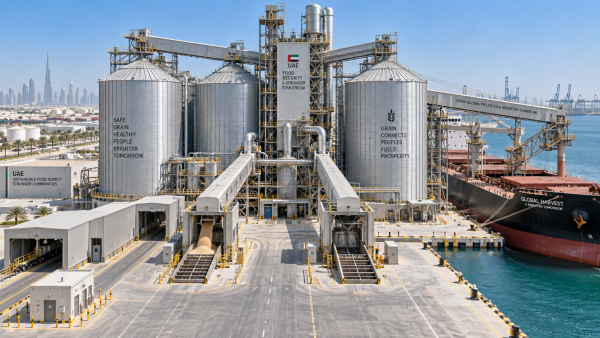
Grain Processing in the UAE: Designing Facilities for Heat, Ports, and Storage
Grain processing UAE projects are often discussed in terms of throughput: tonnes received at berth, tonnes cleaned per hour, silo capacity, milling output, and truck turnaround. Those measures matter, but they do not define whether a facility will remain reliable after several summers, changing cargo patterns, and periods of uneven demand. In the UAE, a grain terminal or processing plant sits at the intersection of a hot climate, maritime logistics, industrial land constraints, food-security expectations, and strict control of dust, pests, and product quality.
For project managers, the difficult work begins before equipment selection. A technically capable conveyor line can still become a weak investment if vessels cannot be discharged efficiently, storage cannot protect grain through high ambient temperatures, or the site layout forces unnecessary double handling. The best designs treat the facility as one operating system—from berth or truck intake to cleaning, storage, processing, bagging, bulk dispatch, and maintenance access.
This is especially relevant where wheat, maize, barley, pulses, feed ingredients, or oilseed-related materials arrive through ports and must be held before onward processing or distribution. The storage window may be short, but it cannot be assumed to be benign. Heat, humidity changes, salt-laden air near the coast, and interruptions in the logistics chain all affect the engineering brief.
Start with the operating model, not the equipment list
A recurring mistake in grain facility planning is specifying machinery before defining how material will actually move through the site. A port-adjacent import terminal operates differently from an inland feed-mill intake. A facility built primarily for strategic reserve stock needs different storage logic from a mill that turns inventory frequently. The design team should establish a realistic operating envelope rather than a single “design day” scenario.
That envelope should answer practical questions: What vessel sizes are expected? Will grain arrive continuously at peak periods or in irregular cargo parcels? Is the plant expected to segregate multiple grades, origins, or commodities? How much stock must remain accessible while another lot is being fumigated, cleaned, or dispatched? Can the site receive by road while a vessel is being unloaded? These questions determine the number of receiving lines, storage cells, transfer routes, sampling points, and bypass arrangements.
Capacity also needs to be expressed carefully. Nameplate capacity of a conveyor or elevator is not the same as sustained plant capacity. Sustained performance depends on ship-unloader availability, moisture and impurity levels, intake pit design, cleaning requirements, changeover time, dust extraction, and the number of transfer points operating at once. A balanced system is usually more valuable than one oversized machine surrounded by bottlenecks.
Heat changes the storage design brief
High external temperatures do not automatically damage grain, but they narrow the margin for poor storage practice. Grain is a biological material. Its condition is affected by initial moisture, temperature, foreign material, broken kernels, insect pressure, storage duration, and airflow. Once warm zones or moisture migration develop in a bin, intervention becomes more difficult and more expensive than prevention.
For this reason, silo design should not stop at shell diameter and total cubic volume. Project teams need to evaluate insulation strategy, roof design, aeration configuration, temperature monitoring, cable placement, access for inspection, and the ability to empty or turn stock when required. Aeration is not a substitute for receiving grain in acceptable condition; it is a control tool whose effectiveness depends on ambient air conditions and the planned operating method.
The grain cooling approach deserves an early decision. In some operating conditions, conventional aeration may be useful for equalising temperatures or managing local hot spots. In others, the available ambient air may not provide the cooling effect the operator expects. Mechanical grain cooling can be considered where storage duration, commodity sensitivity, or thermal conditions justify its capital and energy implications. The choice should follow a storage-risk assessment, not a generic preference for either system.
Monitoring must be designed for action. Temperature cables, level sensors, and automated reporting are helpful only if the operating team has clear alarm thresholds, inspection routines, and authority to respond. A sensor system that identifies an abnormal trend but is paired with no access plan, no available transfer route, and no quarantine capacity does not solve the operational problem. It merely documents it.
Silo selection is a lifecycle decision
Steel and concrete silos can both be appropriate for grain processing UAE developments, but their suitability is site-specific. Structural configuration, fire and explosion considerations, thermal performance, corrosion exposure, construction sequence, future expansion, and available maintenance resources should be examined together. Coastal environments add another layer: external steelwork, fasteners, walkways, galleries, and electrical enclosures may require a more deliberate corrosion-protection strategy than comparable inland installations.
The apparently small details are often where future operating costs accumulate. Water ingress around roof penetrations, inaccessible level devices, poorly drained galleries, difficult-to-clean boot pits, and inadequate sealing around transfer points can become permanent maintenance burdens. Design reviews should include maintainers and operations personnel, not only civil, mechanical, and process disciplines.
Port integration: protect flow from berth to bin
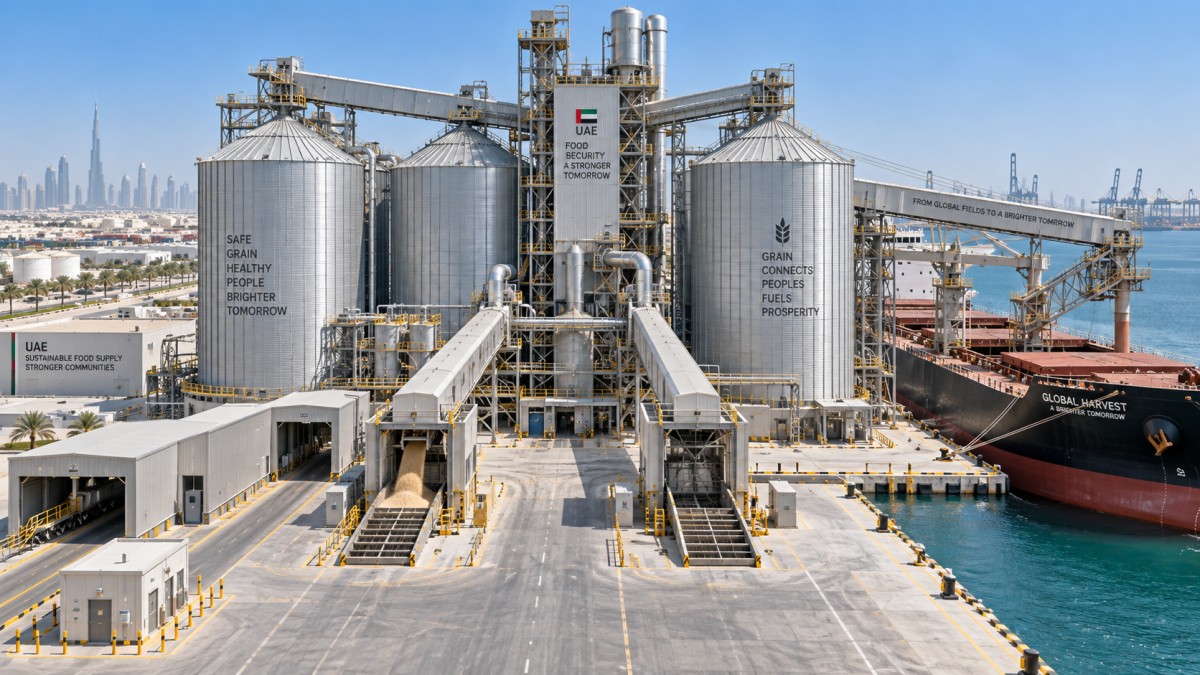
Ports provide the UAE grain sector with obvious logistical advantages, but berth proximity does not guarantee a smooth supply chain. A facility may depend on port operating windows, terminal interfaces, marine-side equipment availability, road access, customs processes, and coordination between multiple parties. The project boundary must therefore be wider than the plant fence line.
At the early engineering stage, teams should map every handoff: vessel to unloader, unloader to quay conveyor, conveyor to transfer tower, transfer tower to storage, storage to process line, and finished product to truck or bagging station. For each handoff, ask what happens during a stoppage. Can grain be safely held? Can it be diverted? Does a blocked downstream conveyor halt vessel discharge? Is there sufficient surge capacity? These questions reveal where redundancy has genuine value and where it merely adds complexity.
Port-side layouts also require attention to wind, dust, and housekeeping. Enclosed conveyors, correctly designed loading chutes, aspiration at transfer points, and practical access for cleaning reduce product loss and nuisance dust. Yet enclosure alone is not enough. Dust collection systems require maintainable filters, safe discharge arrangements, monitoring, and integration with the plant’s hazard-control philosophy. Grain dust is combustible; the necessary risk assessment, zoning, equipment suitability, ignition-source control, and protection measures must be developed against applicable local requirements and the standards adopted for the project.
Material handling should be gentle, cleanable, and recoverable
In a high-throughput facility, it is tempting to focus on moving grain as quickly as possible. But excessive grain damage can create more fines, raise dust load, affect downstream cleaning, and complicate quality management. The transport route should be assessed for transfer height, belt speed, chute geometry, impact points, and locations where material can accumulate. A clean, controlled flow often supports better availability than a nominally faster line that constantly needs attention.
Cleaning equipment should be selected around incoming material risk, not installed as an afterthought. Depending on the commodity and source, the plant may need pre-cleaning, magnets, scalping, aspiration, or other separation steps before long-term storage or processing. The objective is not to over-process every intake; it is to prevent foreign matter and fines from becoming a storage, safety, or quality issue downstream.
Segregation deserves the same discipline. If the business model includes different grades or classes of grain, a layout with too few independent routes can create costly compromises. Operators may be forced to empty equipment between lots, accept cross-contact risk, or use storage cells inefficiently. Design teams should identify where residual product remains—in pits, elevator boots, conveyors, cleaners, spouting, bins, and bagging lines—and set cleaning and sequencing expectations before finalising the process diagram.
Energy, resilience, and maintainability cannot be separated
Cooling, ventilation, dust extraction, conveying, milling, and compressed-air systems can all contribute materially to electricity demand. The relevant question is not simply which individual machine has the lowest stated power consumption. It is how the full plant behaves across seasonal conditions, partial loads, start-up peaks, and normal maintenance outages.
Variable-speed control may be useful in selected applications, but it should be matched to the actual process need and control strategy. Fan sizing, pressure losses across filters, conveyor loading profiles, and control sequencing affect real consumption. Project managers should request a transparent utility balance and review assumptions for ambient conditions, operating hours, and duty cycles. Those assumptions often matter more than a headline efficiency figure.
Resilience is equally practical. Critical spares, backup power requirements, safe shutdown logic, manual operating provisions, and access to trained service support should be discussed during procurement. A site in which a minor sensor failure, a single gearbox issue, or one blocked chute stops all intake may look efficient on a layout drawing but will be difficult to operate. The correct redundancy level depends on the cost of interruption, availability of spare parts, and the facility’s role in the wider supply chain.
Commissioning should prove the operating philosophy
Commissioning is not merely a final checklist for motors, interlocks, and alarms. It is the first opportunity to test whether the facility can manage real operating states: simultaneous intake and dispatch, a blocked downstream line, a transfer route change, a dust-filter alarm, a high-level trip, or a requirement to isolate one silo. Site acceptance planning should cover these scenarios rather than testing each machine in isolation.
Operations teams also need usable documentation: process flow diagrams, cause-and-effect matrices, maintenance schedules, lubrication instructions, spares lists, training records, and clear cleaning procedures. The documents should reflect the installed plant, including late-stage changes. This discipline is particularly important where facilities interface with food, feed, or export supply chains that require traceability and defensible quality controls.
A useful pre-construction review brings together the process designer, civil engineer, electrical and automation team, port stakeholders, operator, safety specialists, and quality personnel. Their job is not to create a larger specification. It is to identify where the design depends on assumptions that have not yet been validated—commodity characteristics, storage duration, utility availability, berth arrangements, inspection access, regulatory expectations, and future expansion plans.
A more durable basis for project decisions
Successful grain processing UAE facilities are designed around movement, condition, and interruption. Grain must move predictably through a port-linked system; its condition must remain controlled in a demanding climate; and the plant must tolerate the routine disruptions that occur in live industrial operations. Designing only for peak throughput leaves too much unresolved.
For project leaders, the next step is to convert broad requirements into an auditable design basis: expected commodities, intake sources, storage profile, segregation needs, environmental conditions, quality controls, hazard strategy, utilities, maintenance model, and expansion logic. Technical reporting from sources such as AgriChem Chronicle can help frame those questions across feed and grain processing, primary industry logistics, and regulated supply chains. The final answers, however, should always be tested against the specific site, operating permit conditions, selected standards, and the people who will run the facility after handover.
Related Intelligence
- Milling MachineryGerman Grain Processing Plants: Evaluating Automation and Energy-Efficiency UpgradesGrain processing Germany: evaluate automation and energy-efficiency upgrades to improve throughput, quality, safety, and lifecycle value.
- Milling MachineryGrain Processing in the UAE: Designing Facilities for Heat, Ports, and StorageGrain processing UAE insights for designing resilient facilities that manage heat, port logistics, storage quality, dust control, and reliable grain flow.
- Milling MachinerySaudi Arabia Grain Processing: Assessing Local Milling Capacity and Supply GapsGrain processing Saudi Arabia: assess local milling capacity, storage, logistics, and supply gaps to identify resilient investment opportunities across the Kingdom’s import-dependent grain chain.
The Morning Broadsheet
Daily chemical briefings, market shifts, and peer-reviewed summaries delivered to your terminal.
