

The Authority in Global Agricultural Chemistry & Bio-Resources
How easy is it to change hammer mill screens to adjust particle size?
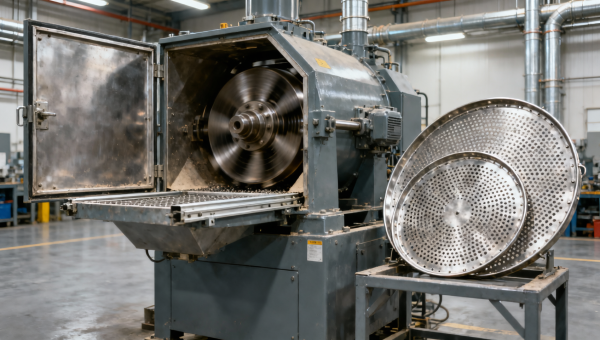
Changing a hammer mill screen can be a straightforward maintenance task when the machine has accessible screen carriers, simple retainers, and enough space around the grinding chamber. On a less accessible mill, the same adjustment may involve removing guards, handling awkward screen sections, cleaning packed material from mounting surfaces, and checking the assembly before restarting. The physical screen swap is only one part of the production interruption.
For operators, two questions need separate answers: how easily can the screen be replaced, and will the replacement produce the required particle size? A well-designed access system helps with the first. The second depends on screen aperture, screen condition, hammer condition, feedstock properties, and operating settings. A smaller opening generally produces a finer grind, but it does not define an exact finished particle size.
Judge ease of changeover by the complete job. A demonstration with a clean, empty machine can make screen replacement look simpler than it will be after production. Residual material, worn retainers, restricted access, and a heavy curved screen can all change the effort involved. A useful assessment follows the operation from stopping the feed through to producing acceptable material again.
Start with the access route. Can an operator reach every retainer without awkward stretching? Does the door open fully with the mill installed beside its feeder, ductwork, and discharge equipment? Can the screen be withdrawn without moving another component? A large access door offers limited benefit if surrounding equipment blocks the removal path. Screen storage also matters: carrying a replacement across the plant adds handling and increases the chance of damage.
The retaining mechanism deserves close attention. Captive fasteners, accessible clamps, and positively located carriers can simplify repeated changes. Bolted assemblies may also be practical when the fasteners remain accessible and serviceable. What matters is whether the mechanism releases predictably, holds the screen securely, and allows the operator to verify correct seating. “Tool-free” describes the release method; it does not establish the difficulty of the whole task.
Screen weight and flexibility can be equally important. Large curved sections may be difficult to guide into position, particularly where their edges must engage a narrow track. A distorted screen can appear installed while sitting incorrectly at one end. If the design requires a handling aid or more than one person, include that requirement in the changeover plan. Forcing a reluctant screen into place can damage the carrier or create an unsafe fit.
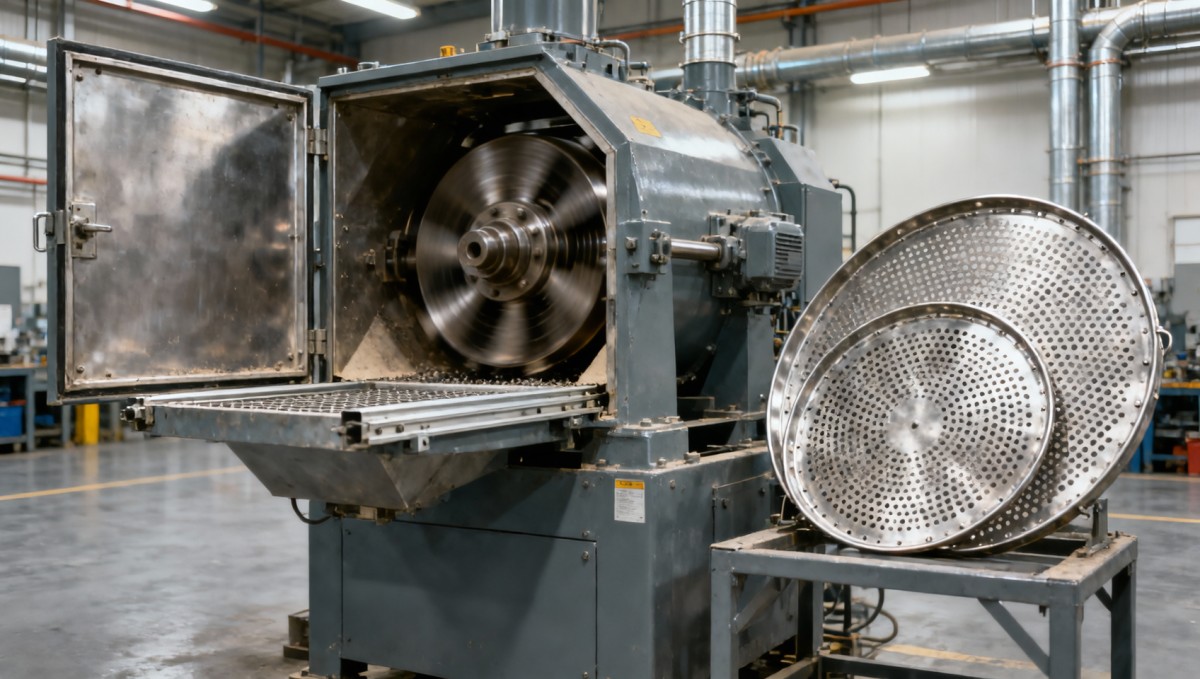
Machine condition determines whether these features remain useful. Dust and compacted product can obstruct tracks and seating surfaces. Damaged clamps, distorted carriers, or unsuitable replacement screens can turn a routine change into fault-finding. Before buying additional screens to improve flexibility, inspect the mounting system already in service. A clean, sound carrier may make a greater difference to changeover effort than a different style of fastener.
Safe access sets the minimum downtime. Stopping the motor does not by itself make the grinding chamber safe to open. The rotor can continue moving after power is removed, and the mill may remain exposed to energy or material from connected equipment. Screen changes require the manufacturer’s procedure and the site’s energy-isolation process, including verification that hazardous motion and energy have been controlled. An access-door interlock does not replace required isolation.
The exact sequence depends on the installation. Feeding, aspiration, discharge, and upstream or downstream equipment may need coordinated shutdown arrangements. Where the operating procedure calls for clearing material before stopping, follow that sequence before isolation. Do not reach into the chamber to remove a blockage or speed up emptying. Guards and access covers should remain in their required positions until safe access has been established.
Once access is safe, the work should include more than exchanging metal panels. Remove residues using the approved cleaning method, inspect the screen supports and retainers, and check for visible damage or foreign objects. Cleaning needs particular care where successive products have different ingredient, contamination, or hygiene requirements. Dust removal methods must also suit the material and the site’s dust-control arrangements; dispersing accumulated dust can introduce another hazard.
For planning purposes, divide changeover time into four parts: preparing and safely stopping the system; accessing, cleaning, and replacing the screen; inspecting and restoring the machine; and restarting until acceptable product reaches the sampling point. This gives a more useful production figure than timing the screen swap alone. It also reveals whether delays come from the machine design, maintenance condition, cleaning requirement, or production layout. No single changeover time applies reliably to every hammer mill.
Screen aperture changes the grind, but it does not act as a precise sizing gate. Hammer mills produce a distribution of particle sizes. Material experiences repeated impacts and movement within the chamber before discharge, and its ability to pass through an opening depends partly on particle shape and orientation. Long or thin fragments may pass in ways that a simple comparison between hole diameter and particle length would not suggest.
Consequently, a screen designation should not be treated as a finished-product specification. Two samples produced through the same nominal aperture can have different proportions of fines and coarse particles. If the process requires a particular particle-size distribution, define how it will be measured and which part of that distribution matters. Depending on the application, excessive fines, an oversize fraction, or both may be more consequential than the average size alone.
Smaller apertures generally retain material for further grinding and can increase resistance to discharge. Depending on the material and mill configuration, this can reduce throughput, increase energy demand, or contribute to temperature rise. A finer screen therefore needs a production check as well as a sizing check. A satisfactory sample at a very low feed rate does not establish that the mill can maintain the required quality at its intended operating load.
Aperture diameter is also only one screen characteristic. Hole shape, perforation pattern, plate thickness, and total open area can influence passage and capacity. Two screens with the same nominal hole size may perform differently if their construction differs. Use screens specified as compatible with the mill, including the correct dimensions, curvature, thickness, and mounting arrangement. An apparent physical fit is insufficient evidence that a substitute is suitable for service.
Screen condition can explain an unexpected change in output. Wear may enlarge openings, while a tear or an incorrectly seated edge can provide a route for oversized material. Conversely, blocked perforations reduce the effective discharge area. If the product becomes coarser, finer, or less consistent without an intentional setting change, inspect the installed screen and its seating before assuming that a different aperture is needed.
Some size adjustments can be made without replacing the screen, where the mill permits them. Rotor speed affects impact conditions and can influence particle-size distribution. However, variable-speed operation must stay within the equipment manufacturer’s approved range and configuration. Increasing speed is not a universal remedy for coarse output, and its effects on power demand, wear, temperature, and product quality need assessment. On a fixed-speed machine, the operator may have no approved speed adjustment available.
Feed rate affects how material loads the grinding chamber. Excessive or uneven feeding can produce unstable operation and inconsistent grinding conditions. Reducing feed may help establish whether chamber loading contributes to a problem, but the resulting sample must be assessed alongside the loss of capacity. Where airflow assists discharge, its condition and setting also deserve attention. Restricted airflow or a discharge bottleneck can interfere with performance even when the installed screen is appropriate.
Material properties can shift the result further. A dry, brittle grain and a moist, fibrous ingredient will not necessarily respond alike to the same screen. Moisture, fat content, fibre, and incoming piece size can affect breakage and passage through the perforations. When output changes between batches, check whether the feedstock changed before adjusting several machine settings. Otherwise, an operator may compensate for a raw-material variation and leave the mill poorly set for the next batch.
Hammer wear is another practical limit on adjustment. Worn working edges and changes in the grinding assembly can alter performance, making a previously successful screen choice appear inadequate. Follow the manufacturer’s inspection and replacement criteria for hammers and related components. Installing progressively finer screens to compensate for deteriorating grinding components can add restriction while leaving the underlying maintenance issue unresolved.
A controlled trial makes the next screen choice easier. Begin with a baseline that records the material, its relevant condition, installed screen, approved speed setting, feed rate, and available operating measurements such as motor load. Retain a representative product sample. Change one main variable at a time where practical, then allow the system to reach stable operation before comparing results. This makes the effect of each adjustment easier to interpret.
Sampling must account for the route from the mill to the collection point. Material remaining in conveying equipment, hoppers, or other downstream sections can mix with the newly ground product. A sample collected immediately after restart may therefore represent both settings. Use a consistent sampling location and method, with enough allowance for the preceding material to clear. Apply the same particle-size measurement procedure to each comparison; otherwise, sampling differences can obscure the effect of the screen change.
Before returning to normal production, verify that screens and retainers are correctly installed, tools and loose items are removed, and guards and access covers are restored as specified. Follow the approved restart procedure and watch for abnormal vibration, noise, load, or discharge behaviour. If these appear, stop and investigate under the required isolation procedure. Accept the new setup only after it produces suitable material at a sustainable operating rate.
For a mill that changes products frequently, keep the proven settings with each identified screen: which material it suits, the approved operating conditions, and the particle-size result achieved. Inspect and store spare screens so their markings remain readable and their shape is protected. The most useful answer to “how easy is it?” then becomes specific to the operation: the screen can be handled safely, the full interruption is understood, and the replacement has a demonstrated route back to acceptable production.
Related Intelligence
- Milling MachineryHow easy is it to change hammer mill screens to adjust particle size?Is it easy to change the screen or adjust the output size of the hammer mill? Discover what affects changeover time, particle size, and throughput—and how to choose the right screen.
- Milling MachineryChanging Hammer Mill Screens: Particle Size Control and DowntimeIs it easy to change the screen or adjust the output size of the hammer mill? Discover practical tips for smoother screen changes, consistent particle size, and less downtime.
- Milling MachineryChanging Hammer Mill Screens: Particle Size Control and DowntimeIs it easy to change the screen or adjust the output size of the hammer mill? Discover practical tips for smoother screen changes, consistent particle size, and less downtime.
The Morning Broadsheet
Daily chemical briefings, market shifts, and peer-reviewed summaries delivered to your terminal.