

The Authority in Global Agricultural Chemistry & Bio-Resources
Changing Hammer Mill Screens: Particle Size Control and Downtime
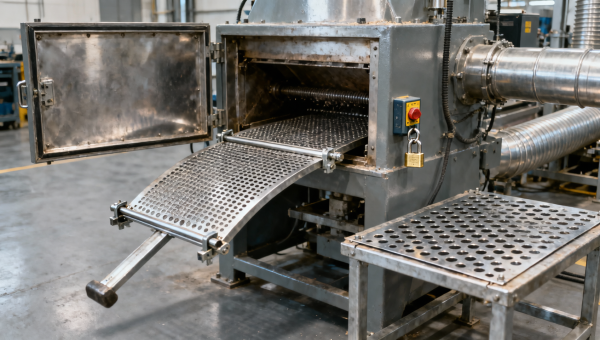
Changing a hammer mill screen can be a straightforward maintenance task when the machine provides clear access, manageable screen sections, and secure, accessible retainers. Adjusting the finished particle size takes more judgment. A different screen changes the material’s opportunity to leave the grinding chamber, but the resulting grind also depends on the feedstock, hammer condition, rotor speed, feed rate, and air movement through the system.
For operators asking whether it is easy to change the screen or adjust the output size of a hammer mill, the practical answer is conditional: the mechanical change may be simple, while achieving a repeatable particle size requires a controlled trial. Plan downtime around the full interval from the last acceptable product before shutdown to the first acceptable product after restart. The time spent physically exchanging screens is only one part of that interval.
What makes a screen change straightforward?
The first consideration is access. A screen behind a fully opening service door, with room to withdraw it without disturbing surrounding equipment, is easier to handle than one reached through a restricted opening. Installation layout matters as much as the mill itself. Nearby conveyors, pipework, platforms, or walls can make an otherwise accessible screen difficult to remove.
Screen size and weight also affect the job. Segmented screens may be easier to handle individually, although additional sections create more seating points to inspect. A large curved screen may require a handling aid or additional personnel under the site’s maintenance procedure. Thin perforated material can still have sharp edges, and a distorted screen can be awkward to control.
Retaining systems deserve close attention. Captive fasteners, accessible clamps, and clearly defined seating surfaces can simplify replacement. Worn retainers, damaged threads, packed product, or bent support rails can turn removal and refitting into the longest part of the shutdown. A quick-release mechanism offers little benefit if the screen binds in its housing or cannot be secured consistently.
When assessing an existing mill, observe the complete changeover under its normal safe maintenance procedure. Check where operators struggle, which tools are needed, and whether the replacement screen seats without force. For equipment selection, a demonstration using the actual screen dimensions and proposed installation clearances provides more useful evidence than a general claim of “easy screen replacement.”
A smaller opening does not produce one uniform particle size
A hammer mill produces a particle size distribution: material leaving the mill contains a range of sizes. The screen helps control discharge, but its hole diameter does not define the exact size of every particle. Particle shape, orientation, and the action inside the chamber influence what passes through. Elongated or fibrous fragments can behave differently from compact, brittle particles.
Reducing the screen opening generally shifts the grind toward finer material because particles have fewer opportunities to escape before further impacts. That change can also increase resistance to discharge and reduce throughput. If the mill is already operating near its practical load limit, installing a finer screen may require a lower feed rate to maintain stable operation.
Opening diameter is only part of the screen specification. Hole spacing, perforation pattern, thickness, and total open area affect discharge behavior and screen strength. Two screens with the same nominal hole size may therefore perform differently. Replacement screens should meet the manufacturer’s requirements for fit, support, material, and operating conditions; matching the hole diameter alone is insufficient.
Begin with the product requirement. A feed specification may place limits on coarse particles, fines, or both. An average particle size can hide an undesirable distribution: a sample containing excessive coarse material and excessive fines may still produce an acceptable average. Choose a measurement method that captures the part of the distribution relevant to the product and downstream process.
Where an established screen already gives acceptable results, use it as the baseline. Record its specification, material condition, feed rate, motor load, and measured grind. Trial a suitable alternative while keeping other adjustable conditions as steady as practicable. Changing the screen, feed rate, and speed together makes it difficult to identify which adjustment caused the result.
Check the process before blaming the screen
A coarser or less consistent product does not always call for a smaller opening. First inspect the screen for wear, cracks, and poor seating. Enlarged holes can allow a coarser discharge, while a damaged edge or an incorrectly seated section may create a route around the intended grinding surface. These faults require repair or replacement before process adjustments can be evaluated meaningfully.
Hammer condition also affects grinding performance. Worn working edges, uneven wear, or an incorrect hammer arrangement can alter breakage and loading. Follow the manufacturer’s instructions for inspection, rotation, and replacement. Replacing a screen cannot reliably compensate for a grinding assembly that needs maintenance.
Feedstock changes can explain a sudden shift even when the machine settings remain unchanged. Moisture, ingredient composition, initial particle size, and fiber content influence how material breaks and passes through the screen. Sticky material can obstruct openings; tougher material may require more grinding effort. Compare incoming material with the conditions under which the screen previously performed well.
Air movement is another diagnostic point on systems designed to use aspiration. Restricted filters, obstructed ducts, or incorrect system settings can interfere with discharge and contribute to unstable performance. Investigate these conditions within the equipment’s operating limits. Increasing airflow without understanding the system can create additional problems elsewhere in collection or conveying.
Rotor speed can influence particle size, but it is an adjustment only where the mill and its drive are designed for it. Changes affect hammer tip speed, loading, and mechanical stresses. Operators should use approved speed ranges and settings. Changing pulleys, drive parameters, or other speed controls requires the appropriate technical review and authorization.
Organize the change around isolation, inspection, and correct seating
Before stopping production, confirm that the replacement screen is the correct part, undamaged, clean, and ready beside the mill. Prepare the required tools, handling equipment, and retainers. Check the job instructions and identify the screen orientation. Discovering an incorrect curvature or missing clamp after shutdown adds downtime without advancing the work.
The machine-specific maintenance procedure governs the change. Stop and clear the system as directed, isolate hazardous energy, apply the required lockout/tagout controls, and verify isolation before accessing the chamber. Account for rotor coast-down, stored energy, and connected equipment that could feed material or create hazardous movement. An interlocked door does not replace the required energy-isolation procedure.
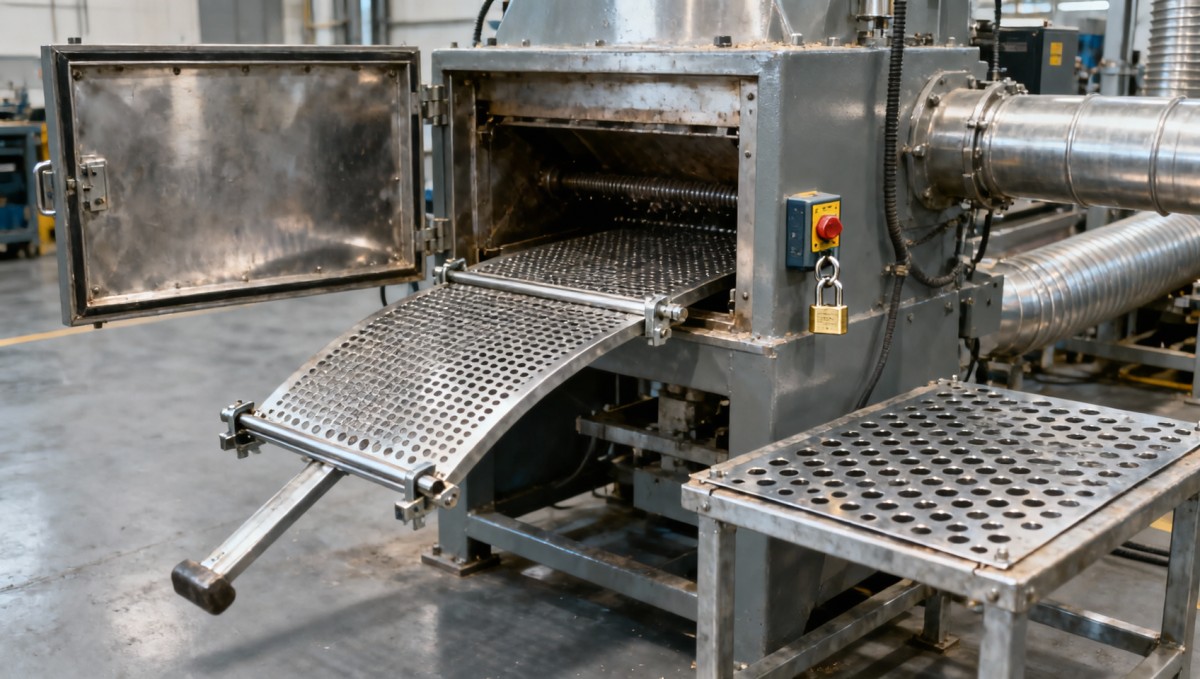
Once access is safe, inspect the removed screen before setting it aside. Note the location of wear, cracks, blinding, or distortion. Localized damage can point to a seating problem, foreign material, or abnormal contact that deserves investigation. Clean the seating and retaining surfaces using approved methods so accumulated product does not prevent the replacement from locating correctly.
- Check support rails, clamps, and fasteners for damage or wear.
- Install each screen section in the specified orientation and position.
- Confirm that edges are seated and secured, with no unintended gaps.
- Check clearances and perform any permitted manual movement checks exactly as the manufacturer directs.
- Account for tools and loose parts, then restore guards, doors, and protective devices before the authorized restart.
Do not force a screen into place to finish the job faster. Resistance can indicate an incorrect part, trapped product, distortion, or damaged supports. A screen that appears installed but is poorly supported may fail during operation. Resolve the cause while the mill remains safely isolated.
Recover stable production before judging the result
Restart using the approved sequence and introduce feed as directed by the operating procedure. Watch for unusual noise, vibration, rising motor load, poor discharge, or abnormal temperature behavior. If a fault appears, stop and investigate under the appropriate isolation procedure. Repeatedly restarting a mill with suspected contact or loose components can turn a fitting problem into equipment damage.
Allow the process to reach stable conditions before collecting the sample used to approve the grind. Material retained in downstream equipment may mix with the first output after restart, so an immediate sample may represent both the previous and new settings. Account for that transition when directing product to storage or further processing.
Use a consistent sampling location and method, then measure against the actual acceptance criteria. Visual checks can reveal obvious coarse fragments or a major change in fines, but they are a weak basis for accepting a narrow specification. Record particle size results alongside throughput and operating load. A finer product achieved at an unacceptable production rate may require a different operating compromise.
If the result misses the target, make the next adjustment deliberately. Excess coarse material calls for checks on screen integrity, seating, feedstock, and grinding condition before another screen change. Excess fines may justify evaluating a larger opening or another approved process setting. Keep each trial traceable so the next operator can reproduce the accepted conditions.
Reduce repeat downtime with a usable screen history
The most useful changeover record includes preparation, isolation, access, cleaning, replacement, restart, and product approval. Separating these stages shows where time is actually lost. If cleaning and access dominate, faster clamps may offer little improvement. If the machine restarts promptly but product takes a long time to stabilize, focus on feed control, retained material, and sampling.
Maintain a practical screen log linking each screen specification to the material processed, operating conditions, and measured result. Identify screens clearly and store them so their curvature and edges remain protected. Inspect used screens before returning them to storage; a damaged spare merely postpones the problem until the next shutdown.
For frequent changes between coarse and fine products, review production sequencing where formulation, hygiene, and carryover controls permit it. Grouping compatible runs can reduce changeovers. Persistent demand for substantially different grinds may justify evaluating another processing arrangement, but that decision should follow evidence about the mill’s operating limits and the cost of interrupted production.
A screen change is successful when the mill returns to a stable, acceptable grind at a workable throughput. Easy access and reliable retainers help achieve that result. Correct screen selection, sound grinding components, and a consistent acceptance check determine whether the saved maintenance time carries through into production.
Related Intelligence
- Milling MachineryChanging Hammer Mill Screens: Particle Size Control and DowntimeIs it easy to change the screen or adjust the output size of the hammer mill? Discover practical tips for smoother screen changes, consistent particle size, and less downtime.
- Milling MachineryHow Should Milling Machinery Be Maintained to Extend Its Service Life?Learn how to maintain processing machinery to extend service life with practical milling maintenance tips on cleaning, lubrication, and wear checks to reduce downtime.
- Milling MachineryWhat Is the Difference Between Primary and Secondary Grain Processing?What is the difference between primary and secondary grain processing? Compare key operations, equipment needs, and quality risks to choose the right investment for your business.
The Morning Broadsheet
Daily chemical briefings, market shifts, and peer-reviewed summaries delivered to your terminal.