

The Authority in Global Agricultural Chemistry & Bio-Resources
How peak feeding load determines RAS equipment sizing
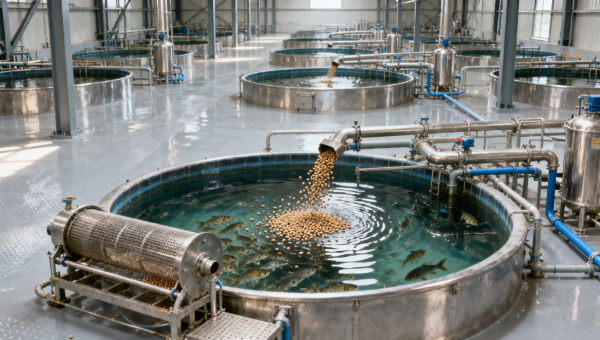
Peak feeding load sets the treatment duty of a recirculating aquaculture system because feed drives ammonia production, oxygen consumption, solids generation, and carbon dioxide release. Tank volume remains necessary for stocking density, circulation, and hydraulic design, but it cannot establish treatment capacity by itself. Two systems with equal water volume can require substantially different RAS equipment when their biomass, feed composition, or feeding schedules differ.
A defensible design therefore needs two linked inputs: the highest credible daily feed quantity and the time profile of the resulting waste and respiratory loads. Daily totals establish sustained treatment requirements. Shorter peaks determine whether oxygen delivery, filtration, gas exchange, and water circulation can keep conditions within the specified operating limits.
Establish the feeding scenario before selecting equipment
The starting point is the production schedule at its most demanding operating condition. Maximum standing biomass does not necessarily coincide with maximum daily feeding. Smaller, rapidly growing fish can receive a higher ration relative to biomass, while larger fish create a different combination of respiration, stocking density, and hydraulic requirements.
For each production cohort, calculate daily feed from live biomass and the feeding rate appropriate to species, size, temperature, and production conditions:
Daily feed load = sum of each cohort’s live biomass × its daily feeding fraction.
Use consistent units and express the feeding fraction as a decimal. The design feed load should reflect a credible overlap of cohorts, including delayed harvests or grading changes where these form part of the operating plan. Adding every tank’s theoretical maximum without considering the production schedule can inflate capacity; assuming perfectly timed harvests can leave insufficient headroom.
Feed specifications belong in this calculation. Protein content and nitrogen retention affect ammonia generation. Digestibility, pellet stability, and uneaten feed affect solids production. A feed change that preserves daily tonnage can still change the duty imposed on the treatment train.
The design basis should also state whether the feed allowance represents feed dispensed or estimated feed consumed. Uneaten pellets contribute differently from metabolized feed: they increase particulate loading and subsequently release dissolved pollutants as they break down. Treating both quantities as interchangeable obscures where capacity is required.
Daily feed and hourly process loads follow different clocks
Dividing daily feed by twenty-four produces an average feed rate, not a reliable peak treatment requirement. Feeding windows, digestion, fish activity, and solids transport create different load profiles across the system.
A concentrated feeding period can produce a rapid solids pulse at the mechanical filter. Oxygen demand responds to feeding and activity, while ammonia excretion follows species-specific and temperature-dependent digestion patterns. Carbon dioxide production reflects respiration by fish and microorganisms. These peaks need not occur simultaneously.
Develop a time-based load profile from the proposed feeding schedule and relevant biological data. Where reliable data are unavailable, identify the uncertainty explicitly and evaluate plausible concentrated-feeding and extended-feeding scenarios. Spreading feed across more hours only reduces peak equipment duty when the resulting biological response supports that assumption.
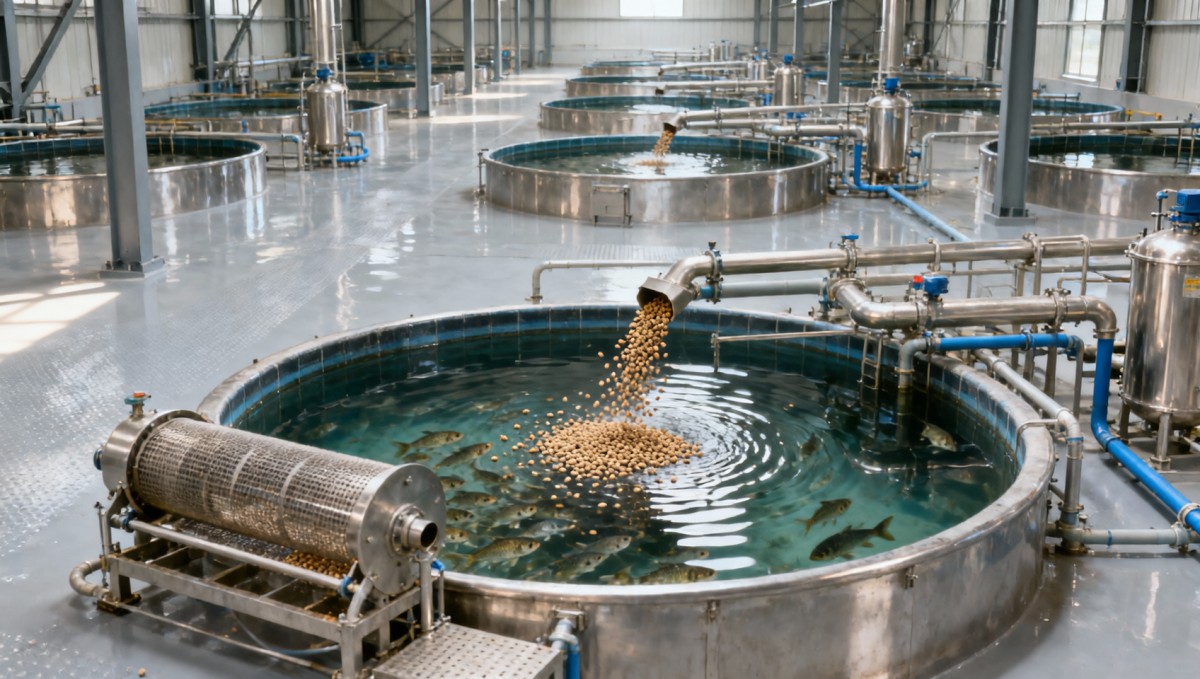
System water provides temporary storage for some dissolved constituents, but the allowable concentration rise limits that buffer. A dynamic mass balance should account for pollutant generation, treatment removal, makeup water, and effective system volume. For oxygen, the available buffer is constrained by the difference between the operating concentration and the minimum acceptable concentration at the fish.
This distinction prevents a common sizing error: applying one generic peak factor to every component. Each process needs a load profile and response time consistent with its function.
Translate feed nitrogen into biofilter duty
Biofilter sizing begins with the mass of total ammonia nitrogen, or TAN, that must be oxidized. A simplified design relationship is:
Daily TAN load = daily feed × feed-specific TAN generation coefficient.
The coefficient must have a documented basis covering feed composition, species, nitrogen retention, and the treatment boundary. A value derived for one feed and growth condition should not automatically be transferred to another. State whether the coefficient represents nitrogen mass or ammonia compound mass; mixing those bases creates a direct sizing error.
For a biofilter rated by effective media area:
Required effective media area = design TAN removal load ÷ validated areal TAN removal rate.
The removal rate must apply at the intended temperature, salinity, pH, dissolved oxygen, and TAN concentration. Performance demonstrated at elevated ammonia concentration does not establish equal removal capacity at a lower operating concentration. This matters when fish welfare requirements leave little concentration difference available to drive treatment.
Media surface area alone is also insufficient. Protected surface area, reactor mixing, media fill, oxygen delivery, hydraulic distribution, and solids accumulation influence usable capacity. A quoted media volume becomes meaningful only when the supplier connects it to a removal rate under the specified operating conditions.
Nitrification consumes oxygen and alkalinity. Those demands must enter the oxygen and dosing calculations, with the same nitrogen basis used throughout. Otherwise, a biofilter can have adequate nominal area yet lose performance as pH falls or oxygen becomes limiting. Nitrite oxidation also requires verification; acceptable TAN removal does not by itself demonstrate acceptable nitrite control.
Startup and recovery deserve separate operating limits. A mature biofilter’s rated duty does not establish its capacity immediately after commissioning, disinfection, or a prolonged interruption. The feed ramp must follow demonstrated biological capacity.
Separate oxygen generation capacity from oxygen delivery
Total oxygen demand includes fish respiration, nitrification, and the oxidation of organic material retained within the system. These loads respond differently to temperature, feeding, and solids management. A calculation based only on fish biomass omits treatment demand; a calculation based only on daily feed can miss short-term respiratory peaks.
Express oxygen requirements as mass per unit time at the demanding operating condition. Then distinguish oxygen supplied from oxygen actually transferred into water:
Required oxygen supply rate = required dissolved oxygen addition rate ÷ effective transfer efficiency.
Use transfer performance appropriate to water temperature, salinity, operating pressure, incoming dissolved oxygen, and the selected contactor. A generator’s nameplate output or a diffuser’s clean-water rating does not establish the oxygen available at the tank inlet.
Delivery hydraulics impose a separate limit. Water flow multiplied by the usable dissolved oxygen concentration drop establishes how much oxygen a circulating stream can carry through a tank. Increasing oxygen production will not correct inadequate tank flow, poor inlet distribution, or local areas where fish consume oxygen faster than circulation replenishes it.
Evaluate the outlet and the most demanding locations within the tank, rather than relying solely on a well-oxygenated inlet measurement. The design should also define emergency oxygen duty and automatic activation independently of normal treatment capacity. A power failure changes both oxygen supply and water movement, so backup performance requires its own operating scenario.
Size solids removal for simultaneous hydraulic and waste loads
Mechanical filtration has two distinct duties: passing the required water flow and removing the expected solids load. Feed-derived solids estimates establish the mass arriving at the filter, while tank hydraulics and drain arrangements determine how quickly and in what concentration that material arrives.
A filter selected only by nominal flow can become constrained by screen fouling or excessive backwashing during feeding peaks. Conversely, selecting equipment only by daily solids mass can overlook hydraulic bypass or unacceptable head loss at the required circulation rate.
The relevant specification links flow, screen opening, incoming solids characteristics, water level difference, and the allowable backwash demand. Capture performance should reflect the particles expected in the actual process. Fragile fecal material can fragment during pumping and transport, creating fine particles that pass through a screen sized for larger solids.
Removal speed affects downstream sizing. Solids retained in tanks, sumps, or poorly flushed pipework continue to consume oxygen and release dissolved nutrients. Increasing biofilter capacity does not resolve the underlying solids retention problem. Drain design, conveyance velocity, and filter location therefore belong in the feed-load assessment.
Carbon dioxide removal and circulation can become the limiting duties
A system can maintain adequate dissolved oxygen while accumulating excessive carbon dioxide, particularly where pure oxygen supports high biomass. Oxygen addition does not provide an equivalent amount of carbon dioxide removal.
Degasser sizing requires a carbon dioxide mass balance and a defined allowable concentration. Performance depends on water flow, incoming concentration, gas-to-water contact, air supply, packing condition, and the concentration difference driving transfer. A tower rated at a favorable inlet concentration may remove less mass at the lower concentration required by the production design.
Ventilation conditions also matter. Recirculating carbon dioxide-rich room air through a stripping device reduces the driving force for removal. Fan capacity and exhaust routing must therefore be evaluated with the water-side equipment.
Required circulation emerges from several constraints: oxygen delivery, carbon dioxide transport, ammonia delivery to the biofilter, solids conveyance, and tank mixing. The controlling constraint varies across designs. A fixed number of tank turnovers per hour does not demonstrate that all these duties are satisfied.
Once the necessary flow is established, select pumps against the calculated system head, including treatment equipment, pipe losses, elevation changes, and expected fouling. Flow at negligible head provides little evidence of installed performance. Part-load operation also needs attention because reducing feed does not necessarily permit circulation to fall without affecting solids transport or tank distribution.
Make the design margin visible in the equipment specification
Uncertainty allowances, future production capacity, and standby capacity serve different purposes. Combining them into an unexplained percentage makes supplier proposals difficult to compare and can conceal a shared point of failure.
Compare proposals against the same feed schedule, feed properties, water conditions, and concentration limits. Each equipment rating should identify both its process duty and its hydraulic duty. Where performance relies on an upstream component, such as solids removal protecting biofilter media, that dependency should be explicit.
Acceptance testing should then reproduce the specified conditions as closely as practical, using a mature biological system and a documented feeding regime. Measurements should cover the feeding cycle rather than a convenient low-load interval. Feed delivered, flow, temperature, oxygen, TAN, nitrite, carbon dioxide, pH, and alkalinity provide the context needed to interpret treatment performance.
If commissioning reaches only part of the design feed load, the demonstrated capacity remains limited to that condition. Any extrapolation to full production needs a stated engineering basis, with unresolved constraints carried forward into the permitted feed ramp.
Related Intelligence
- RAS SystemsHow peak feeding load determines RAS equipment sizingSize RAS equipment around peak feeding loads, not tank volume alone. Learn how to match biofilters, oxygen delivery, and solids removal to real demand and avoid costly capacity gaps.
- RAS SystemsAquaculture Filter Installation Costs: Plumbing, Labor, and CommissioningUnderstand aquaculture filter installation cost, from plumbing and labor to commissioning. Compare complete project scopes, uncover hidden expenses, and budget confidently before you buy.
- RAS SystemsSizing RAS Equipment: Matching Biofilters and Oxygen Supply to Feed LoadSize ras equipment around peak feed load—not tank volume. Learn how to match biofilters and oxygen supply, avoid costly sizing errors, and plan reliable backup capacity.
The Morning Broadsheet
Daily chemical briefings, market shifts, and peer-reviewed summaries delivered to your terminal.