

The Authority in Global Agricultural Chemistry & Bio-Resources
German Grain Processing Plants: Evaluating Automation and Energy-Efficiency Upgrades
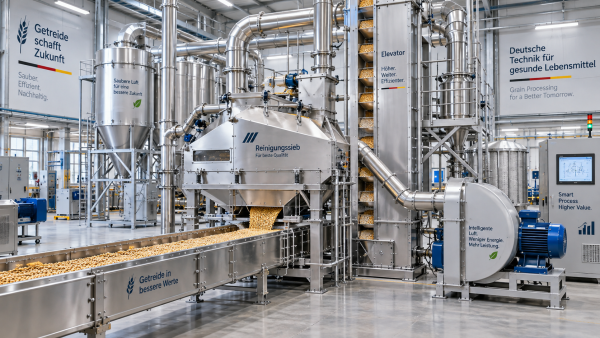
In a German grain plant, an upgrade decision rarely begins with a single machine. It usually begins with a familiar operational tension: energy costs remain visible on every production report, customers expect tighter consistency in flour, meal, or feed fractions, and experienced operators know that a new control screen alone will not solve bottlenecks buried in conveying, aspiration, drying, or maintenance practice.
For technical evaluators working in grain processing Germany, automation and energy-efficiency projects should therefore be assessed as plant-performance programs rather than equipment purchases. The relevant question is not simply whether a proposed system is more advanced than the installed base. It is whether the upgrade improves controllability, product integrity, safety, and lifecycle economics under the plant’s real material flows, shift patterns, utility constraints, and regulatory obligations.
That distinction matters in facilities processing wheat, barley, maize, rye, oats, and specialty grains. A high-capacity handling line may look attractive on paper yet create segregation problems at lower seasonal throughput. A sophisticated automation layer may generate extensive data while leaving operators without useful alarms. An efficient dryer can reduce fuel demand but disappoint if upstream cleaning and moisture measurement are inconsistent. Sound selection requires looking across the process, not just at its most visible equipment.
Start with the production questions that equipment brochures do not answer
Before comparing automation platforms or energy-saving machinery, establish a credible operating baseline. This is more than a historical energy bill divided by tonnes produced. Technical teams need to understand where variation enters the process and how it propagates downstream.
A useful baseline normally includes hourly and annual throughput, product mix, incoming moisture range, cleaning rejects, finished-product specifications, unplanned stoppages, electricity and thermal-energy consumption, dust-control performance, and labour demand by process area. It should also record conditions that distort averages: short production campaigns, wet harvest periods, frequent changeovers, low-load operation, or storage constraints that force grain to be moved more than once.
For a milling operation, the key issue may be the relationship between tempering consistency, roller-mill loading, extraction rate, and finished flour quality. In a feed or bulk-grain site, pneumatic conveying pressure, bucket-elevator condition, and intake congestion may have a larger effect on power use and availability. Drying facilities need a clearer picture of inlet moisture, ambient conditions, heat source, recirculation rates, and cooling requirements.
Without this context, projected savings can become a generic percentage applied to a unique plant. That is not a defensible investment case. The better approach is to define a small set of site-specific performance indicators, such as kWh per tonne at comparable moisture conditions, tonnes per operator hour, yield variance, downtime per critical asset, and out-of-specification events per campaign.
Automation should make decisions clearer, not merely make the plant more digital
Automation investment in grain processing often spans several layers. At the field level are sensors, variable-speed drives, moisture analyzers, weigh systems, level controls, vibration monitoring, and motor protection. Above them sit programmable logic controllers, supervisory control and data acquisition systems, recipe management, alarm handling, historian functions, and interfaces with maintenance or enterprise software.
The value comes from how those layers work together during normal and abnormal operation. A modern control system can coordinate intake, storage, cleaning, conditioning, milling, mixing, pelleting, and dispatch. Yet technical evaluators should be wary of treating integration as an automatic benefit. A control architecture that is difficult to troubleshoot during a night shift may reduce resilience even if it offers more dashboards.
Good automation specifications answer practical questions:
- Which control loops must be closed automatically, and which decisions should remain with trained operators?
- Can the system distinguish a genuine process deviation from a faulty or drifting sensor?
- Will operators see actionable alarms, with priorities and probable causes, rather than a stream of non-critical notifications?
- Can production, maintenance, quality, and energy data be viewed in a common time sequence?
- Is the architecture open enough to connect future equipment without forcing a complete platform replacement?
- Who owns the data, who can access it remotely, and how will cybersecurity responsibilities be managed?
For many established sites, a phased approach is more sensible than a full control-room replacement. One plant may begin by adding submeters and drive-level data to its existing historian. Another may prioritize automated routing and batch traceability where manual valve selection creates product-mix risk. A third may have enough production data already and need better condition monitoring on elevators, fans, and gearboxes.
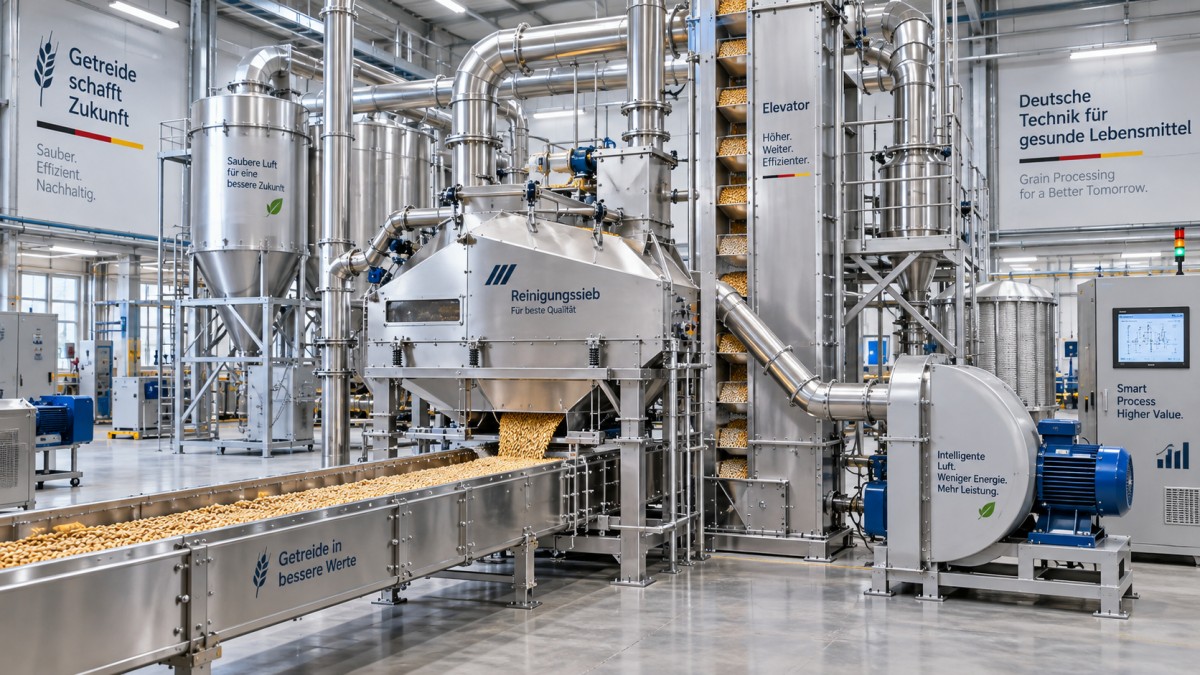
The evaluation should also include the human interface. Skilled operators often recognize changes in sound, vibration, smell, and product behaviour before a data trend becomes obvious. The most useful automation preserves that operational knowledge, makes it transferable, and provides evidence for intervention. It should not turn operators into passive observers of a system they cannot interpret or override safely.
Where energy is actually consumed in a grain plant
Electricity in grain processing is commonly concentrated in material handling, aspiration, grinding, air movement, compression, and ancillary utilities. Thermal demand is especially significant where drying is part of the operation. The relative importance changes by site, which is why a site survey is more valuable than a generic ranking of “high-efficiency” technologies.
Material handling and air systems
Conveyors, bucket elevators, screw systems, pneumatic lines, and fans are often treated as basic infrastructure. In reality, they can be persistent energy and reliability drains. Oversized motors running at fixed speed, poorly balanced aspiration networks, restricted ducts, leaking pneumatic systems, and unnecessary empty running all consume power without adding value.
Variable-frequency drives can offer meaningful control where flow demand changes, particularly on fans and certain conveying applications. However, they are not universally appropriate. The motor duty cycle, starting torque, belt or chain condition, process stability, harmonic considerations, and control logic must all be assessed. Installing a variable-speed drive on a poorly maintained fan may simply make a poorly understood system more complicated.
Airflow deserves particular attention. Dust extraction must meet safety and hygiene needs, but excessive extraction volumes can increase fan power and product losses. A proper review considers hood design, duct velocity, filter pressure drop, fan curves, cleaning cycles, and the interaction between aspiration and product transport. In German facilities, combustible-dust risks and applicable ATEX responsibilities make this review a safety matter as well as an energy matter.
Milling, grinding, and separation
In flour milling and feed grinding, energy use cannot be separated from particle-size control, yield, and product temperature. A more aggressive grinding setting may appear to increase capacity while creating excess fines, higher heat generation, or downstream screening issues. Conversely, an apparently conservative setting can hide wear, poor roll condition, or inefficient feed distribution.
Technical teams should evaluate roller condition, sieve performance, feeder accuracy, grinding-gap control, bearing health, and load stability together. Online monitoring can help identify deviations, but it is only reliable when calibration routines and sampling discipline are part of the operating model. Quality laboratories and process engineers should be involved early; otherwise, energy targets may unintentionally pressure production teams to compromise product specifications.
Drying and thermal integration
Drying is often the largest opportunity—and the largest source of misleading claims. Dryer performance depends on grain type, initial and target moisture, airflow, recirculation, weather, residence time, fuel source, and the condition of pre-cleaning equipment. Comparing two dryers solely by nominal capacity is not enough.
A robust assessment examines specific thermal energy at defined moisture removal, exhaust conditions, heat recovery potential, fan energy, cooling demand, and control response to variable incoming grain. Moisture measurement is central. If the incoming measurement is unreliable or sampling is unrepresentative, a dryer may over-dry grain to protect quality, wasting energy while reducing saleable mass.
Heat recovery, improved insulation, burner controls, staged drying, and better cooling integration can all be relevant. But the plant layout and campaign profile decide whether they are worthwhile. An upgrade that performs well at sustained high throughput may deliver limited returns in a site operating intermittently across short intake windows.
Evaluate upgrades through lifecycle value, not a simple payback race
Simple payback remains useful as an initial screen, especially when capital budgets are constrained. It should not be the sole basis for selecting a grain-processing upgrade. The lowest-cost option may increase maintenance dependence, require proprietary service access, or provide savings only under conditions the plant rarely reaches.
A stronger business case separates benefits into several categories: measurable utility reduction; increased throughput at the required quality; lower product loss; avoided downtime; reduced manual intervention; improved traceability; maintenance savings; and risk reduction. Not every category should be monetized with false precision. Some, such as improved audit readiness or reduced dependence on a single operator’s experience, may be better recorded as strategic benefits with supporting evidence.
Use sensitivity analysis rather than one optimistic forecast. Test the case against lower throughput, changing electricity or fuel costs, different grain moisture profiles, expected maintenance expenditure, and delayed commissioning. This is particularly important where the project depends on several linked improvements. If a new dryer’s economics require uninterrupted downstream conveying and stable storage availability, those assumptions must be explicit.
Procurement documents should request performance boundaries, not just headline ratings. Suppliers should describe the material assumptions, utility conditions, guaranteed operating window, instrumentation supplied, control-system scope, maintenance intervals, spare-parts requirements, and acceptance-test method. A proposal that is transparent about limitations is often easier to integrate than one that promises broad gains without defining the conditions.
A practical selection sequence for German grain processors
The most reliable projects tend to follow a deliberate sequence. Begin with an operational walk-through involving production, maintenance, quality, safety, energy management, and IT or automation personnel. Map the process from intake to dispatch, noting rehandling, waiting points, manual workarounds, repeated alarms, dust leaks, and equipment that is routinely bypassed.
Next, verify the measurement infrastructure. Temporary metering and data logging are often worthwhile before major capital decisions. If the plant cannot identify energy use by core process area, it cannot confidently verify improvement afterwards. Baseline data should be normalized where possible for throughput, product type, moisture, and ambient conditions.
Then rank opportunities by criticality and interdependence. A failed elevator feeding the main mill is not equivalent to an inefficient auxiliary conveyor. A control-room modernization may need to precede smart drives if the present system cannot reliably exchange signals. In other cases, repairing air leaks, cleaning ductwork, restoring sensors, and tuning existing controls can create an immediate foundation for larger upgrades.
Finally, plan commissioning as an operational change, not a handover date. Define factory and site acceptance criteria, operator training, fallback modes, documentation requirements, alarm philosophy, cybersecurity access rules, and a post-installation review period. Performance should be assessed after the process has stabilized, using the baseline conditions agreed at the start of the project.
Common selection mistakes that weaken otherwise sound projects
One recurring mistake is to specify automation by brand preference before defining process requirements. Another is to assume that more sensors automatically mean better control. Sensors need suitable locations, calibration, cleaning, validation, and someone responsible for responding to the information they produce.
Technical evaluators should also avoid treating energy and safety as separate workstreams. A modified aspiration system, altered fan speed, or changed conveying route can affect dust behaviour, pressure balance, and housekeeping requirements. Likewise, cybersecurity should not be left until commissioning when remote service, legacy controllers, and enterprise connectivity are involved.
Perhaps the most costly mistake is ignoring maintainability. Equipment access, availability of local service support, spare-part lead times, diagnostic clarity, and compatibility with existing maintenance skills can matter more over ten years than a marginal difference in quoted efficiency. In grain plants, where seasonal peaks leave little room for experimentation, serviceability is part of performance.
Making the final decision
For decision-makers assessing automation and energy upgrades in grain processing Germany, the strongest option is usually not the most heavily automated line or the machine with the highest isolated efficiency claim. It is the solution that fits the plant’s material profile, removes a verified constraint, gives operators useful control, and can be measured honestly after installation.
That requires disciplined technical evaluation, but it also requires respect for the realities of production. Grain is variable. Campaigns change. Utilities fluctuate. People work around imperfect systems because output must continue. Investments that acknowledge those realities can improve energy intensity and throughput while protecting the quality, traceability, and operational resilience that German processing facilities are expected to maintain.
Related Intelligence
- Milling MachineryGerman Grain Processing Plants: Evaluating Automation and Energy-Efficiency UpgradesGrain processing Germany: evaluate automation and energy-efficiency upgrades to improve throughput, quality, safety, and lifecycle value.
- Milling MachineryGrain Processing in the UAE: Designing Facilities for Heat, Ports, and StorageGrain processing UAE insights for designing resilient facilities that manage heat, port logistics, storage quality, dust control, and reliable grain flow.
- Milling MachinerySaudi Arabia Grain Processing: Assessing Local Milling Capacity and Supply GapsGrain processing Saudi Arabia: assess local milling capacity, storage, logistics, and supply gaps to identify resilient investment opportunities across the Kingdom’s import-dependent grain chain.
The Morning Broadsheet
Daily chemical briefings, market shifts, and peer-reviewed summaries delivered to your terminal.
