

The Authority in Global Agricultural Chemistry & Bio-Resources
When does a bran finisher improve flour recovery in wheat milling?
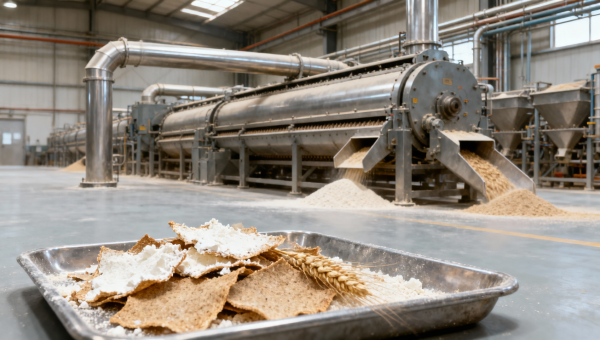
A bran finisher improves flour recovery when bran leaving the break system still carries detachable endosperm, and that material can be recovered without pushing finished flour beyond its ash, color, speck, or functionality limits. The strongest application is a mill losing usable endosperm with otherwise sound bran—not a mill seeking higher extraction regardless of flour quality.
A practical warning sign is bran with visible white patches while flour extraction remains below the mill’s established performance for comparable wheat. Yet appearance alone does not justify another machine. Poor conditioning, unsuitable roll settings, or ineffective sifting can produce similar symptoms. The decision depends on whether controlled finishing creates additional saleable flour, rather than simply transferring finely broken bran into the flour stream.
Establish whether the bran contains a recoverable loss
A bran finisher uses mechanical action to detach adhering endosperm from bran. In a typical design, a rotor works the material inside a screened enclosure: detached fines pass through the screen, while larger bran particles discharge separately. Rotor construction and internal geometry vary, so machines with similar motor ratings or screen areas should not be assumed to perform identically.
The intended action is separation, not indiscriminate size reduction. Bran that remains relatively intact is easier to separate from endosperm than bran reduced to small fragments. Once bran particles approach the size of flour particles, downstream sifting cannot reliably distinguish them by composition.
Before evaluating equipment, sample the individual bran-rich streams that could feed it. A mixed final bran sample can conceal a useful opportunity in one stream and poor suitability in another. Assess:
- Adhering endosperm: inspect bran surfaces under magnification and compare representative samples from different passages.
- Particle structure: distinguish broad, resilient flakes from brittle fragments and an already fine-rich feed.
- Moisture and variability: relate samples to wheat blend, conditioning conditions, throughput, and operating shift.
- Residual starch: use a consistent analytical method as supporting evidence, not as a direct measurement of recoverable flour.
Starch in the bran stream may include loose flour, attached endosperm, or material trapped in particles that cannot be economically separated. A controlled separation trial is therefore more informative than a starch result alone. Likewise, bran ash can support a material balance but does not establish the quality of the recovered fraction.
Correct upstream faults before adding finishing intensity
Wheat conditioning influences whether the bran survives mechanical treatment and whether endosperm separates cleanly. Inadequately conditioned wheat can produce brittle bran that fragments during both breaking and finishing. Uneven moisture distribution can make a single machine setting unsuitable for the whole feed, with some particles remaining insufficiently cleaned while others break excessively.
Review actual wheat moisture, water distribution, tempering time, wheat hardness, and blend consistency. There is no universal moisture target or tempering duration that establishes suitability for every wheat and milling system. Evaluate these conditions against the mill’s product requirements and established operating practice.
Break-roll operation also matters. Excessively severe action can generate bran fines before the finisher receives the material. Insufficient release may leave substantial endosperm attached, but a finisher should not automatically be used to compensate for incorrect roll gaps, worn corrugations, or an unsuitable break balance.
Finally, check sifter performance. A stream containing substantial loose flour because of blinded sieves, damaged covers, or poor distribution may need separation maintenance rather than more mechanical treatment. Correcting that fault changes both the available recovery and the capacity required from a finisher.
Choose the process location before specifying capacity
A suitable location receives a defined bran-rich stream with recoverable endosperm and has a clear route for both discharge fractions. Depending on the mill diagram, finishing may serve selected break-system bran streams or operate near the final bran discharge. Combining streams is sensible only when their particle characteristics and treatment needs are compatible.
Material passing through the finisher screen should not automatically be classified as finished flour. It may require further sifting, grading, or routing to an appropriate milling passage. Its destination depends on particle size and composition. Providing a separate sampling point and controllable routing allows the mill to assess the fraction before blending it into a commercial flour.
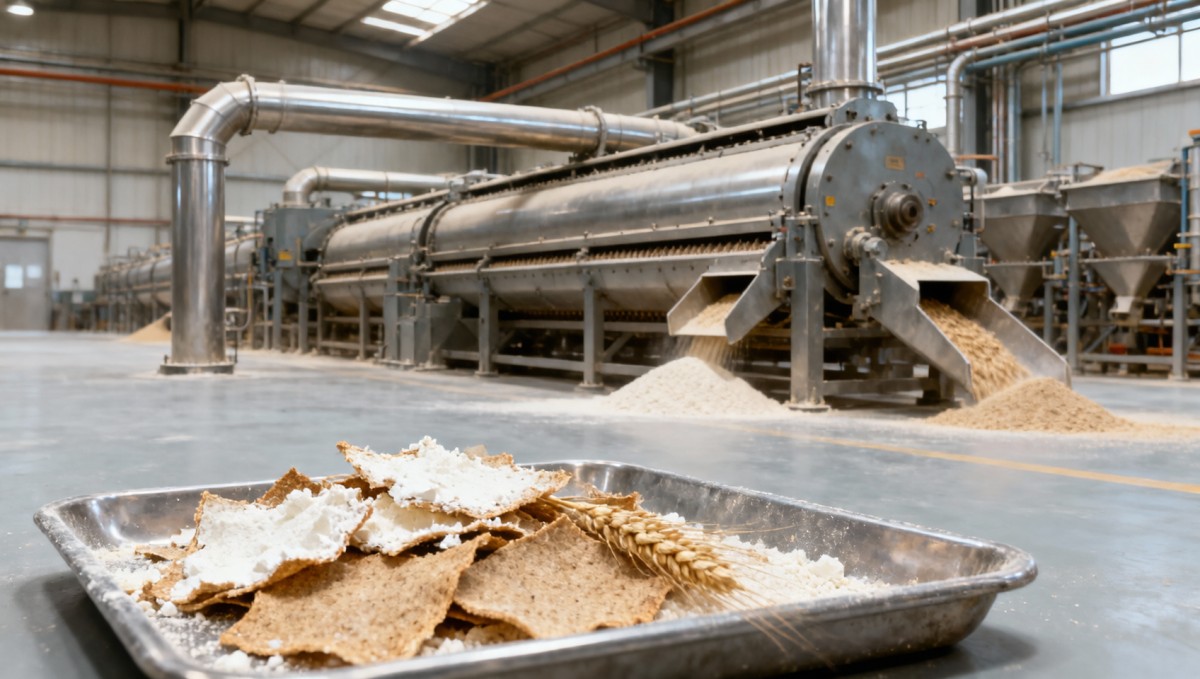
Capacity evaluation must include downstream equipment. A finisher can release more material than the receiving sifter, conveyor, or pneumatic line can handle. Overloading that route can impair separation elsewhere and erase the apparent gain. Check peak feed rate, bulk density, available conveying capacity, aspiration requirements, and access for screen inspection—not just nominal machine throughput.
A bypass is valuable for maintenance and comparative trials. However, comparing bypassed and finished operation requires accounting for the changed routing: diverting a stream away from its normal destination can itself alter extraction and loading elsewhere in the mill.
Use settings to protect separation, not maximize screen-through yield
Rotor speed, working-element configuration, screen aperture, feed loading, and residence time interact. Their effects are machine-specific, and a setting that releases endosperm efficiently from resilient bran may damage a more fragile feed.
Start within the equipment supplier’s permitted operating range and change one variable at a time where practical. Record actual feed rate and motor power alongside each sample. Motor current alone is not a recovery measurement: it can rise because the machine is doing useful separation, because material is accumulating, or because mechanical resistance has increased.
Screen condition deserves particular attention. Worn openings, damaged panels, and blinded areas change the separation even when the nominal aperture specification remains unchanged. A machine that performs well immediately after cleaning but deteriorates during a run needs an operating-duration assessment, not just a short demonstration.
Prove the gain with a balanced mill trial
The central measurement is additional flour meeting the intended specification per unit of wheat processed. Screen-through yield is an intermediate measurement. It overstates the benefit if part of that fraction is rejected, recirculated without useful recovery, or blended only by sacrificing the quality margin of other flour streams.
- Establish a stable baseline. Record wheat blend, moisture, conditioning, wheat throughput, roll settings, flour routing, and relevant sifter condition. Avoid comparing unrelated production periods.
- Define the balance boundary. Measure finisher feed, screen-through material, and bran discharge over matched periods. At mill level, account for flour, by-products, inventory changes, and moisture differences.
- Allow operation to stabilize. Account for transport delays and material held in bins, conveyors, and sifters before collecting comparison samples.
- Sample all relevant fractions. Use representative composite samples rather than a convenient handful taken during steady-looking discharge.
- Test quality and repeat. Examine the recovered fraction and finished blend under comparable conditions, then repeat across the wheat and loading range the machine will actually encounter.
Report extraction on a consistent moisture basis. Conditioning and moisture changes can distort apparent mass yield. Calculate any extraction change in percentage points, with the wheat-input basis clearly stated, rather than describing an ambiguous percentage increase.
For quality, assess ash, color, visible bran specks, moisture, and particle-size distribution. Add protein, damaged starch, dough testing, or end-product tests where relevant to the flour grade. Higher ash alone does not identify the exact contamination mechanism, but a rise combined with more bran specks and finer bran discharge strongly suggests that treatment has become too aggressive.
The blend result matters as much as the isolated fraction. A recovered stream may be acceptable at a limited inclusion rate but constrain production of a low-ash flour. Demonstrate the proposed blending rate rather than assuming that dilution will solve the problem.
Interpret the result against the mill’s product mix
A positive result is not necessarily the largest increase in total extraction. A modest recovery that consistently meets specification can be more valuable than a larger stream requiring downgrading. Conversely, a higher-ash fraction may have a legitimate destination in a suitable flour grade, provided it does not displace a more valuable stream or create an unsaleable surplus.
Use the trial to distinguish three outcomes:
- Useful recovery: saleable flour increases, quality remains within agreed limits, and bran retains an acceptable physical and commercial specification.
- Conditional recovery: the additional fraction is usable only for particular blends, wheat types, or operating rates. Segregated routing or a restricted operating window is necessary.
- False improvement: screen-through mass increases, but finished-flour quality deteriorates, other streams must be downgraded, or downstream losses offset the gain.
Economic evaluation should subtract the value of the material no longer sold as bran. Include added electricity, screen and rotor wear, maintenance labor, aspiration or conveying changes, and any quality-control burden. Evaluate incremental energy per tonne of additional saleable flour as well as energy per tonne of feed; low machine power does not guarantee economical recovery when little usable flour is gained.
Set acceptance terms around the feed and the flour specification
For equipment selection, request trials using representative mill material rather than relying solely on a nominal capacity statement. Define the expected feed envelope: wheat types, moisture range, particle-size distribution, bran condition, and minimum-to-maximum flow. Require the proposed screen, rotor arrangement, drive settings, and discharge routing to be identified in the trial record.
Acceptance criteria should pair recovery with quality limits and sustained capacity. Specify the sampling method, analytical methods, moisture basis, test duration, and treatment of recirculated material. Also review screen-change access, cleanability, wear-part availability, rotor balance, guarding, and integration with the mill’s dust-control and combustible-dust safety arrangements.
A bran finisher is justified when trials demonstrate a repeatable separation opportunity within that operating envelope. If acceptable flour can be recovered only at unusually low throughput, with freshly cleaned screens, or from a narrow wheat selection, those restrictions belong in the investment decision—not in a later operating workaround.
Related Intelligence
- Milling MachineryWhen does a bran finisher improve flour recovery in wheat milling?Discover when a bran finisher boosts saleable flour recovery in wheat milling. Learn how to assess bran, optimize settings, and validate gains without compromising flour quality.
- Milling MachineryHow easy is it to change hammer mill screens to adjust particle size?Is it easy to change the screen or adjust the output size of the hammer mill? Discover what affects changeover time, particle size, and throughput—and how to choose the right screen.
- Milling MachineryChanging Hammer Mill Screens: Particle Size Control and DowntimeIs it easy to change the screen or adjust the output size of the hammer mill? Discover practical tips for smoother screen changes, consistent particle size, and less downtime.
The Morning Broadsheet
Daily chemical briefings, market shifts, and peer-reviewed summaries delivered to your terminal.
