

The Authority in Global Agricultural Chemistry & Bio-Resources
China’s Feed Additives Export Up 12.7% YoY in April 2026
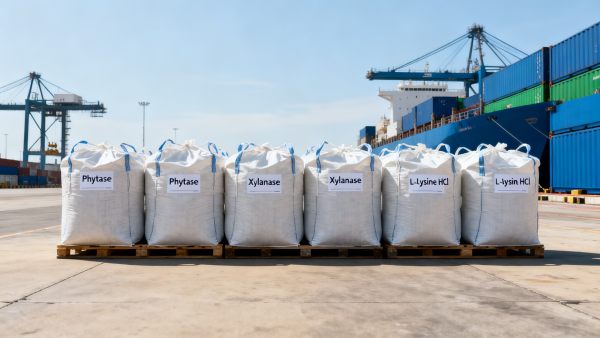
On May 19, 2026, China’s General Administration of Customs reported that feed additives exports reached 183,000 metric tons in April 2026 — a 12.7% year-on-year increase. This growth reflects accelerating overseas demand tied to commercial feed pellet plant expansions, particularly in South America and the Middle East, and signals notable shifts for enzyme and amino acid suppliers, traders, and logistics providers.
Event Overview
According to official data released by China’s General Administration of Customs on May 19, 2026, China exported 183,000 metric tons of feed additives in April 2026, up 12.7% from April 2025. Among key products, phytase exports rose 23.4%, xylanase 19.8%, and lysine hydrochloride 16.2%. The surge coincides with the concentrated commissioning of new commercial feed pellet production facilities abroad, driving procurement of配套 enzymes and synthetic amino acids. Order cycles from clients in South America and the Middle East have shortened to 7–10 working days.
Industries Affected
Feed Enzyme & Amino Acid Manufacturers
Manufacturers of phytase, xylanase, and lysine hydrochloride face increased export order volume and compressed delivery timelines. Production planning and export compliance capacity are under heightened pressure, especially given the observed shortening of client order-to-shipment windows.
Export-Trading Enterprises
Trading firms handling feed additive exports are experiencing tighter operational cycles. The 7–10-day order cycle from key regional buyers implies reduced lead time for documentation, customs clearance, and shipment coordination — raising requirements for real-time inventory visibility and cross-border logistics responsiveness.
Raw Material Suppliers (e.g., fermentation substrates, chiral synthesis intermediates)
Suppliers providing upstream inputs for enzyme and amino acid production may see downstream pull-through effects. However, this linkage is not yet confirmed in the data; any upstream impact remains contingent on sustained order flow and production ramp-up at manufacturing level.
Logistics & Customs Compliance Service Providers
Firms offering export documentation support, bonded warehousing, or sea/air freight solutions for agrochemicals and feed ingredients face rising transaction frequency per client. Shorter order cycles imply greater need for pre-approved HS code classification, origin certification readiness, and familiarity with destination-market feed additive registration requirements (e.g., ANVISA in Brazil, SFDA in Saudi Arabia).
What Relevant Enterprises or Practitioners Should Focus On
Monitor official export statistics for May and June 2026
The April 2026 figure is a single-month snapshot. Sustained growth would suggest structural demand shift; volatility could indicate project-timing effects. Subsequent monthly releases will clarify whether the trend reflects broader market expansion or transient infrastructure commissioning activity.
Track order patterns by product and region — especially phytase, xylanase, and lysine HCl in South America and the Middle East
These three categories showed the strongest growth. Their concentration in specific geographies suggests regional regulatory alignment, formulation preferences, or local feed pellet plant technology partnerships — all relevant for channel strategy and technical support deployment.
Distinguish between policy-level signals and actual procurement execution
The data reflects realized export volume, not forward contracts or MOUs. Enterprises should avoid conflating announcement of new feed pellet projects abroad with immediate procurement — actual orders materialized only after facility commissioning, as observed in the April data.
Prepare for accelerated documentation and shipping coordination
With order cycles compressing to 7–10 working days, enterprises should verify readiness of export licenses, certificates of origin, and destination-specific labeling compliance. Pre-vetted freight forwarders familiar with feed additive classifications are advisable.
Editorial Perspective / Industry Observation
Observably, the April 2026 export surge is best understood as a lagged response to overseas commercial feed pellet capacity additions — not an autonomous demand inflection. Analysis shows it functions more as a timing signal than a structural pivot: the 12.7% growth aligns closely with known project timelines in key markets, and the regional concentration (South America, Middle East) and product skew (phytase > xylanase > lysine HCl) point to technology-driven, rather than macroeconomic, drivers. From an industry perspective, this indicates that feed additive exporters are entering a phase where responsiveness — not just scale — determines competitive positioning. Continued monitoring is warranted because sustained compression of order cycles may reshape minimum viable service levels across the export value chain.
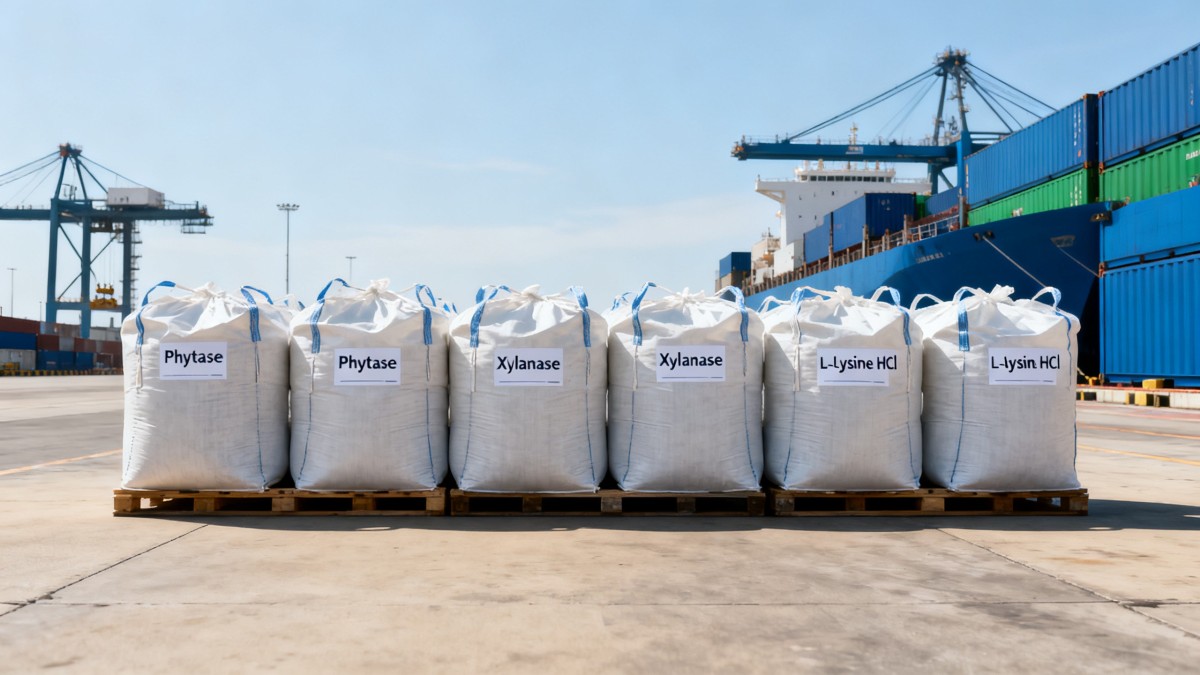
China’s April 2026 feed additives export data is not evidence of broad-based global feed demand recovery, nor does it imply near-term diversification into new product lines. Rather, it reflects a synchronized, project-led procurement wave tied to physical infrastructure rollout. For stakeholders, the priority lies in calibrating operational cadence — not redefining strategy.
Source: General Administration of Customs of the People’s Republic of China, official release dated May 19, 2026.
Note: Regional regulatory developments (e.g., feed enzyme registration updates in Brazil or Saudi Arabia) and follow-up export figures for May–June 2026 remain under observation.
Related Intelligence
- Commercial Feed PelletHow to Build a Sanitary Feed Production Plan That Reduces Cross-ContaminationSanitary feed production planning: reduce cross-contamination with smarter sequencing, validated flushing, material segregation, and traceable sanitation controls.
- Commercial Feed PelletFeed Pellet Mill Sourcing: How to Vet Suppliers for Capacity, Quality, and SupportFeed pellet mill sourcing made smarter: vet suppliers for proven capacity, pellet quality, lifecycle cost, factory controls, commissioning, and reliable after-sales support.
- Commercial Feed PelletFeed Production System Price Trends: Cost Drivers and Budgeting for New LinesFeed production systems price trend insights: compare cost drivers, automation, utilities, compliance, and total ownership costs to budget smarter for new feed lines.
The Morning Broadsheet
Daily chemical briefings, market shifts, and peer-reviewed summaries delivered to your terminal.
