

The Authority in Global Agricultural Chemistry & Bio-Resources
Cosmetic Grade Mica Powder in Makeup: Particle Size, Shine, and Formula Compatibility
Cosmetic Grade Mica Powder in Makeup: Particle Size, Shine, and Formula Compatibility
For quality control and safety teams, visual appeal is only one part of the decision.
Cosmetic grade mica powder also affects texture, processing behavior, regulatory review, and batch-to-batch consistency.
In makeup, small specification changes can alter payoff, spreadability, adhesion, and long-term stability.
That is why cosmetic grade mica powder should be assessed as a functional raw material, not just a visual effect pigment.
A practical review usually starts with three linked questions.
What particle size is suitable for the target format?
How strong should the shine be for the intended product positioning?
Will the cosmetic grade mica powder remain compatible with oils, waxes, binders, water phases, and preservatives?
When these factors are reviewed together, formulation risks become easier to predict and control.
Why particle size matters in makeup performance
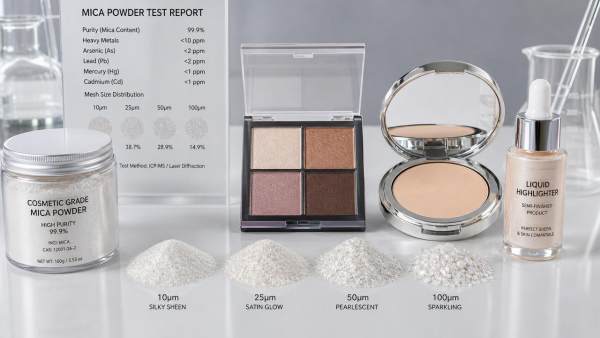
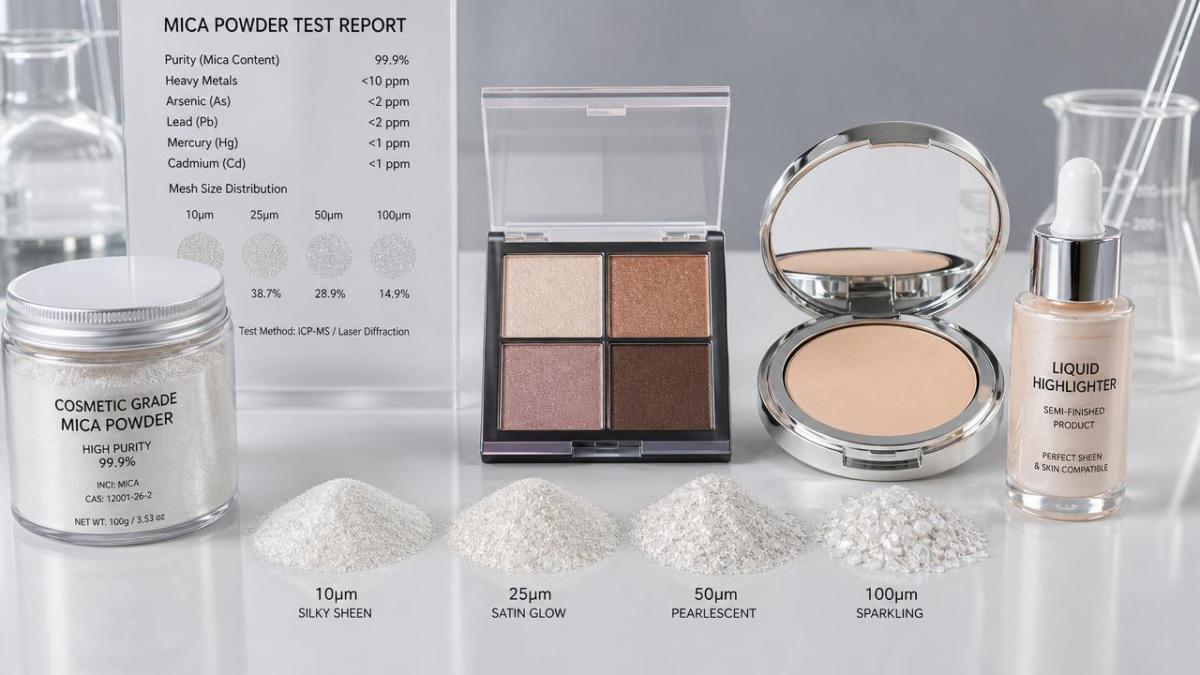
Particle size is one of the most important specifications for cosmetic grade mica powder.
It shapes sensory feel, coverage pattern, light reflection, and manufacturing behavior.
Finer grades usually feel smoother on skin.
They are often preferred for pressed powders, finishing powders, and lighter face products.
Larger particles create stronger sparkle and more obvious reflectivity.
These grades are common in high-impact eyeshadows, illuminators, and trend-driven color cosmetics.
However, bigger particles can also increase drag during application.
They may feel gritty if the overall formula lacks enough slip agents or cushion.
This becomes more critical in products used around the eyes.
In actual production, particle size distribution matters more than a single average number.
A narrow distribution tends to give more predictable shine and smoother process control.
A broad distribution can cause uneven appearance, segregation, and inconsistent pressing behavior.
For this reason, cosmetic grade mica powder should be evaluated by sieve profile or laser diffraction data.
The goal is not simply to buy fine or coarse material.
The goal is to match the particle profile to the application format.
Typical particle size choices by product type
- Face powders: favor smoother, finer cosmetic grade mica powder for soft-focus finish.
- Pressed blush and bronzer: use balanced particle size for payoff and stable compaction.
- Eyeshadow: select by effect target, from satin sheen to bold shimmer.
- Liquid highlighters: require tighter control to prevent sedimentation or nozzle issues.
- Lip products: demand careful review of mouthfeel and dispersion under wax-rich systems.
Shine level and how it changes product positioning
Shine is not just an aesthetic detail.
It directly influences how a makeup product is perceived in the market.
A soft satin effect signals refinement and everyday wear.
A stronger pearl or shimmer effect supports premium, festive, or trend-focused positioning.
This also means cosmetic grade mica powder selection has branding consequences.
From a control perspective, shine should be measured and described with internal reference standards.
Visual panel checks alone are rarely enough for long-term consistency.
More reliable programs combine visual comparison, microscopy, and reflectance data where possible.
Another practical issue is interaction with other effect materials.
Cosmetic grade mica powder may be blended with iron oxides, titanium dioxide, ultramarines, or synthetic pearls.
In those blends, small raw material shifts can change color travel, brightness, and opacity.
That is where incoming inspection becomes especially important.
A visually acceptable mica lot may still perform differently after pigment blending or pressing.
Questions worth asking before approval
- Does the shine level match the product brief under store and daylight conditions?
- Does the cosmetic grade mica powder stay visually stable after mixing and filling?
- Will the effect remain consistent across different binder levels?
- Does the finished product show fallout, streaking, or patchiness during wear tests?
Formula compatibility: where many hidden problems begin
Many formula failures are not caused by poor pigment quality alone.
They come from weak compatibility between cosmetic grade mica powder and the full formulation system.
This issue appears in both anhydrous and water-based makeup.
In powder systems, poor compatibility may cause hard pan, poor pickup, dusting, or pan cracking.
In emulsions or suspensions, the warning signs are sedimentation, floating particles, agglomeration, or phase instability.
Surface treatment plays a major role here.
Some cosmetic grade mica powder grades are untreated.
Others are coated for better hydrophobicity, dispersibility, or affinity with silicone and oil phases.
That surface difference can completely change production results.
A grade that performs well in a dry powder may fail in a liquid illuminator.
Likewise, a treated grade may improve dispersion but alter press strength or skin feel.
In practical terms, compatibility review should include the full formula matrix.
That includes oils, esters, waxes, gums, film formers, solvents, and preservation systems.
It also includes process conditions such as shear level, mixing order, milling intensity, and filling temperature.
Common compatibility checkpoints
- Wetting behavior in oil, silicone, or water-rich systems.
- Dispersion stability after heat, freeze-thaw, and vibration stress.
- Effect on viscosity, suspension, and filling performance.
- Interaction with preservatives, pH, and package contact surfaces.
- Changes in payoff after storage and repeated use.
Safety, purity, and regulatory suitability
For safety management, cosmetic grade mica powder must meet more than appearance standards.
Purity, contaminant control, and documentation quality are equally important.
Typical review points include heavy metals, microbiological risk, asbestos-related concerns, and traceability.
The exact risk profile depends on source geology, processing route, and downstream handling.
This is why supplier qualification cannot rely only on a sales specification sheet.
A stronger approach uses certificates of analysis, audit records, contaminant testing, and change control commitments.
For multinational brands, regulatory suitability also varies by market.
Ingredient naming, impurity thresholds, and color additive rules may differ across jurisdictions.
That makes early compliance review a cost-saving step.
A cosmetic grade mica powder approved for one region may need extra support documents for another.
In recent market practice, buyers also pay closer attention to ethical sourcing and supply chain visibility.
This is partly a compliance issue and partly a brand protection issue.
Supplier review checklist
A practical evaluation workflow for better raw material decisions
A useful evaluation workflow keeps technical, safety, and commercial checks connected.
That reduces the chance of approving cosmetic grade mica powder that looks fine but fails later.
A simple but effective process often includes the following steps.
- Define the target effect, texture, and application zone first.
- Review cosmetic grade mica powder particle data and treatment type.
- Run lab screening in the intended formula base, not in isolation.
- Check dispersion, shine, feel, and wear under realistic processing conditions.
- Confirm safety documents, compliance status, and supply traceability.
- Approve with retained samples and clear change-control expectations.
This workflow is especially helpful when multiple product lines share one effect material.
It creates a repeatable standard for comparing new lots and alternate suppliers.
Over time, that improves consistency, shortens investigation cycles, and supports cleaner audits.
Final takeaways for consistent makeup quality
Choosing cosmetic grade mica powder for makeup is a multi-factor decision.
Particle size affects feel and effect.
Shine influences product identity and user expectations.
Formula compatibility decides whether performance remains stable after scale-up and storage.
At the same time, safety documentation and supplier transparency protect both compliance and brand reputation.
The most reliable results come from evaluating cosmetic grade mica powder in the real product context.
That means linking raw material data, formula trials, processing conditions, and regulatory review into one decision path.
When that discipline is in place, makeup formulas become easier to scale, safer to release, and more consistent in the market.
If current specifications feel too broad, the next practical step is to tighten cosmetic grade mica powder approval criteria around particle distribution, shine benchmarks, and formula-specific compatibility testing.
Related Intelligence
- Natural IngredientsFreeze-Dried Fruit Ingredients: A Packaging Checklist for Bulk StorageBuying freeze dried fruit ingredients? Use this bulk packaging checklist to assess moisture barriers, seals, and pack sizes, reduce waste, and protect quality from storage to production.
- Natural IngredientsBotanical Ingredient Prices in Europe: Comparing Quotes by Grade and Order VolumeCompare Europe botanical ingredients price quotes by grade and order volume. Discover how potency, testing, delivery, and inventory costs reveal real savings before you buy.
- Natural IngredientsMayonnaise vs. Salad Dressing: Ingredient and Texture DifferencesMayonnaise vs. salad dressing: discover key ingredient, texture, stability, and application differences to choose the right product for every recipe.
The Morning Broadsheet
Daily chemical briefings, market shifts, and peer-reviewed summaries delivered to your terminal.
