

The Authority in Global Agricultural Chemistry & Bio-Resources
FDA Proposes GMP Annex V for Botanical Extracts
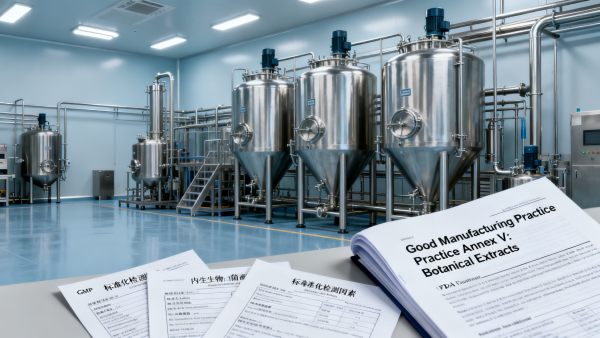
On May 22, the U.S. Food and Drug Administration (FDA) released the draft Good Manufacturing Practice Annex V: Botanical Extracts, introducing mandatory, end-to-end biological contamination controls for all botanical extract dietary supplements exported to the United States. The proposal signals a significant tightening of regulatory oversight in a high-growth segment of the global nutraceutical supply chain — one where microbial and mycotoxin risks have long been under-characterized in practice.
Event Overview
The FDA published the draft Annex V on May 22. It mandates that all botanical extracts intended for use in dietary supplements sold in the U.S. comply with new GMP requirements covering three critical stages: (1) microbial monitoring during raw material harvest; (2) pathogen inactivation validation during drying processes; and (3) dual quantitative limits for endotoxins and mycotoxins in finished products. The rule is scheduled to take effect in Q4 2026, with a transition period of only five months following finalization. Facilities failing to pass FDA on-site audits or submit required process validation documentation will lose their Exporter Identification Number (EUA) eligibility — directly blocking customs clearance and retail shelf access for North American distributors.
Industries Affected
Direct export trading enterprises: These firms act as legal U.S. importers or authorized representatives for foreign manufacturers. Under the draft, they bear primary responsibility for ensuring compliance documentation — including harvest site audit reports, drying validation dossiers, and batch-specific toxin test results — is complete and accessible to FDA upon request. Non-compliance triggers immediate EUA suspension, halting shipments regardless of product quality history.
Raw material sourcing enterprises: Companies procuring wild-harvested or cultivated botanicals — especially in regions with variable climate, soil conditions, or post-harvest handling infrastructure — face new upstream verification burdens. The requirement for harvest-stage microbial monitoring implies traceability systems must now extend to field-level practices, not just processing facilities.
Extraction and manufacturing enterprises: Firms performing solvent extraction, spray-drying, or encapsulation must now validate pathogen reduction efficacy for each drying step used — including parameters such as temperature profiles, dwell time, and moisture equilibrium. This goes beyond existing thermal validation standards and requires dedicated microbiological challenge studies.
Supply chain service providers: Third-party labs, certification bodies, and logistics auditors will see increased demand for specialized testing (e.g., endotoxin ELISA, multi-mycotoxin LC-MS/MS), drying process validation support, and GMP Annex V–aligned gap assessments. However, current capacity for such services remains concentrated among a limited number of accredited labs globally.
Key Focus Areas and Recommended Actions
Conduct a gap assessment against Annex V’s three control pillars
Map existing SOPs for harvest monitoring, drying validation, and finished-product toxin testing against the draft’s specific technical criteria — particularly the requirement to demonstrate consistently achieved pathogen log-reduction, not just nominal process settings.
Secure qualified laboratory partnerships ahead of the transition window
Given the narrow five-month implementation window post-finalization, pre-qualifying labs capable of delivering FDA-recognized endotoxin and mycotoxin testing — with documented method validation and ISO/IEC 17025 accreditation — is operationally urgent.
Review and document harvest-to-dry chain traceability
Annex V treats field harvesting as a GMP-critical control point. Enterprises must now retain records linking specific batches to harvest dates, locations, ambient conditions, and initial microbial screening — even if conducted by contracted growers.
Prepare for FDA audit readiness beyond paper records
The draft emphasizes ‘process understanding’ over checklist compliance. Auditors are expected to probe staff knowledge of microbial risk drivers at each stage, not only review documents. Cross-functional training across agronomy, processing, and QA teams is advisable.
Editorial Perspective / Industry Observation
Observably, this proposal marks a structural shift: the FDA is treating botanical extracts not as inert phytochemical intermediates, but as biologically dynamic matrices requiring integrated control from soil to shelf. Analysis shows the dual toxin limits — especially the inclusion of endotoxin — reflect growing concern over gram-negative bacterial contamination in aqueous extracts, a risk previously addressed inconsistently across global suppliers. From an industry perspective, the compressed transition timeline suggests the FDA anticipates minimal stakeholder resistance — possibly due to prior informal enforcement actions or increasing incident data on contaminated imports. Current more pressing concern lies not in feasibility, but in harmonization: Annex V contains no cross-references to ISO, ICH, or WHO guidelines, potentially creating divergence from other major markets.
Conclusion
This draft regulation does not merely add compliance steps — it redefines the scope of accountability for botanical ingredient safety in the U.S. market. Rather than representing a temporary adjustment, it signals a longer-term expectation: that biological risk management must be predictive, process-based, and vertically integrated. For global suppliers, success will depend less on passing a single audit and more on embedding scientific rigor into routine operational decision-making.
Source Attribution
FDA Draft Guidance: Good Manufacturing Practice Annex V: Botanical Extracts (Docket No. FDA-2024-D-XXXX), issued May 22, 2024. Available via the Federal Register and FDA’s Guidance Documents portal. Note: The draft remains subject to public comment until August 20, 2024; final timing, scope adjustments, and enforcement phasing remain under observation.
Related Intelligence
- Botanical ExtractsChoosing Botanical Extracts for Pharmaceuticals: Potency, Purity, and ComplianceBotanical extracts for pharmaceuticals: learn how to assess potency, purity, traceability, and GMP compliance for confident, regulatory-ready supplier selection.
- Botanical ExtractsBotanical Extracts Market Outlook: Supply, Pricing, and Buyer RisksBotanical extracts market insights on supply, pricing, quality control, and buyer risks—compare suppliers confidently and protect your sourcing strategy.
- Botanical ExtractsEurope Botanical Extracts Market: Key Growth Drivers, Risks, and OpportunitiesEurope botanical extracts market insights: explore growth drivers, regulatory risks, supply-chain challenges, and scalable opportunities for compliant, high-value ingredients.
The Morning Broadsheet
Daily chemical briefings, market shifts, and peer-reviewed summaries delivered to your terminal.
