

The Authority in Global Agricultural Chemistry & Bio-Resources
NZ Introduces NZ$3.50 Customs Processing Fee for Low-Value Parcels
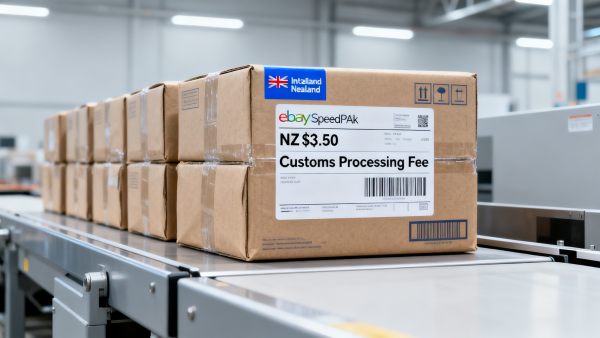
New Zealand implemented a NZ$3.50 Customs Processing Fee for all low-value imported parcels valued at NZ$1000 or less, effective 25 March 2026. This measure directly affects exporters of small-batch aquaculture and water quality equipment—including prototype aerators, dissolved oxygen sensors, and spare parts—particularly those serving small-to-medium buyers in New Zealand. The fee, collected by carrier eBay SpeedPAK, raises per-shipment costs by 12%, potentially dampening trial-order uptake and altering cost calculations for cross-border micro-shipments.
Event Overview
Effective 25 March 2026, New Zealand Customs requires a NZ$3.50 Customs Processing Fee on every imported parcel with a declared value of NZ$1000 or less. The fee is collected by the designated carrier, eBay SpeedPAK, at the point of delivery. It applies uniformly to all such low-value consignments, regardless of origin, commodity type, or importer size. No exemptions or thresholds below which the fee does not apply have been publicly announced.
Industries Affected
Direct Exporters of Small-Batch Aquaculture & Water Quality Equipment
Companies exporting compact aerators, inline water sensors, calibration kits, or replacement modules—often shipped as samples or pilot orders—are directly impacted. Since these shipments frequently fall within the NZ$1000 threshold and are routed via SpeedPAK, the NZ$3.50 fee applies to nearly all such consignments. The 12% average cost increase affects gross margin per shipment and may reduce price competitiveness for first-time or low-volume buyers.
Supply Chain Service Providers (e.g., Cross-Border Fulfilment Partners)
Firms managing end-to-end logistics—including customs documentation, carrier coordination, and duty/tax estimation—for small equipment exporters must now update fee calculation logic and client-facing cost models. The fixed NZ$3.50 charge introduces a non-variable cost component that cannot be absorbed proportionally across multi-item parcels, complicating blended cost reporting and quotation accuracy.
Small-to-Medium Distributors & Resellers in New Zealand
Local partners sourcing prototypes or niche spares from overseas suppliers face higher landed costs per unit. As the fee is levied per parcel—not per item—it disproportionately impacts orders containing only one or two units (e.g., a single sensor or pump head), eroding margin on low-volume technical purchases and potentially delaying product evaluation cycles.
Key Considerations and Practical Responses
Monitor official guidance on fee applicability scope
Confirm whether the NZ$3.50 fee applies to parcels cleared under formal import entries (e.g., via NZ Customs’ eCert platform) versus those processed under the simplified low-value consignment regime. Current public information confirms application under the latter; clarification on overlap or exceptions remains pending.
Review shipment consolidation strategy for sample and spare-part exports
Since the fee is assessed per parcel, consolidating multiple low-value items into fewer shipments—where technically and logistically feasible—may reduce total fee incidence. However, this must be weighed against increased inventory holding time, risk of delayed customer feedback, and potential customs scrutiny of higher-value consolidated parcels.
Update pricing and quoting tools to reflect the fixed fee
Integrate the NZ$3.50 charge as a mandatory line item in automated quoting systems used by exporters and fulfilment providers. Avoid embedding it into product pricing; instead, display it transparently as a logistics surcharge to maintain comparability with pre-fee quotes and support accurate margin tracking.
Communicate proactively with New Zealand-based buyers
Inform existing and prospective customers about the new fee, its timing, and its impact on delivery timelines and landed cost. Early communication helps manage expectations around sample lead times and supports informed purchasing decisions—especially where buyers evaluate multiple vendors on landed cost basis.
Editorial Observation / Industry Perspective
Observably, this fee represents a procedural tightening rather than a tariff shift: it does not change valuation rules, duty rates, or GST treatment, but adds a fixed administrative cost to the final mile of low-value imports. Analysis shows it functions primarily as a revenue mechanism for customs processing infrastructure—not as a trade barrier per se—but its uniform application amplifies cost pressure on high-frequency, low-volume export flows common in hardware prototyping and after-sales support. From an industry perspective, this is best understood as an operational signal: it reflects growing global emphasis on standardising cost recovery for digital-era parcel clearance, rather than an isolated policy intervention. Continued monitoring is warranted, particularly for potential extension to other carriers or alignment with similar measures in Australia or the UK.
This development underscores how seemingly minor administrative fees can meaningfully reshape cost structures for exporters operating at the intersection of hardware innovation and cross-border micro-logistics. It is not yet evidence of broader regulatory tightening—but it is a concrete indicator that low-value parcel pathways are no longer treated as cost-neutral channels. Current understanding should focus on implementation fidelity and near-term cost recalibration—not strategic redirection.
Information Source: Official notice issued by New Zealand Customs Service, effective 25 March 2026; confirmed carrier implementation details published by eBay SpeedPAK. Pending observation: Whether alternative carriers will adopt equivalent fees, or whether exemptions emerge for certified technical samples or R&D shipments.
Related Intelligence
- Aeration & Water TechHow Water Treatment Research Guides Technology Selection for Industrial Wastewater ProjectsWater treatment research guides smarter industrial wastewater technology selection. Learn how to assess variable streams, pilot risks, compare process trains, and reduce compliance costs.
- Aeration & Water TechSelecting Solids Filtration for Aquaculture: Flow Rates, Loading, and Fish WelfareSolids filtration aquaculture guide: compare flow rates, peak loading, capture performance, maintenance, and fish welfare to choose a reliable system.
- Aeration & Water TechWhat RO water treatment systems deliver consistent 98% salt rejection at 25°C with feed TDS over 3,000 ppm?RO water treatment systems that deliver proven 98% salt rejection at 25°C with >3,000 ppm TDS—engineered for API synthesis, aquaculture & grain processing.
The Morning Broadsheet
Daily chemical briefings, market shifts, and peer-reviewed summaries delivered to your terminal.
